Essential Market Research Tips for Canadian Entrepreneurs in 2026
Seven out of ten founders feel confident until they face real customers. Crickets. Missed sales. Savings evaporate. A majority of new Canadian firms don’t make it to a fifth birthday, and the top post‑mortem reason worldwide is simple: there wasn’t a real market need. That’s exactly what thorough research prevents. ISED’s 2024 Key Small Business Statistics provides survival data for Canadian firms, while CB Insights continues to rank “no market need” as the leading failure cause. (ised-isde.canada.ca)
If you’re unsure where to begin, start with the basics: market research before starting a business means sizing your likely audience, mapping competitors, listening to customers, and grading industry momentum before you commit serious time or money. Done lean, this work fits into a few focused weeks and a modest budget. The goal isn’t a perfect forecast. The goal is to reduce expensive guesses. These insights also feed directly into the business plan market analysis you will bring to lenders or partners.
Related: Best Advice to Small Business Owners — Goldman Sachs
Defining Market Research
Think of research as a map you draw before you drive into the Rockies at night. Primary research is information you collect yourself from real prospects: interviews, surveys, intercepts at a farmers’ market, or test orders from a landing page. Secondary research is what you gather from credible sources that already exist: Statistics Canada tables, provincial small‑business guides, analyst reports, public filings, trade associations, and competitor websites. Both matter. One tells you what people say and do, the other gives your findings context. For Canadian entrepreneurs, primary work clarifies local nuance, while secondary data sets the boundaries of how big and how fast your market can be. BDC’s small‑business guidance places research at step one of starting a company. (bdc.ca)
The goals are concrete. First, validate demand: do enough customers care about this problem urgently enough to pay? Second, understand willingness to pay, not just interest. Third, pinpoint your segment and buying job: who buys, who influences, and what “job” your product does for them. Fourth, chart competitors and substitutes, including “do nothing.” Fifth, estimate market size and growth so you can plan capacity and avoid overbuilding. This is where TAM, SAM, and SOM help. TAM is the entire universe of demand for the problem you solve, SAM is the portion that matches your offer and geography, and SOM is the realistic share you can win in the near term. For how to size your market, use these three lenses with Statistics Canada counts and provincial directories. Government resources help here: see Ontario’s “Conduct market research” guide and provincial equivalents for curated links to datasets and industry directories. Ontario’s step‑by‑step page is a solid entry point. (ontario.ca)
Here’s how this looks in practice. Imagine a Halifax bookkeeping startup. Primary research could be twenty short calls with independent contractors to capture their tax headaches and monthly budgets. Secondary research then narrows the real addressable market by pulling the count of self‑employed workers in the HRM and their average revenues. Then use Google Maps to map competitor density, hours, and review patterns, a fast way to spot overserved pockets and gaps.
🔑 Key Takeaway
Understanding market research is the foundation of successful business planning. You’re not hunting for a “yes.” You’re pressure‑testing where demand is strong enough to support a business.
Types of Market Research Methodologies
Qualitative methods uncover why customers behave as they do. Quantitative methods measure how many, how often, and how much. You need both, but not in equal measure at every stage.
Start qualitative when your idea is still fuzzy. One‑on‑one interviews reveal language your customers actually use, the triggers that cause them to shop, and the constraints that kill deals. Observational research, like watching shoppers navigate a shelf or heat‑mapping clicks, shows what people do when they’re not being asked. If you want to know how to validate a business idea, pair five to ten interviews with one small willingness‑to‑pay test and a simple waitlist or preorder.
Once themes stabilize, switch to quantitative instruments to size them: structured surveys, conjoint analysis (a method that forces trade‑offs to estimate feature value), and simple experiments like A/B pricing tests.
Surveys shine when you have clear hypotheses and specific questions that can be answered on a scale. Keep them short, target one persona at a time, and pilot with five respondents to catch confusing wording. Interviews work best when you’re exploring unknowns. Ask about the last time the problem showed up, what they tried, what it cost them, and what “good” looks like. Focus groups can spark ideas, but groupthink is real; use them to test messaging, not to set product direction. Observational methods are powerful when decisions happen in the real world, like aisle selection, wait‑time tolerance, or checkout abandonment.
Which should you pick? Use this comparison as a quick filter.
| Methodology | Type | Pros | Cons | Use Cases |
|---|---|---|---|---|
| Customer interviews | Qualitative | Deep stories, uncovers language and unmet needs | Time‑intensive, small samples | Early idea validation, message finding |
| Focus groups | Qualitative | Fast reactions to concepts, sparks debate | Risk of groupthink, loud voices dominate | Packaging, ad creative, naming shortlists |
| Field observation | Qualitative | Real behavior, context rich | Hard to generalize, requires access | Retail flow, service bottlenecks, UX |
| Online survey | Quantitative | Scalable, segmentable, fast to field | Garbage‑in risk if questions are poor | Demand sizing, price range, feature ranking |
| Conjoint analysis | Quantitative | Reveals trade‑offs and willingness to pay | Requires careful design and analysis | Pricing tiers, bundle decisions |
| Landing‑page test | Quant/behavioral | Real intent via sign‑ups or preorders | Needs traffic, may bias early adopters | Smoke tests, offer calibration |
Curious who your “real” competitors are? Many founders target the wrong ones. To avoid that trap, study substitutes and adjacent solutions using this field guide: How to Identify Your Real Competitors (Not Who You Think They Are).
The Importance of Market Research in Business Planning
Research reduces uncertainty. It turns foggy opinions into testable assumptions, which you can rank by risk and cost. Without it, teams build for imaginary customers, misprice offers, enter the wrong cities, and burn through cash fixing mistakes they could’ve prevented. It also grounds your understanding of the local market before opening a business, so you do not overspend on the wrong block.
Watch how this plays out across Canada. In our analysis via the Aurevon Intelligence Service, two March 2026 patterns stood out. For a Calgary manufacturer in custom metal fabrication, near‑perfect online ratings meant quality wasn’t the battleground; visibility, localized supply chains, and adoption of technologies like CNC automation shifted the win conditions. For a Saskatoon bar, diners simultaneously demanded better value, stronger food‑safety signals, and a more compelling atmosphere, a triple pressure point for already thin margins. Those are not generic insights. They’re market‑specific signals telling owners where to invest and what to skip.
The risk of skipping research isn’t just wasted ad spend. It’s regulatory or reputational exposure when claims don’t hold up. If you compare against competitors or make sustainability promises, remember that Canadian enforcement expects “adequate and proper substantiation,” especially for environmental claims. That standard nudges teams toward rigorous evidence and clear language in their marketing and packaging. See the Competition Bureau’s 2025 guidance on environmental claims. (canada.ca)
So the risk is real. What can you do about it? Put a light research plan into your business planning checklist before you budget for inventory, leases, or dev sprints.
How to Conduct Effective Market Research
Start with a one‑page research brief. Clarify the problem, the decision you’re trying to make, the customer segment, and the three riskiest assumptions. Then run a fast sequence:
1) Map the market. Pull current counts of potential buyers, revenue per buyer, and growth signals. Use Statistics Canada tables and provincial small‑business portals to ground your sizing. For how to size your market, frame it with TAM, SAM, and SOM, then sanity‑check with a bottoms‑up count of buyers by neighborhood. Use Google Maps to inventory competitors, hours, and review volume, and note “popular times” to infer traffic patterns. A practical primer: How to Track Competitor Pricing and Marketing Without Expensive Tools. To research industry trends for a new business at no cost, start with Statistics Canada data, BDC articles, provincial economic dashboards, Google Trends, and public reports from trade associations.
2) Interview ten to fifteen target customers. Screen tightly. Ask about the last time the problem occurred, what they did first, what it cost, and how they choose among options. Record and tag quotes by theme.
3) Validate willingness to pay. Field a simple survey that tests price ranges and bundle preferences. If you can, run a landing‑page test with two price points and measure sign‑ups or waitlist conversion.
4) Assess competitors and substitutes. Build a two‑page dossier for the top three alternatives: positioning, price, distribution, and recent moves. Then run a quick SWOT to isolate where you can credibly win. A template helps: How to Do a Competitor SWOT Analysis for Your Small Business.
5) Decide what to test next. Convert findings into one or two pre‑launch experiments: a pilot in one neighborhood, a B2B beta with five accounts, or a weekend pop‑up.
For data hygiene, keep everything in a single spreadsheet or research notebook with fields for date, source, segment, and decision impact. Color‑code findings by confidence level. It’s like sending two salespeople to pitch the same client: one brings hearsay, the other brings numbers with notes. Guess which one gets the order.
Tools you already know are enough. Google Trends for directional interest, Meta Ad Library for creative benchmarking, cost‑effective survey tools for small samples, and Canada’s open data portals for macro context. When you need deeper context on your local market before opening a business, provincial guides offer curated links and checklists. British Columbia’s page is a good example that references Statistics Canada expenditure data for quick spending estimates. See B.C.’s “Conduct market research” resource. (www2.gov.bc.ca)
Do this today: draft one screening question that cleanly separates your target buyer from the curious bystander. Field it in a relevant Facebook group or local subreddit. Ten good conversations beat a hundred lukewarm clicks.
Analyzing and Interpreting Market Research Data
Great analysis starts with a decision in mind. If your decision is “Which two neighborhoods should we pilot first?”, then your analysis should rank neighborhoods by target density, competitor intensity, and expected basket size, not drown you in a 40‑page slide deck.
For qualitative data, tag interviews by problem, trigger, frequency, workaround, and purchase criteria. Then convert stories into a Jobs‑to‑Be‑Done sketch: when I’m in situation X, I want to achieve Y, so I can avoid Z. Patterns emerge quickly. If three independent buyers describe the same trigger and workaround, that’s a high‑confidence signal. Use verbatim quotes sparingly to capture voice‑of‑customer phrases for copywriting.
For quantitative data, keep it simple: pivot tables, scatter plots, and a few ratios go a long way. Three that matter early: conversion rate by segment, average revenue per user by segment, and contribution margin by offer. If you ran a pricing test, chart price on the x‑axis and conversion on the y‑axis to see your demand curve. Even a rough view tells you where margins get squeezed.
Here’s a before/after to make this concrete. Before: a Toronto meal‑prep startup prices at $18 per serving because rivals do. CAC creeps up, margins collapse, and reviews complain about sameness. After: interviews surface two distinct jobs (“skip the grocery trip” vs. “hit macro goals”), a quick conjoint reveals different price sensitivities, and the team splits the offer into a family plan and a high‑protein plan at $14 and $22 with distinct add‑ons. Churn falls, margins improve. Same kitchen, smarter packaging.
When findings conflict, use a 2×2 matrix: impact vs. confidence. Ship high‑impact, high‑confidence changes first. Park low‑impact noise. And when competitive moves complicate the picture, go deeper on competitor behavior over claims. If you’re unsure how to separate true rivals from loud neighbors, revisit this explainer: How to Identify Your Real Competitors (Not Who You Think They Are). Later, when you need a structured synthesis of strengths and gaps, ground your thinking with a fresh SWOT: Competitor SWOT template for small business.
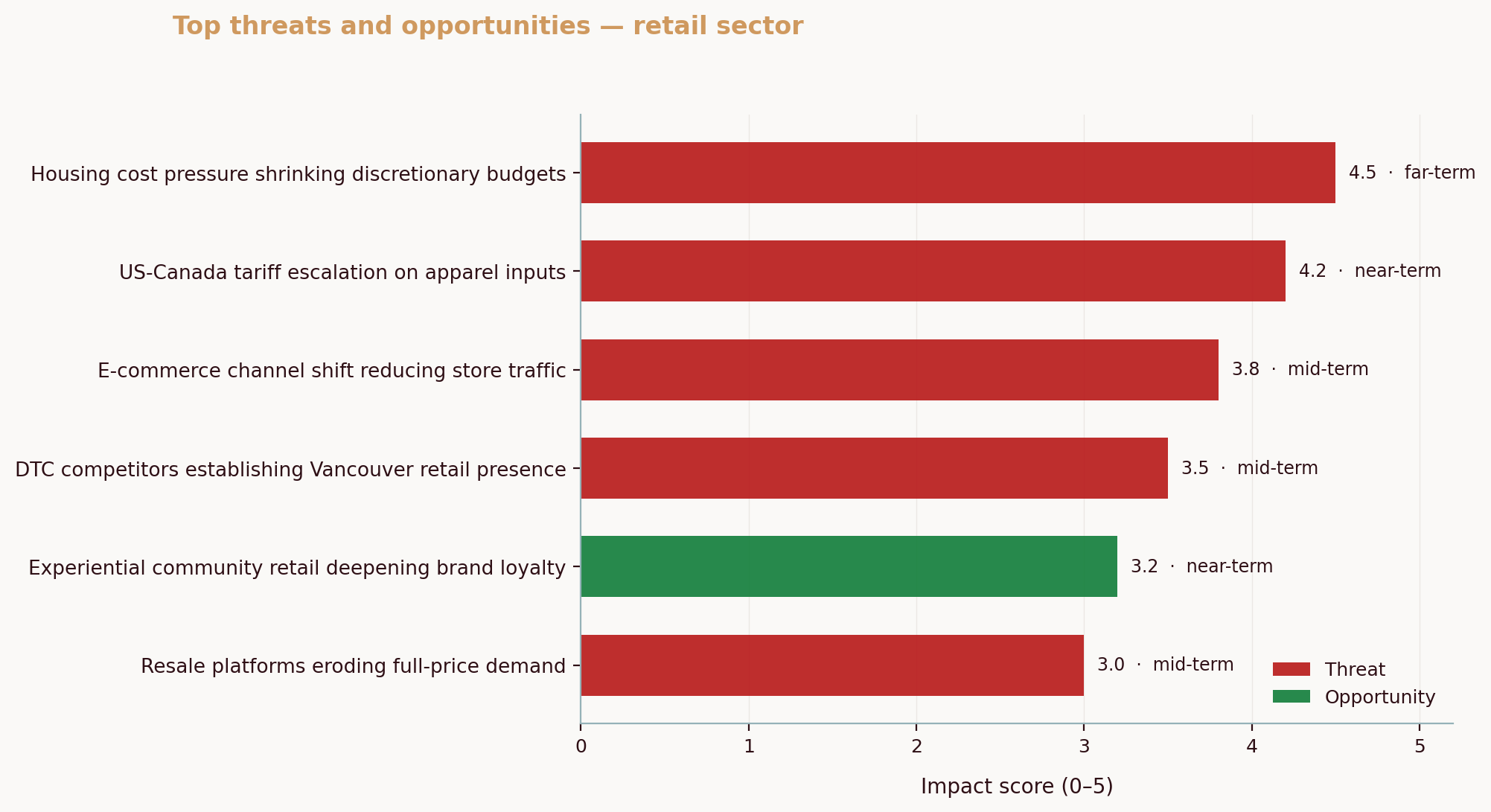
Remember, analysis isn’t just about risk. It reveals opportunity wedges. In Vancouver retail, for example, social listening can show when a single brand’s share of conversation starts to slip as new entrants and influencer‑led labels crowd the feed. That’s a green light to reposition before foot traffic erodes. (Our March 2026 review of a Vancouver athletic‑wear retailer showed exactly that pattern as global chains expanded and premium pricing faced pushback.) When you can name the shift, you can plan the response.
Common Questions About Market Research Before Starting a Business
Wondering how to know if your business idea is good? Look for three signals: the problem occurs often and feels costly to your segment, a handful of qualified buyers say they would pay now at a price that preserves margin, and you can reach that segment through one repeatable channel at a sustainable acquisition cost.
Why is market research crucial before starting a business?
Because it converts uncertainty into evidence. Research surfaces customer needs, buying triggers, and competitive dynamics so you can choose a viable segment, set realistic pricing, and prioritize features that win early adopters. It’s also your best defense against the classic failure pattern of building something nobody needs, which remains the top reason cited in startup post‑mortems. See CB Insights’ ongoing analysis. (cbinsights.com)
What are the most effective methods for conducting market research?
Use interviews to understand problems and language, surveys to measure interest and price sensitivity, and observational methods to capture real behavior. When it’s time to choose, start qualitative to find the signal, then quantify to size it. Provincial guides consolidate useful datasets and directories to speed this up for Canadian founders. Ontario’s research guide is a good hub. (ontario.ca) For local research, walk the area at peak and off‑peak hours, use Google Maps and Street View to inventory competitors and foot‑traffic cues, then call five nearby businesses to sanity‑check demand. To find industry trends for free, start with Statistics Canada tables, BDC publications, provincial portals, Google Trends, and open reports from trade associations.
How can I analyze market research data effectively?
Tie every analysis to a decision, tag qualitative insights so themes pop, and keep your quantitative views to a handful of decision‑driving charts. A simple impact‑versus‑confidence grid will keep debates focused. When you’re weighing competitors, ground your take in evidence from their pricing, distribution, and creative, not just their slogans. For a practical walkthrough on low‑cost monitoring, see this explainer: Track competitor pricing and marketing on a budget.
What common mistakes should I avoid in market research?
Four stand out: asking leading questions that confirm your bias, treating interest as willingness to pay, over‑generalizing from a tiny sample, and trusting only secondary data. The fix is simple: write neutral questions, test a price, recruit from the segment you plan to serve, and pair interviews with a short survey or behavior test. When environmental claims enter your messaging, ensure you can substantiate them under Canadian rules to avoid enforcement risk. Review the Competition Bureau’s guidance. (canada.ca)
A final step worth taking this week: pick one city block, one buyer segment, and one price point. Run a micro‑pilot there for two weeks. Then decide whether to double down, pivot, or park the idea.
Aurevon’s Ecosystem Dynamics Report distills local demand signals, competitor behavior, and channel shifts into a decision‑ready brief for Canadian SMBs. If you’re ready to turn research into a launch plan, get the details at aurevon.ca.
Mitchell Ozmun
SMB Researcher, Business Analyst - Saskatchewan Born and Raised