5 Key Points That Differentiate Your Business in 2026: what makes your business different in one sentence
You say “quality.” They nod. You say “great service.” They hear it every day. The phone stops ringing. If you can’t explain what makes your business different in one clear sentence, your customers can’t either. The work that follows shows you how to craft a one-line business differentiation statement that people remember and repeat.
Most businesses assume the basics (reliability, friendly staff, fair prices) set them apart. They don’t. Those are table stakes. True separation comes from naming a specific customer, a specific job, and a specific way you solve it better than the alternatives. One clean sentence forces that focus. It acts like a magnet for the right buyers and a filter for the wrong ones. The test is simple: would that sentence still be true if you slapped a competitor’s name on it? If yes, keep going. You’re not there yet.
Related: 5 Small Business Ideas Every Town Desperately Needs — Shane Hummus
Differentiation Test: Are You Blending In?
Start with a quick gut-check. Open your website’s “About” section and your top competitor’s. Swap their name into your paragraph. If your words still read fine, you have a blending problem. Customers scanning three tabs won’t slow down to decode subtle differences, clear competitive messaging wins.
What does this mean for you? In a market where Canadian consumers are trading loyalty for value and switching to lower-priced brands when messages aren’t clear, vague claims get punished. NielsenIQ’s 2025 outlook shows that value-focused shoppers readily switch and that trust is make-or-break for purchase decisions. That’s a loud signal: clarity about the value you deliver is now a growth lever, not a nice-to-have. See how that raises the stakes? NielsenIQ consumer outlook
The macro backdrop adds pressure. In the first quarter of 2026, Statistics Canada reported that a large share of businesses still expected obstacles like inflation over the next three months. When wallets tighten, sameness hurts more because buyers scrutinize trade-offs faster. They ask, “Why you, not them?” If your answer is fuzzy, they default to price or proximity. Statistics Canada, Canadian Survey on Business Conditions
Here’s a quick analogy: imagine sending two salespeople to pitch the same client with the same generic talking points. They compete with each other instead of the real rival. That’s what undifferentiated messaging does to your marketing channels. Your email, ads, and homepage end up fighting for the same attention because they all say the same nothing.
Before we move on, reality check from the field. Across two Canadian SMB intelligence reports analyzed via the Aurevon Intelligence Service, a consistent pattern appears: when categories get crowded, “quality” converges. In Calgary’s custom metal fabrication market, near-perfect online ratings removed “quality assurance” as a battleground. The real edge shifted to visibility, supply chain localization, and proof of technology adoption. If everyone’s a five-star shop, your message must explain how you deliver speed, certainty, or risk reduction differently.
🔑 Key Takeaway
A unique value proposition, stated in one crisp sentence, keeps you from being perceived as just another option.
Curious who your real rivals are before you write that sentence? Start here: identify your real competitors.
The Differentiation Formula: Crafting Your Unique Statement
If you are wondering how to differentiate your small business or how to describe what makes your business unique, use this sentence framework. It is brand positioning, not just copy.
With the blending risk clear, let’s build a one-sentence answer that holds up when compared head-to-head. Use this formula:
We help [who] [do what] by [how, differently].
Each bracket forces a choice. “Who” narrows the audience you want more of. “Do what” clarifies the job you’re hired to do. “How, differently” names the specific approach that separates you from alternatives. The sentence should fail if applied to your competitor. If it doesn’t break, it’s not specific enough. Messaging frameworks like Simon Sinek’s Start With Why and the StoryBrand approach align with this logic; they help you clarify purpose, audience, and promise so the line is unmistakable.
Here’s how this actually works across three common business types.
1) Local plumber
Weak: “We provide fast, reliable plumbing for homeowners.”
Why it fails: no plumber chooses “slow and unreliable.”
Stronger: “We help Calgary infill homeowners avoid surprise shutoffs by using camera-first diagnostics and on-truck stock for same-day fixes.”
Why it lands: a precise audience (infill homeowners), a concrete job (avoid surprise shutoffs), and a clear “how” (camera-first plus stocked trucks). It also hints at an operational promise the competitor might not match.
2) Neighborhood restaurant
Weak: “We serve great food with friendly service.”
Stronger: “We help Saskatoon music lovers make a night of it with ticket-free live sets and a two-hour table guarantee.”
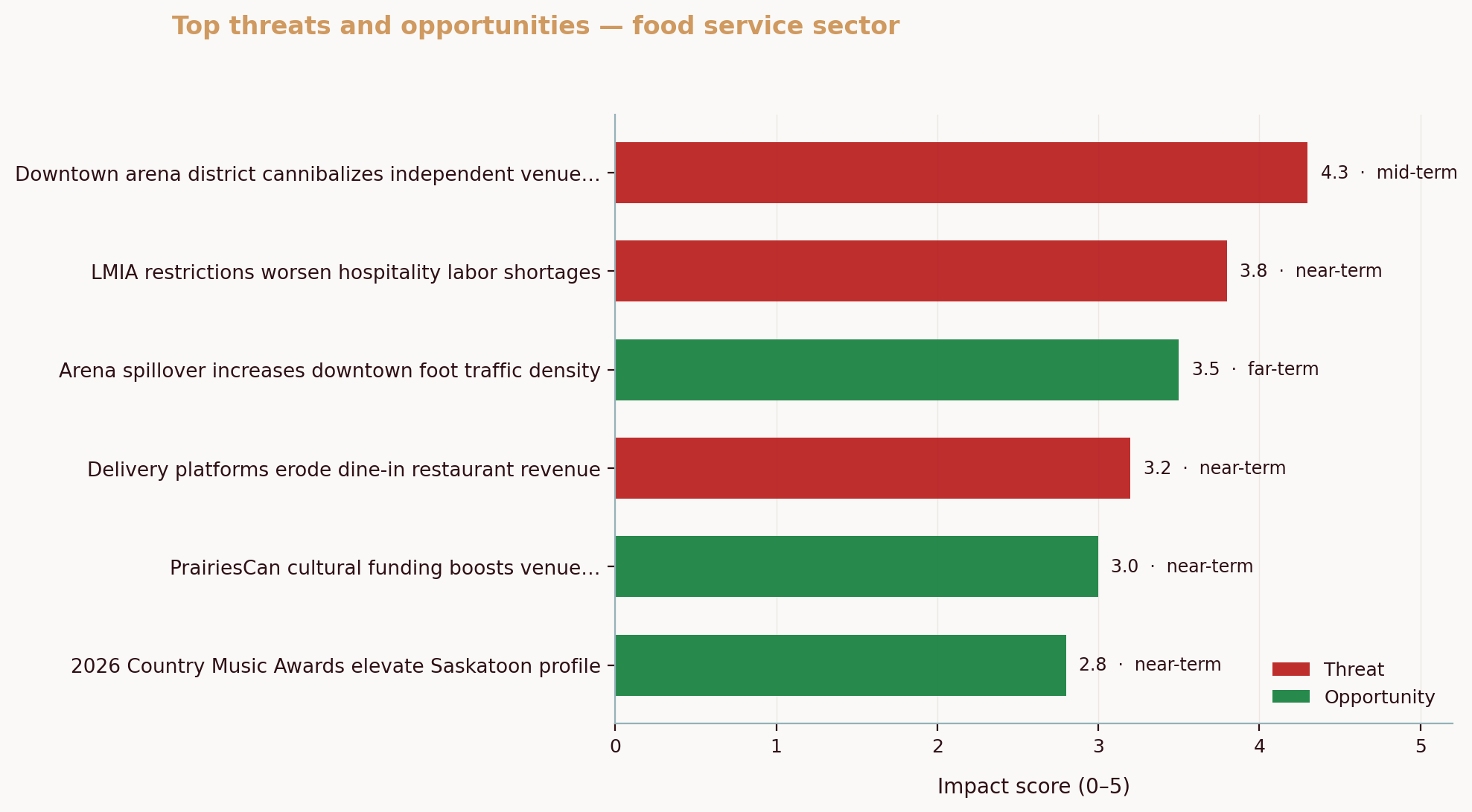
Why it lands: it says exactly who shows up and what experience they get. It also flips a common frustration (ticketed events) into a benefit. In our analysis of a Saskatoon restaurant via the Aurevon Intelligence Service, two external forces were poised to reshape demand: larger Regina venues and consumer frustration with ticketed value. A message that removes that friction can be a real wedge.
3) Small accounting firm
Weak: “We offer tax and bookkeeping services for small businesses.”
Stronger: “We help Alberta trades contractors keep bids cash-flow positive by project-based bookkeeping and quarterly tax set-asides.”
Why it lands: naming “trades contractors” and “cash-flow positive bids” invites the right prospects while screening out mismatches. The “how” (project-based books plus quarterly discipline) is a method competitors may not offer as a package.
What does this mean for you? You don’t need poetic language. You need precision. Treat the sentence like a spec sheet for attention. Keep it under 25 words, avoid adjectives you can’t measure, and choose nouns your buyer uses aloud.
Quick step-by-step you can do today:
- Draft three versions of your sentence using the formula.
- Read each aloud to a customer who bought in the last 60 days. Ask: “What part is false, vague, or generic?”
- Replace any adjective (“quality,” “fast,” “affordable”) with a proof-backed detail (“24-hour turnaround in Calgary city limits,” “flat-rate onsite fee within 25 km”).
If you want help mapping the “who,” these primers will save you time: competitor SWOT for small business and a simple guide to tracking competitor pricing and marketing.
Bridge to the next section: now that you can write a tighter sentence, let’s make sure you’re not falling into the traps that keep it from working.
Common Traps in Differentiation: What to Avoid
Three words sink most positioning: quality, service, experience. They’re important. They’re not differentiators because everyone says them and most buyers assume them. A “business unique selling point” (USP), also called a unique selling proposition, needs to specify what you do that rivals don’t or won’t. The Business Development Bank of Canada puts it plainly: a USP should, in a short sentence or two, define why customers should buy from you based on what they care about most, not just a slogan. BDC on finding your USP
Here’s how those traps show up:
- Quality: “Best materials.” Better: “CSA-certified parts with serialized tracking so commercial clients pass inspections without rework.” The difference is verifiable.
- Service: “We care more.” Better: “24/7 phone line answered by licensed techs, not a call center.” The difference is operational, not emotional.
- Experience: “20 years in business.” Better: “3,200 residential heat pump installs since 2019, average repair rate under 1% in year one.” The difference is quantified.
Another trap is copying category language because it sounds safe. When every dental clinic promises “gentle, family-friendly care,” the phrase becomes noise. Say what you do that others sidestep: “needle-free numbing for eligible procedures” or “Saturday pediatric blocks only.” Specifics earn attention.
One correction worth making: the problem isn’t that your claims are wrong. It’s that they’re undifferentiated. Buyers assume you’ll be competent. They need proof you’ll be better for them in a way that matters now.
A quick before/after to cement this:
- Before: “Full-service landscaping. Quality you can trust.”
- After: “We help Calgary homeowners stop surprise sprinkler repairs by mapping every zone in your yard and texting a pre-winter shutoff plan.”
Feel the shift? It’s a job, an outcome, and a method.
With the traps in view, where do you find the raw material for a sharper sentence? From the people who choose you and the gaps your competitors leave open.
Finding Your Real Difference: Insights from Customers
The fastest way to a stronger “what makes my business unique” message is to ask recent buyers two questions:
1) What almost made you not choose us?
2) What sealed the deal?
The first answer reveals friction you overcame, the second reveals the value you delivered that others didn’t. That paired signal helps you focus the message on the moment that mattered.
Do this today:
- Call three customers from the last 45 days. Keep it short. “Two questions to improve our service, can I take 90 seconds?”
- Write down exact phrases they use. Don’t translate. Use their words in your sentence.
- Ask one follow-up: “Which competitor was second place, and what would have made you pick them?” That’s where your differentiator lives.
Look for competitive gaps, not just features. What don’t rivals do because it’s hard, slow, or “not how things are done”? That’s often your “how, differently.” In Canadian retail, for example, one Vancouver athletic wear retailer that dominated local conversation saw its share of mentions eroded by international chains and influencer-fueled brands, plus consumer pushback on premium pricing. When a category’s buzz fragments, nimble service promises or pricing guarantees aimed at a defined micro-segment can reclaim relevance. That’s a reminder to anchor your sentence in a segment where you can credibly overdeliver.
Proof that this isn’t theoretical: BDC’s guidance on a unique selling proposition emphasizes that a short, specific claim should reflect the precise customer experience you deliver end to end, not just marketing copy. That includes what happens after the click, delivery, returns, and wait times. A clean sentence you can’t operationalize will hurt you more than help. BDC on finding your USP
You can also sanity check your options against external signals:
- If your industry faces tougher competition or shifting demand, clarity carries even more weight. A 2026 Competition Bureau study underscores the gains when markets are more competitive. Translation for SMBs: your clearer claim helps you win on value instead of discounting. Competition Bureau study on competition and growth
- If attracting customers sits atop your worries list, you’re not alone. A 2025 CIBC poll found that business viability and growth concerns include attracting customers and growing competition. Your one-sentence differentiator is a fast way to make paid channels work harder. CIBC small business poll
One more practical anchor: test your sentence where it counts. Put it as the first line of your Google Business Profile description, your homepage H1, and the opening of your “Services” page. Measure click-through and call volume for two weeks. If nothing moves, your sentence may still be too generic, or your “who” is too broad. Tighten again.
For deeper competitive context, these how-tos can guide your next pass: identify real competitors, run a quick SWOT, and track competitor pricing and marketing.
Examples of Strong vs. Weak Differentiators
Ten industries, side by side. The left column statements would likely fail the competitor swap test. The right column statements would not.
| Industry | Strong Differentiator | Weak Differentiator |
|---|---|---|
| Restaurant | “We help downtown lunch crowds get in and out in 28 minutes with prepaid ordering and reserved counter seats.” | “Great food and service.” |
| Plumber | “We stop infill-home shutoffs by using camera-first diagnostics and on-truck stock for same-day fixes.” | “Fast, reliable repairs.” |
| Accountant | “We keep Alberta trades bids cash-flow positive with project-based books and quarterly tax set-asides.” | “Tax and bookkeeping for small businesses.” |
| Salon | “We help curly-haired clients avoid heat damage using water-only cuts and ingredient-safe products.” | “Experienced stylists.” |
| Landscaping | “We reduce surprise sprinkler repairs with zone mapping and a texted pre-winter shutoff plan.” | “Quality lawn care.” |
| E‑commerce apparel | “We fit powerlifters with quad-friendly jeans using a three-measure fit quiz and free first exchange.” | “Premium fabrics.” |
| Physiotherapy clinic | “We get runners back to race day with gait video analysis and a 12‑week return-to-run plan.” | “Personalized treatment.” |
| Home renovation | “We finish kitchen refreshes in 10 days by prebuilding offsite and scheduling trades in locked sequences.” | “On-time, on-budget renos.” |
| Dental clinic | “We reduce anxiety for needle-averse patients with needle-free numbing where eligible and 7 a.m. appointments.” | “Family-friendly dental care.” |
| Online tutoring | “We raise Calgary Grade 11 math scores by two letters with AI‑flagged weak spots and weekly parent check-ins.” | “Expert tutors for all subjects.” |
Why does the right side work? It names a buyer, a job, and a method that others likely don’t offer as a package. It carries a measurable promise (time, result, process) instead of an adjective. It also suggests a pricing power story. When buyers believe you can deliver a specific outcome, they’re less likely to reduce you to a commodity.
Want a quick mirror test? Read your sentence and underline the nouns and numbers. If all you have are adjectives, it’s weak. If you see a segment (who), a job (do what), and a mechanism (how), you’re close.
For more on separating your message from the pack as you analyze rivals, revisit competitor mapping: field guide for SMB owners.
Common Questions About Business Differentiation
Why is differentiation important for my business?
Because buyers make trade-offs fast. In a value-focused environment where many Canadians will switch brands to save money or gain trust, generic claims invite comparisons you don’t want. Clear differentiation helps the right customers self-select and justifies your price. It also aligns your operations around one promise, so your team knows what to deliver first when things get busy. Research backing the stakes is real: when competition intensifies, firms that articulate and deliver distinct value capture more growth. NielsenIQ consumer outlook, Competition Bureau study
How can I identify what makes my business different?
Engage recent customers and ask what almost made them not choose you and what won them over. Then look at competitor blind spots: services they won’t offer, time windows they won’t cover, guarantees they won’t make. Shape your who, do what, how sentence around those gaps. If you’re stuck, borrow precision from credible playbooks. BDC’s guidance on a business unique selling point is a helpful lens to keep claims grounded in customer experience, not slogans. BDC on finding your USP
What if I can’t find a unique differentiator?
You may be looking too broadly. Instead of “homeowners,” try “infill homeowners in older Calgary neighborhoods.” Instead of “faster service,” try “same-day camera diagnostics within 25 km.” You can also differentiate on process transparency, risk reduction, or convenience when product features converge. Remember, a strong business differentiation statement should fail the competitor swap test. Keep shrinking the “who” and sharpening the “how” until it does.
Can I use more than one differentiator?
You can operate with multiple strengths, but you should communicate one core differentiator in your external “one sentence business description.” Think of it like an elevator pitch for a business, a 15 to 30 second summary of who you serve, the problem you solve, and how you do it differently. Internally, you’ll still excel at other things. Externally, lead with the one that matters most to your best customers right now.
Take a final step that pays dividends: write your sentence, put it at the top of your homepage, and run a simple A/B test for two weeks. If version B increases calls or quote requests, keep it. If not, iterate with a sharper “who” or a clearer “how.”
Final nudge to act today: Paste your sentence into your Google Business Profile and your email signature. Then ask three customers to rate it from 1 to 5 for clarity, and to circle the one word they’d change. Speed wins.
As you tighten your message, you can also improve your view of the field with these practical reads: competitor SWOT and hands-on ways to track pricing and marketing.
Looking for structured external context while you refine that sentence? A single, Canada-focused market snapshot can help you pressure-test your who, do what, how claim against real trends and rivals. The Ecosystem Dynamics Report brings those signals together for SMBs in plain language. If that would help, learn more here: Ecosystem Dynamics Report.
Mitchell Ozmun
SMB Researcher, Business Analyst - Saskatchewan Born and Raised