How to Find Market Gaps Nobody Else Is Filling
You’re staring at a crowded field. Everyone’s selling something that looks like yours. Feeds are noisy. Margins are thin. The reflex is to chase a brand-new idea. Resist it. The real growth often hides in plain sight: the recurring complaints people make, the 30-minute drives they tolerate, the clunky workarounds they stitch together. Learning how to find market gaps is less about blue-sky invention and more about pattern-spotting in everyday customer behavior. It is disciplined opportunity identification done in the wild.
Here’s the twist: customers will tell you where the gaps are, just not in a tidy sentence. They’ll leave hints in competitor reviews, offhand comments to frontline staff, abandoned carts, poor local search results, long Reddit threads that circle the same annoyance, or a bundle of services they cobble from three vendors. Follow the breadcrumbs and you’ll surface opportunities others miss. See how that reframes the task?
Related: How to Conduct Market Research for Your Business Idea — Young Entrepreneurs Forum
Understanding Market Gaps
A market gap is a space where demand exists but options don’t, or where the options miss something specific that customers care about. It’s not always a new category. Often it’s the missing feature, the awkward process step, the out-of-the-way location, or the price-pack that never seems to fit. Think of it like a bridge missing a plank. The road is there, traffic is flowing, yet everyone slows down and shifts their weight at the same spot. That wobble is your opening.
Do a quick gap analysis across features, process steps, and geography to see where unmet demand piles up. Customer pain points are the fastest way to zero in. If “value for the money” is fuzzy, if wait times are long, if returns are painful, if people can’t compare options side by side, a gap exists. And because most Canadians research purchases online to find information, poor or confusing search results often signal underserved needs. That’s your early radar, especially when you notice the same complaints repeated across brands in a local area. (canada.ca) When you need a sense of market size or local demographics before you invest, scan recent releases from Statistics Canada to ground your assumptions.
It’s common to assume that in saturated markets, all the value is already captured. Not true. When everything looks “good enough,” the battleground shifts to the edges: speed, convenience, and trust. Independent research consistently shows that tuning the customer journey can lift revenue while cutting costs, which is exactly what happens when you remove nagging frictions that competitors ignore. For instance, companies that focus on better experiences often see a notable uptick in revenue alongside meaningful cost reductions in service. That upside compounds when you become “the place that finally fixed X,” because satisfied customers repeat and refer. (mckinsey.com)
A few public examples make the point. In grocery, value-plus-convenience formats have surged because shoppers will trade brand loyalty for sharp pricing and easy pickup when money is tight, a pattern confirmed by consumer data showing price sensitivity edging out “buy local” intentions. In retail, Canadians still favor in‑store purchases, partly due to frustration with online experiences like unclear product information and clumsy returns. Where the experience breaks, a local business with clearer expectations, faster exchanges, and transparent fees can win share, even against larger chains. That’s the leverage you get when you solve the exact thing people grumble about. (pwc.com)
So the opportunity is real. The question is where to look first.
Identifying Customer Complaints
Start with the raw material of every market gap: complaints. They’re not noise; they’re maps. If you are asking how to find opportunities in your market, start here. Mine competitor reviews, your own support emails, community Facebook groups, and store-floor conversations. Then cluster the gripes into themes: price fairness, response time, staff knowledge, store hours, return policies, missing “little extras,” geography, and underserved segments like shift workers, renters, newcomers, or rural addresses. Watch for intensity (strong wording), recency (is it still happening?), and repetition (across rivals, not just one).
Here’s how this looks in practice. Imagine a Halifax appliance repair service. You read 300 local reviews across five competitors and find three patterns: unanswered weekend calls, no clear diagnosis pricing, and delays waiting for parts. Each pain point suggests a gap. Could you offer a small weekend on‑call window? A transparent “diagnosis visit = flat fee” policy? A tighter “parts on hand” list for common fixes? Before building anything, list the smallest test you could run for each.
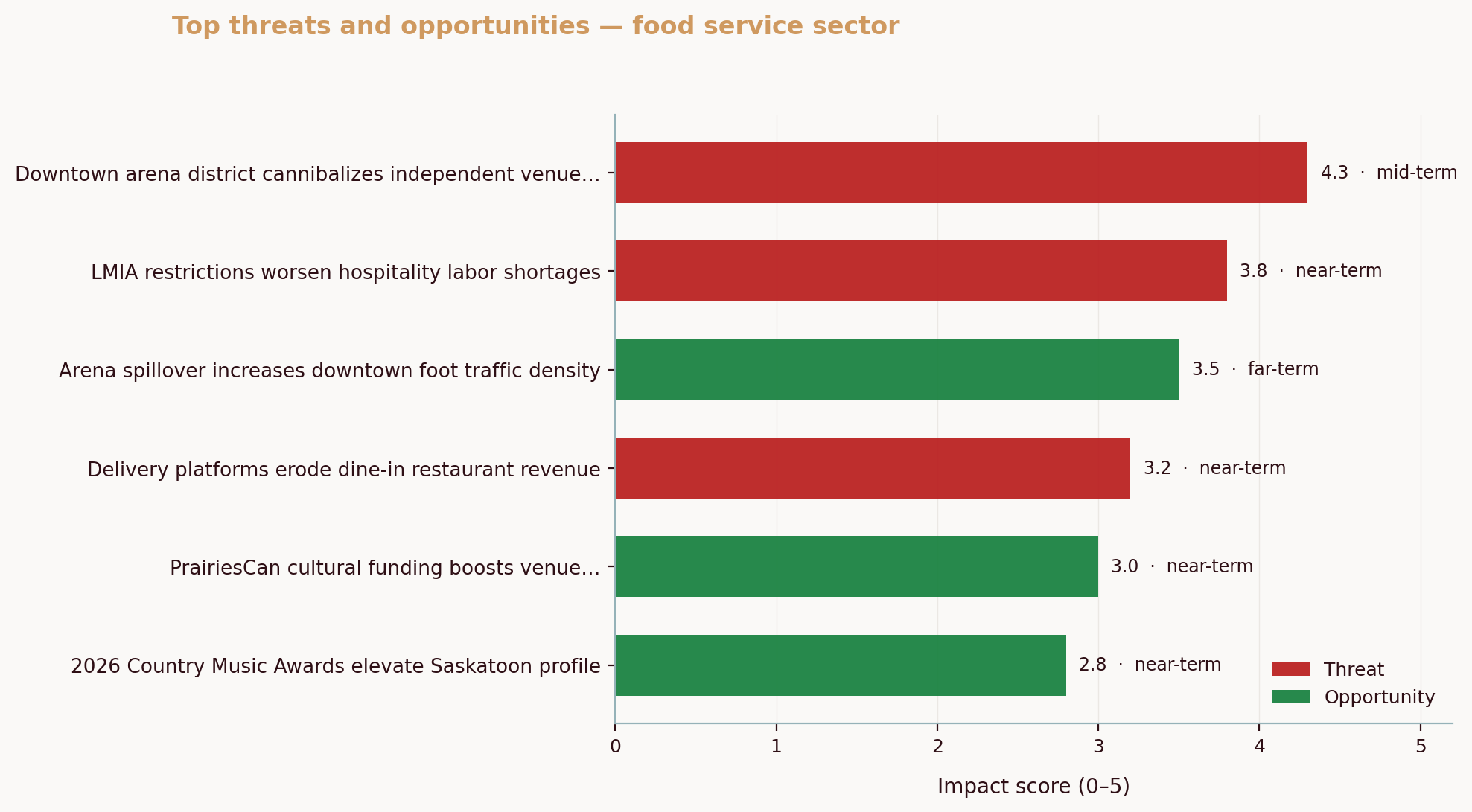
Proprietary intelligence amplifies this approach. In an analysis of a Saskatoon restaurant via the Aurevon Intelligence Service, two forces stood out: big Regina venue projects and growing frustration with the value of ticketed events. That’s not a cue to “add more shows.” It’s a cue to make paid experiences feel worth it: clearer line‑ups, guaranteed seating zones, add‑ons customers actually use, or a “no-surprise fees” policy that resets expectations. When complaints concentrate around value perception, your gap is often a design and communication problem, not a supply problem.
Another pattern we’ve seen across Canadian SMBs: when ratings are uniformly high, reviews won’t highlight quality differences. They highlight discoverability and convenience differences. In Calgary’s custom metal fabrication market, near-perfect ratings turned the fight from “who’s better” to “who’s easier to find, faster to quote, and more local in their supply.” If your industry sits in that zone, study the process friction, not just the stars. That’s where the gap hides.
💡 Pro Tip
Engage customers on their turf. When you see a thoughtful complaint on social or a detailed review, thank the poster and ask one follow‑up question: “If you could change one thing, what would it be?” That single prompt uncovers the “job to be done” in their words, which beats any survey scale for clarity.
One more lens: price sensitivity. Several studies show Canadians are unusually price-conscious right now, which explains why “value gaps” are everywhere. If you hear “I’d pay for it if…” or “I’d drive farther for a fair price,” you’ve found a seam to explore: right-size the offer, repackage the bundle, or create a lighter‑weight tier that removes a costly frill customers don’t want. (wealthprofessional.ca) To find underserved customers, overlay those complaint themes on a map and a calendar, then sort by language or access constraints. The clusters that keep showing up are your underserved segments and likely pockets of market white space. This is practical market gap analysis in action.
With a long list of complaints mapped, the next step is seeing where competitors systematically fall short.
Exploring Competitor Weaknesses
Think of competitor reviews as open-source R&D. You’re looking for weak spots that repeat across brands, cities, or customer segments. Three hunting grounds tend to pay off:
- Review mining for service defects: delayed responses, missed appointments, confusing policies, or staff turnover that affects consistency.
- Product gaps that force bundling: customers mention buying add‑ons elsewhere, building DIY fixes, or using clashing systems.
- Geography and timing: long drives for a simple service, or peak‑time surges that leave customers stranded.
So what does that look like in a quick comparison? Create a simple table like the one below using publicly available reviews, Q&A pages, and policy docs. Keep it factual and recent. The goal isn’t to dunk on rivals, it’s to spot patterns you can ethically outperform. Consistent holes across rows point to market white space you can test.
| Competitor Name | Strengths | Weaknesses | Customer Complaints |
|---|---|---|---|
| Local Competitor A | Broad product range; central location | No weekend support; vague return terms | “Couldn’t reach anyone on Saturday”; “Return took three calls” |
| Local Competitor B | Fast delivery; slick website | Poor in‑store help; limited phone lines | “Staff couldn’t answer basic questions”; “Hold times were long” |
| Regional Chain C | Low everyday pricing | Stockouts on popular SKUs | “Drove 25 minutes and it was sold out” |
| Niche Specialist D | Expert staff; great tutorials | Small pickup window; high fee for small orders | “Pickup only 2–4 pm”; “$25 minimum order fee” |
Now connect those weaknesses to gap ideas. If multiple players have poor weekend coverage, test a small Saturday window with tight scope. If returns feel risky everywhere, be the one who posts a clear, one‑sentence policy on your landing pages and receipts. If people drive far for routine services, pilot a pop‑up location or mobile unit where the demand clusters.
Public research can sharpen your filters. For example, Canadians often prefer to close the sale in‑store while hunting for deals and information online. That means you can win by fixing the handoff between digital research and physical purchase: accurate inventory visibility, real photos, and ironclad return details to prevent “didn’t match the description” disappointments. Each fix erases a friction competitors tolerate, which is the essence of a market gap. (kpmg.com)
One more proprietary lens from the same intelligence service: a Vancouver athletic-wear retailer that once dominated local conversation is now getting flanked by global entrants and influencer‑led brands, while consumers push back on premium pricing. Translation: the gap isn’t a new fabric. It’s community trust, transparent value, and price architecture that feels fair. When competitors drift up‑market without the story to match, the opening is a crisp value line with credible quality signals and local relevance.
So the risks and openings are visible. How do you bring customers into that discovery?
Conducting Wish-List Conversations
A wish‑list conversation is not a survey. It’s a short, specific chat that asks customers what they wish existed, what they pay extra to avoid, and which parts of today’s options they rarely use. The tone matters: non‑defensive, curious, and focused on trade‑offs. You’re trying to learn what they’d sacrifice to get what they truly want.
Here’s a script you can adapt for a 12‑minute phone call or a quick coffee:
1) “Walk me through the last time you bought [category]. Where did it go sideways?”
2) “If you could wave a wand and change one thing, what is it?”
3) “What would you give up to get that change?”
4) “What would make this feel like a great deal without being the cheapest?”
5) “Would you tell a friend about that version? Why or why not?”
The gold is in specific, recent stories. When someone says, “I drove across town because the local shop never has my size on Thursdays,” you’ve found a geographic and timing gap in one sentence. When they say, “I had to call three places to piece together the whole service,” you’ve found a bundling gap. When they say, “I didn’t mind paying more, I just wanted the quote upfront,” you’ve found a trust gap.
What does this mean for you? Treat each wish as a hypothesis you can test in days, not months. If customers want transparent quotes, publish two real examples and measure contact‑form conversions. If they want after‑hours pickup, try a limited window three nights a week and count redemptions. Before: vague promises and “contact us for pricing.” After: two public packages, transparent inclusions, and a simple add‑on menu. See the difference?
To widen your lens, pair wish‑list conversations with quick search analysis. Type the exact phrases customers use into Google and see what comes up for your city or region. Use Google Trends to check whether interest is rising in your area, and Google Keyword Planner to size related searches before you spend. Then scan Reddit threads to hear how people describe the friction in their own words. If you find forum discussions without clear answers, scattered how‑to blogs with no service option, or maps showing only faraway providers, you’re staring at demand with thin supply. Because Canadians routinely go online to find information first, thin or confusing search results often equal opportunity. That’s your cue to write the definitive local guide and attach a small paid test to it. (canada.ca) (Google Trends) (Google Keyword Planner) (Reddit)
As you collect wishes, translate them into crisp offers. Then put those offers where competitors are weak: in the product Q&A, in the return policy, in the “what’s included” list, and at the moments when customers hesitate. If you’re unsure who you’re really up against in the customer’s mind, sharpen that too with a quick pass through how to identify your real competitors.
Validating a Gap
Finding a gap is not the same as owning it. You still need to prove three things: customers will act, they’ll pay enough, and you can deliver repeatedly. Here’s a tight validation path that keeps you honest and fast. Think of it as turning market white space into verified demand.
- Demand pulse: Stand up a one‑page explainer with a single, specific promise. Drive 200–300 qualified visitors with a small local ad spend and tally the signal that matters (preorders, deposits, consult bookings). If you can’t get a modest conversion without discounts, it’s either the wrong gap or the wrong framing. Tie this to known pinch points you surfaced earlier, and make the “what’s different” line unmissable.
- Price‑value clarity: Canadians are deeply price‑attentive at the moment, so structure two versions of your offer: a base tier that nails the core job and a fair‑value add‑on that solves a secondary pain. If the add‑on rate is low but click‑through is high, customers may want the benefit but not at that price. Adjust and rerun the test with small increments. Repeat until the add‑on attach rate moves or you decide it’s not worth pursuing. (pwc.com)
- Speed‑to‑benefit: Your first version should demonstrate the fix quickly. If one complaint was “no Saturday support,” run a 10–12 a.m. Saturday window and measure first‑week take‑up. If the complaint was “unclear returns,” rewrite the policy in one sentence and track return‑related contacts. The fastest wins usually sit in policy clarity, scheduling, and communication.
- Geography proof: If customers constantly drive 30–45 minutes for something routine, pilot a pop‑up or mobile unit closer to demand and track both sales and “I used to drive to X” comments. Deloitte’s consumer work shows that value and convenience often override locality sentiment when money is tight, which means proximity plus clarity can trump legacy loyalty. Use that to your advantage. (deloitte.com)
- Bundling fix: If people stitch together three providers to complete a job, assemble a starter bundle with clean handoffs and one accountable owner. Even if margins on the bundle are thin at first, you’re testing stickiness and referral velocity. If bundle buyers reorder at higher rates, you’re onto something.
- Operational proof: Can you fulfill the promise at scale? That’s the reality check many SMBs skip. In Canadian manufacturing, where review quality is uniformly high, the competitive edge shifted to visibility, local supply chains, and visible adoption of modern tools like CNC automation and welding robotics. The lesson for validation: show how you’ll maintain the fix when orders spike or parts are scarce. Publish lead times truthfully and demonstrate your local sourcing plan before competitors do. (Finding derived from an analysis of a Calgary manufacturer via the same intelligence service cited earlier.)
One more filter separates shiny ideas from real gaps: “Is this empty because nobody wants it, or because nobody tried the obvious fix?” To answer, run what product teams call a smoke test. Offer a clear value proposition and a fair price to a small audience with no discounts, and set a minimum success threshold before you start. If it fails twice with meaningful traffic, move on. Your speed in killing duds is a competitive advantage.
As you confirm the opportunity, position the promise with a line customers can repeat. Use a simple formula: “The only [what] in [where] that [specific difference].” For example, “The only appliance repair service in Dartmouth that posts real‑world diagnostic examples and offers a Saturday on‑call window.” That phrasing forces focus. Don’t sell everything; sell the fix.
To anchor your messaging against a shifting landscape, map “competitors customers actually compare you with,” not just the usual suspects. If you need a refresher, this explainer on finding your real competitors is a quick tune‑up, and this guide to tracking competitor pricing and campaigns can help you spot the next wave of friction points before they become table stakes. If you later want to stress‑test strengths and vulnerabilities, a clean competitor SWOT is still a sharp way to pressure‑test your angle, especially once early data starts rolling in.
A final note on long‑term positioning. In food and live entertainment, value perception around ticketed experiences is under pressure, which means loyalty is fragile when fees feel unfair or programming feels thin. Being “the venue that always makes paid nights feel worth it” is a durable position if you publish what value means, collect proof, and keep promises. (Finding from an anonymized Canadian food‑service analysis via the intelligence service mentioned earlier.) When the market is noisy, the business that explains value in plain language usually wins.
Common Questions About Finding Market Gaps
How do I know if a market gap is worth pursuing?
Look for three green lights: intensity, density, and money. Intensity means customers describe the pain in strong, specific terms (“I had to take time off work just to return it”). Density means you see the problem across several competitors or in multiple neighborhoods. Money means your smoke test earns sign‑ups, deposits, or preorders without heavy discounts. If you’re asking how to know whether there’s demand for a new service, this is the same test, just framed around unmet demand for a clear promise at a fair price. Outside research can guide your confidence level too: consumer studies in Canada show shoppers trade loyalty for value and convenience when budgets are tight, so offers that remove friction at a fair price tend to perform even in crowded categories. (pwc.com)
What if my research shows there’s no market gap?
First, check your lens. Are you scanning the right places? If you only reviewed top‑rated brands, you may have missed the fringe where complaints are more candid. If you only searched formal keywords, try the phrases customers actually use. Because most Canadians begin by seeking information online, thin or contradictory results for those phrases can expose gaps your initial pass didn’t see. If the data still says “nothing here,” that’s a win too. You just saved months of effort you can redeploy elsewhere. (canada.ca)
Can I fill multiple market gaps at once?
You can, but it’s risky early on. Most SMBs succeed faster by picking one gap and becoming unmistakably good at it. When you fix one high‑friction moment so clearly that customers repeat it back to you, expansion gets easier. Solve the Saturday window first, then add the clear quote, then the bundle. One fix that lands beats three that fizzle.
How do I position my offering once I find a gap?
Use plain language that names the difference in customer terms. “The only [what] in [where] that [specific difference]” forces clarity. Back it with proof customers care about: screenshots of real inventory visibility, photo‑verified returns, or side‑by‑side delivery windows. External research helps here too: studies link better customer journeys to measurable revenue gains, which means your “boring” fix can be your biggest growth lever if you talk about it clearly and deliver reliably. (mckinsey.com)
Take one action today: pick a single competitor, read their 50 most recent reviews, and write down the three most repeated complaints. Next, write a one‑sentence offer that fixes one of them for your city. Publish it. Measure for two weeks. Adjust or kill fast. That discipline, repeated, is how you turn gaps into growth.
Aurevon’s Ecosystem Dynamics Report helps Canadian SMB owners see where complaints, competitor moves, and local demand shifts intersect so you can act before the crowd. If you want a concise read on your market’s “missing planks” and the fastest tests to validate them, learn more here: https://aurevon.ca/
Mitchell Ozmun
SMB Researcher, Business Analyst - Saskatchewan Born and Raised