Mastering Competitive Analysis: How to Identify Business Competitors and Who Really Competes with You
The café across the street drops a new latte. Your foot traffic dips. You push a promo. Still quiet. Then a customer admits they skipped coffee and grabbed an energy drink from the gas station. That’s the gut punch: learning how to identify business competitors isn’t just about the players that look like you.
Most small businesses only track half their rivals. The rest hide in plain sight: companies meeting the same customer need in different ways, brands dominating local search for your service, and options your buyers seriously considered before choosing you. To surface the full field, map who serves the same customer job, scan who shows up in local results for your core queries, review industry directories, and ask customers who else was on their shortlist. Those simple moves pull direct, indirect, and replacement competitors into view, fast. This is market landscape analysis in practice. With concise competitor mapping, you outmaneuver threats and spot overlooked opportunities, and you strengthen market positioning with decisions grounded in how customers actually choose.
Related: How Small Business Can Beat the Larger Competition - 10 Winning Strategies for Success — Philip VanDusen
Understanding Different Types of Competitors: Direct, Indirect, and Replacement
Let’s pin down the categories with practical examples an SMB owner will recognize.
Direct competitors sell similar offerings to the same customers. A neighborhood coffee shop competes with other cafés within a few blocks. A mobile dog groomer contends with other vans serving the same postal codes. This is the group you already know well, because you bump into them in ads, foot traffic, and word of mouth.
Indirect competitors solve the same problem in a different way. The coffee shop’s indirect rivals include home espresso machines and office pantry subscriptions. A mobile groomer’s indirects could be self‑serve wash stations at pet stores. Different delivery, same job.
Replacement competitors satisfy the underlying need through an alternative solution entirely. The coffee “hit of energy” can be replaced by canned energy drinks or even a brisk 10‑minute walk before the commute. The groomer’s “clean, safe, cared‑for pet” might be replaced by a monthly pet‑sitting bundle that includes bathing.
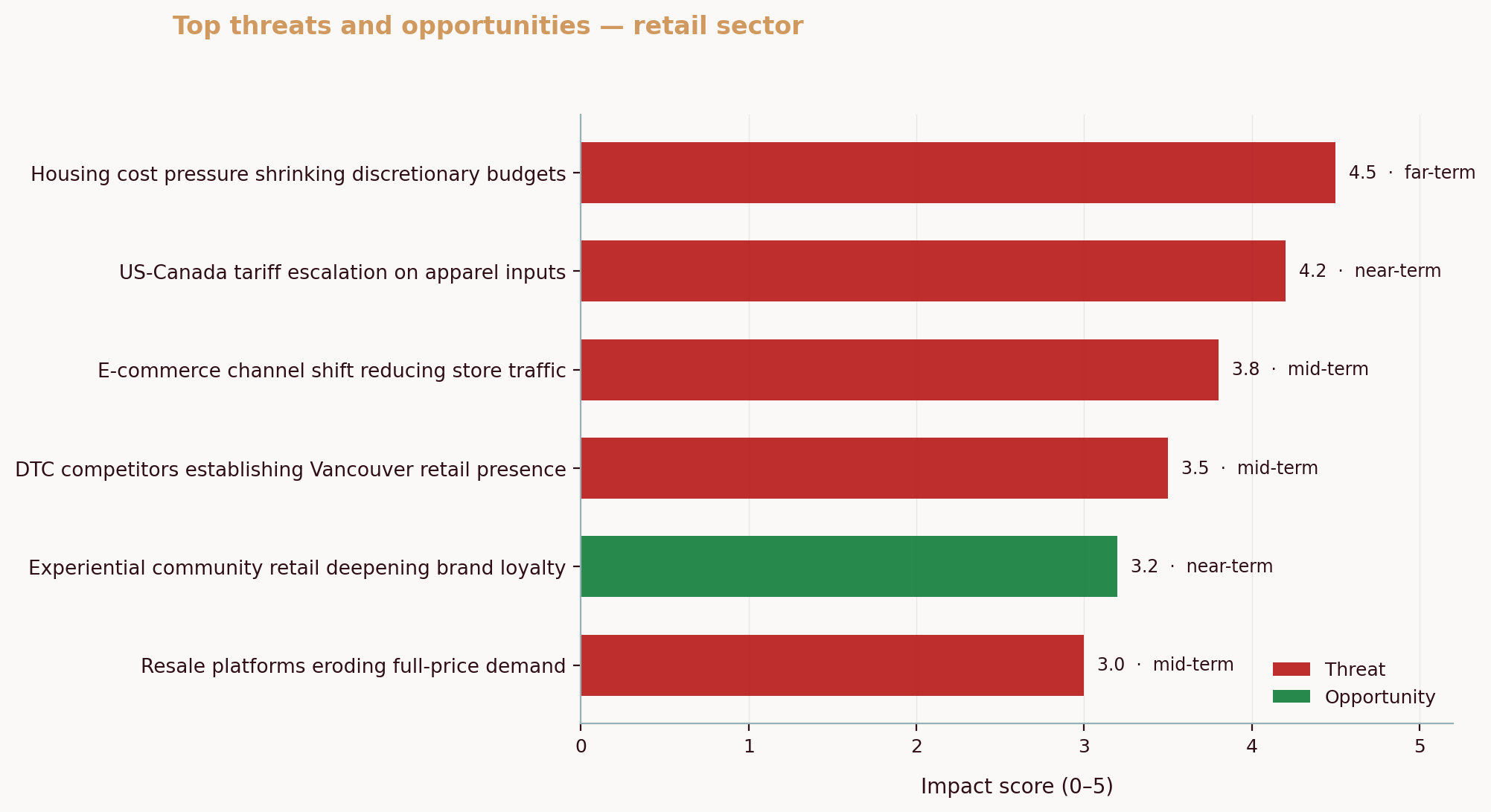
What’s the real risk if you ignore these? You get blindsided when the battleground shifts from product features to visibility, convenience, or price. Across three Canadian SMBs analyzed via the Aurevon Intelligence Service in March 2026, we saw this shift repeatedly: in Calgary’s custom metal fabrication, near‑perfect online review clusters meant the fight moved to content visibility, local supply chain proof, and visible tech adoption like CNC automation and AI‑assisted welding; in Vancouver athletic wear, one retailer’s large share of social conversation was squeezed at once by JD Sports and Decathlon opening nearby and by influencer‑led brands such as Vuori and Alo Yoga challenging premium pricing in feeds; and in Saskatoon dining, sports bars and family pizza spots faced simultaneous pressure on value, food safety reassurance, and atmosphere. Those aren’t edge cases. They’re signals that competitors include whoever wins the customer’s job and wallet, not just the shop next door.
One more angle you might not expect: regulators treat “potential competitors” seriously, which underscores why your lens must be wider than today’s clone rivals. The Competition Bureau considers firms to be competitors even when they’re only likely to compete for similar customers or products in neighboring regions. That’s a formal reminder that indirect and emerging players matter. See the Bureau’s guidance for how “actual” and “potential” rivals are assessed. Competition Bureau of Canada. (competition-bureau.canada.ca)
⚠️ Warning: Defining competitors only by category is like preparing for a hockey game by scouting the other team’s jerseys, not their lines and plays. The jersey tells you little about how they’ll score.
🔑 Key Takeaway
Recognizing all types of competitors, direct, indirect, and replacement, gives you a truer picture of your market and where the next threat or opening will appear. That clarity supports a sharper competitive set definition you can act on.
Comparison at a glance:
| Type | What they sell | Customer need they target | Coffee shop example | What to watch |
|---|---|---|---|---|
| Direct | Same/similar product | Same job, same context | Other cafés nearby | Price, quality, hours |
| Indirect | Different product or delivery | Same job, different delivery | Home espresso machine, office coffee | Convenience, ownership cost |
| Replacement | Alternative solution | Underlying job by a different means | Energy drinks, brisk walk | Habit formation, impulse channels |
With the landscape defined, how do you actually find those players in your backyard and online?
Five Methods to Discover Your Competitors (for small businesses)
You don’t need a consulting budget to map the field. Use these five hands‑on methods and you’ll surface the names that really matter.
1) Google Maps and Yelp sweeps for buyer‑language queries
Search the way customers do, not the way you describe yourself. Run “best [service] near me,” “[service] open now,” and neighborhood‑specific phrases. Add filters like “top rated” and note which listings dominate the map pack and who appears in “People also search for.” Include Yelp category pages and “nearby” suggestions for cross‑category substitutes a buyer might choose. Use Google Trends to compare phrasing so your searches reflect what locals type this season. Capture any business that a buyer could reasonably choose instead of you, even if it’s not your category twin.
Do this today: run three buyer‑language searches, take screenshots of the top results, and mark recurring names. That’s your first pass “consideration set.”
2) Industry directories and NAICS neighbors
Trade associations, local Chambers, and provincial directories help you round up direct and adjacent categories. In Canada, use NAICS to locate neighboring codes that customers treat as substitutes. BDC explains how to use NAICS to build a more complete competitive set that goes beyond obvious clones. BDC: How to conduct a competitive analysis. (bdc.ca) Where available, scan Industry Canada resources and ISED directories for related firms and nearby categories to finalize your competitive set definition.
💡 Pro Tip: If you’re a nail salon, NAICS will nudge you to look at home kits sold through beauty retailers. That’s an indirect you shouldn’t ignore.
3) Short customer surveys that ask one telling question
Skeptical about surveys? Keep them brutally simple: “Before choosing us, which three options did you seriously consider?” That one question reveals your live competitors, not your guesses. Add an open prompt for “what almost made you choose them?” to surface the hooks you must counter on your website and in scripts. This is business rival identification straight from the source.
Before/after you’ll feel:
- Before: you guess at positioning based on what you want to be true.
- After: you use customer‑named alternatives and reasons, which is what new prospects are reading too.
4) Supplier and partner check‑ins
Ask your suppliers which firms are placing similar orders, shortening lead times, or adopting new tech. Suppliers see demand patterns early. If they mention a competitor who just invested in a process you haven’t, that’s a signal about future price, speed, or quality moves.
Ground truth example: in Calgary’s metalworking ecosystem mentioned earlier, where review scores barely differentiate firms, the needle moves when a shop proves it can source locally during shortages and shows evidence of CNC or AI‑assisted processes. That intel often surfaces first in supplier chatter.
5) Social media monitoring with intent
If you doubt social listening, consider the cost of flying blind. Canadians do pre‑purchase research heavily online, with 79% of internet users buying goods or services online in 2022 and near‑universal internet usage overall. Statistics Canada, The Daily, March 21, 2024. (www150.statcan.gc.ca) Social isn’t the top channel for all ages, but its influence spikes with younger buyers: only 23% of Canadian consumers overall say social media is a top‑three research source, while 45% of Gen Z do. PwC Canada consumer insights. (pwc.com)
Here’s how to make it practical: monitor hashtags tied to your city and service (“#yycmetalwork,” “#saskatooneats”), follow competitor handles, and log brand mentions that pop up alongside you. In our Vancouver retail example earlier, one athletic wear shop’s conversation share was chipped away from both brick‑and‑mortar rivals opening nearby and influencer‑backed brands flooding feeds. That erosion only shows up if you’re listening where customers talk.
Bridge to what’s next: spotting names is good. But how do you uncover the non‑obvious competitors solving the same problem by different means? That’s where a smarter lens comes in.
Using the Jobs to Be Done Framework to answer “Who are my competitors?”
Jobs to Be Done (JTBD) is a simple idea with sharp consequences: customers “hire” a product or service to make progress in a specific situation. When you define the job, not the category, your true competitor set often doubles. The foundational work on JTBD, popularized by Clayton Christensen, lays out this mental shift and why it exposes hidden rivals. Harvard Business Review: Know Your Customers’ “Jobs to Be Done”. (hbr.org)
Start with three parts: the situation, the struggle, and the desired progress. Then list all the ways a buyer could achieve that progress.
- Coffee shop example
Situation: commuter leaving a condo at 7:30 a.m.
Struggle: mid‑morning energy dip and social ritual with coworkers.
Desired progress: feel alert and connected by 9 a.m.
Competitor set: café latte (direct), home Nespresso (indirect), canned energy drink from convenience store (replacement), short outdoor walk plus office water cooler chat (replacement). - Saskatoon bar example
Situation: family picking Friday dinner with a game on.
Struggle: tight budget, food safety concerns, and wanting a lively vibe.
Desired progress: affordable night out that feels safe and fun.
Competitor set: sports bar (direct), family pizza chain takeout plus streaming at home (indirect), entertainment center with meal deals (replacement). Our field analysis in Saskatoon showed value, safety signals, and atmosphere working as a three‑way lever of choice, which means your competitors include whoever convincingly ticks those boxes. - Calgary fabrication example
Situation: operations manager under pressure to de‑risk supply during a crunch.
Struggle: on‑time delivery and quality are table stakes; leadership is asking for local sourcing and modern processes.
Desired progress: “I need to show my boss we can deliver reliably, with local suppliers, and modern capability.”
Competitor set: local fabricators with visible CNC/AI investments (direct), out‑of‑province shops promising fast freight and lower price (indirect), modular parts suppliers or 3D‑printed alternatives that bypass custom work (replacement).
So what does this actually look like in your week? Sit with five recent closed‑won and closed‑lost deals. For each, write one sentence that describes the job in the buyer’s words. Then, without categories, brainstorm every path that could have accomplished that job. Label each as direct, indirect, or replacement. See the difference?
Before and after, side by side:
- Before: “We compete with other cafés.”
- After: “We compete with cafés for habit, with home brewing for convenience, and with energy drinks for impulse. Our morning bundle and walk‑up window are designed to intercept all three.”
One caveat worth making once: the job isn’t a slogan. It’s a specific progress statement in a specific moment. Get that wrong and the rest falls apart.
Competitor Discovery Worksheet Template
You’ve identified many names. Now manage them. A simple worksheet keeps the noise organized and your team aligned. Build a spreadsheet with one row per competitor and five columns: Competitor Name, Type, Strengths, Overlap, and Threat Level. Then update it every two weeks.
How to fill it out:
- Competitor Name: the specific business or option the customer considered. For replacements, you can list the solution (“Energy drink from Shell station”) if a single brand isn’t dominant locally.
- Type: direct, indirect, or replacement.
- Strengths: what customers value about them. Use survey language or observed hooks like “open at 6:30 a.m.” or “same‑day delivery.”
- Overlap: where they intersect with you (price tier, audience, channels, location, job to be done).
- Threat Level: Low, Medium, High. High threats score 2‑3 overlaps plus momentum signals (strong reviews, ad spend, store openings).
Populate it from your five methods: map results, directory finds, survey answers, supplier intel, and social mentions. Then meet monthly to demote or promote threats, assign counter‑moves, and note experiments to test.
Here’s a ready‑to‑use layout you can copy:
| Competitor Name | Type | Strengths | Overlap | Threat Level |
|---|---|---|---|---|
| Example: Bean & Co. | Direct | Early hours, patio seating, strong Google rating | Same neighborhood, same price tier | High |
| Example: Nespresso Vertuo | Indirect | Convenience, at‑home speed, cost per cup | Morning energy job, weekday use | Medium |
| Example: Energy drink multipack at Shell | Replacement | Immediate access, habit‑forming, discount promos | Competes for “quick energy,” impulse buys | High |
One final operational note: your worksheet is the foundation for strategy sprints. When something changes (your top indirect launches a subscription, a replacement spikes in mentions), you should know within two weeks and respond within one month.
The Importance of Competitor Analysis in Strategy
Competitor discovery isn’t busywork. It’s the input to every strategic choice you’ll make this quarter. Two reminders anchor this.
First, it informs your positioning statements and your channel bets. If indirects are winning with convenience, your counter might be speed guarantees instead of discounting. If replacements are winning through impulse, you re‑think visibility in the right places. All of this rolls up to clearer market positioning that customers can feel.
Second, it feeds your next round of strategic analysis. A current map of direct, indirect, and replacement rivals makes your SWOT sharper. If you want a concise refresher, BDC’s overview of SWOT is a practical starting point, and it links to templates you can use with your team. BDC: What is a SWOT analysis. (bdc.ca) Pair that with BDC’s competitive analysis guide you used earlier and you’ve got a basic “competitive pillar” for ongoing planning. BDC: Competitive analysis steps. (bdc.ca)
One more stat to keep you urgent: Canadian consumers’ research and purchases are heavily digital, which means rivals can enter your funnel without opening a door on your block. StatsCan notes that almost four in five internet users shopped online in 2022, and older age groups continue to adopt digital behaviors that influence purchase decisions. Statistics Canada, The Daily, March 21, 2024. (www150.statcan.gc.ca) That changes things.
Set an operating cadence so this work sticks. Assign an owner. Schedule a 30‑minute weekly sweep of Maps and social mentions, a monthly supplier call, and a quarterly five‑question customer pulse. Not someday. This week.
Common Questions About Identifying Competitors
What are direct and indirect competitors?
Direct competitors offer the same or very similar products to the same customers in your area. Indirect competitors solve the same customer need differently. A café’s direct competitors are other cafés. Its indirect competitors include home coffee gear or office coffee services. Replacement competitors go one step further by addressing the underlying job through an alternative, like energy drinks. If you want a formal framing that shows why “potential” and adjacent rivals matter, the Competition Bureau’s guidance is a helpful anchor. Competition Bureau of Canada. (competition-bureau.canada.ca)
How can I use social media to find competitors?
Treat social as a live focus group. Track city‑plus‑category hashtags, follow likely rivals and retailers that carry substitutes, and save posts where your brand appears alongside alternative options. If you’re skeptical that social signals matter, note that while social isn’t the top research source for all Canadians, it is for many younger buyers. PwC’s Canadian survey found 45% of Gen Z research products on social media, which means your next cohort of customers is discovering you, and your rivals, there. PwC Canada consumer insights. (pwc.com)
What is the jobs to be done framework?
It’s a way to define the progress customers seek in a specific situation, so you can see every solution they might “hire,” not just category twins. By writing the job in one sentence and brainstorming all the ways to achieve it, you’ll expose non‑obvious indirects and replacements. If you want the original management‑article treatment, Christensen’s HBR piece is the go‑to resource. Harvard Business Review. (hbr.org)
Why is identifying replacement competitors important?
Because replacements often win where you’re not looking: at the impulse channel, in convenience, or on price. If an energy drink steals your morning sale, it doesn’t matter that your latte art is perfect. And as our Canadian field analyses showed, when quality converges, the real battle shifts to visibility, supply assurance, and credible signals of capability. Miss that, and you lose share to solutions your team never tracked.
How do I find out who my competitors are?
Start with local search and directories that reflect buyer language. Run Google Maps and Yelp searches for “best [service] near me,” check “People also search for,” and log who repeats. Use NAICS neighbors, Chamber or trade directories, and Industry Canada or ISED listings to add adjacent categories. Layer in a one‑question customer survey that asks who else they considered. Finally, use Google Trends to compare query phrasing and seasonality so you do not miss rising substitutes.
How many competitors should I analyze?
Keep two tiers. Deep‑dive on 8 to 12 primary rivals that overlap on audience, price tier, and channel. Maintain a watchlist of 20 to 30 names that you scan monthly for momentum signals like review growth, new locations, or ad spend. This balance gives you focus without losing sight of fast‑moving entrants.
How do I find competitors I don’t know about?
Look for substitutes that solve the same job in different ways. Expand beyond category twins by checking Yelp’s related categories, Google’s “People also search for,” NAICS neighbors, and rising search terms in Google Trends. Ask suppliers who is ramping orders and ask new customers who else was on their shortlist. These steps reveal non‑obvious players your prospects already weigh.
Final action to take today: run three local Google Maps searches using buyer language, ask five recent customers who else they considered, and add every name or option to the worksheet with a preliminary threat level. Your next strategy discussion will feel different with that list on the table.
At the very end, if you want a single, affordable snapshot of your ecosystem to validate your work and surface the non‑obvious players your customers consider, Aurevon offers the Ecosystem Dynamics Report. See how it maps direct, indirect, and replacement forces around Canadian SMBs at one glance: Ecosystem Dynamics Report.
Mitchell Ozmun
SMB Researcher, Business Analyst - Saskatchewan Born and Raised