2026 Guide: Read the Signs for Business Expansion Decisions: should I expand my business
Growth is exciting. New hires. Bigger orders. Fresh logos on the door. But ask the blunt question first: should I expand my business? The honest answer starts with motive and ends with math. Expand when demand consistently exceeds supply, your systems run smoothly at current volume, cash reserves cushion surprises, and the market window is real, not imagined. Stay put when operations are still wobbly, quality would slip under extra load, debt would spike to make it happen, or your current setup already gives you profit and a life you actually like. Choosing stability is not defeat. It is strategy and it reflects clear growth decision making.
That stance cuts against a loud drumbeat that “bigger is always better.” It is not. Bigger is just louder. The right size is the one that pays you well, does not hollow out your values, and fits the market you can actually win. This guide gives you a clear way to judge whether expansion, staying small, or a third path, optimization, best serves your next 12 to 24 months. It helps you weigh growth vs stability without letting noise drown out signal.
Related: 20 Small Business Tax Write-Offs to Save THOUSANDS in Canada! — Blueprint Financial
The Misconception That Growth is Always Good
“Grow or die” sounds brave on a poster, yet it glosses over real risk. Capacity strains first. Then culture. Then cash. The reality for many Canadian SMBs is tougher terrain: borrowing costs that bite, customers who expect more for less, and long days spent wrangling compliance. According to the Canadian Federation of Independent Business (CFIB) 2024 Red Tape Report, owners lost the equivalent of 32 business days to regulatory burden, which is time not spent on sales, staff, or service. That lost month often turns “aggressive expansion” into “fragile expansion.” Source.
Consider a hypothetical Halifax accounting firm that doubled its client list without streamlining onboarding. Partners stopped reviewing files, junior staff burned out, and error corrections ate margins. Top-line up, bottom-line flat. More stress for the same pay. That is not success. It is a treadmill.
There is also a sobering macro signal. Since early 2024, more Canadian businesses have closed than opened in some months, pointing to a tougher environment where mistakes are punished quickly and capital allocation must be precise. Statistics Canada publishes monthly estimates of business openings and closures, which is a useful primary reference when you assess your own region. Source. Expanding in that climate demands sharper diligence, not bravado. Source.
A useful analogy: expansion is like adding lanes to a highway. If the bottleneck is a narrow bridge downstream (your quoting process, your supply chain, your hiring), more lanes just create a bigger traffic jam closer to the bridge. Fix the bridge first.
So, the risk is real. What can justify a bigger footprint? Let us test the strongest arguments for growth next.
Arguments for Expansion: When Growth Beats Staying Small
You expand when the market says “more,” not when your ego does. Four cases stand out.
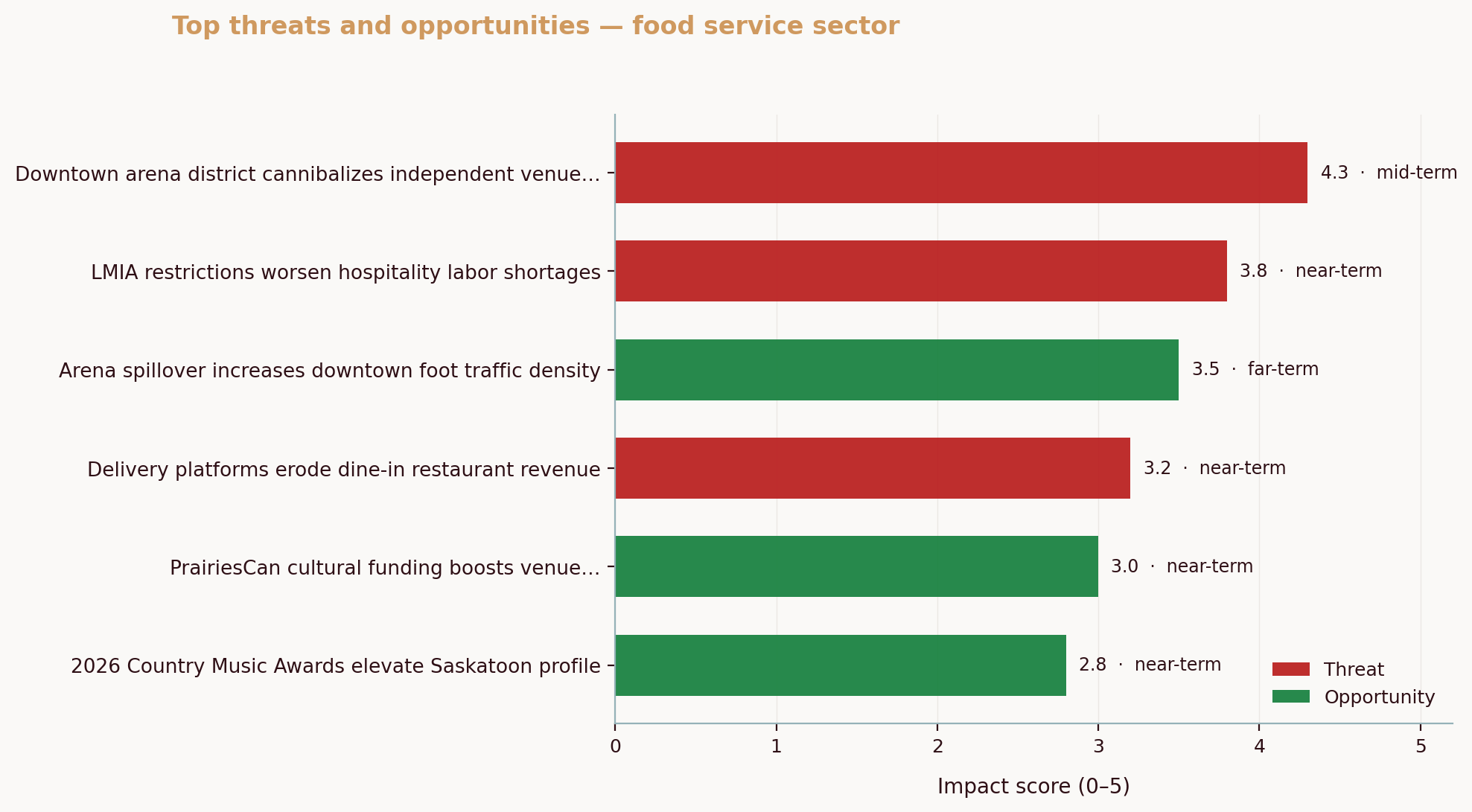
First, market opportunity. If your team consistently turns away profitable work, sees purchase orders dragging into the next quarter, or fields inbound from adjacent regions you can serve without reinvention, that is a real signal. In sectors where visibility is the new battleground, expansion can protect your pipeline. In our analysis of a Saskatoon restaurant and a Calgary custom metal fabricator via the Aurevon Intelligence Service, two patterns stood out: entertainment demand in Saskatchewan is being reshaped by emerging mega-venues and shifting ticket value perceptions in nearby cities, and Calgary’s fabrication market is saturated with near-perfect ratings, moving competition from “quality claims” to content visibility, localized supply, and visible technology adoption. Those forces reward operators who scale the channels that drive discovery and proof, not just the shop floor capacity. (Aurevon Intelligence Service analysis, Canadian food service SMB, April 2026; Canadian manufacturing SMB, March 2026.)
Second, economies of scale. Buying power improves with volume, unit economics can bend in your favour, and overhead can be spread across larger output. But watch the fine print: scale reduces average cost only if your process is standardized, your vendors can match your pace, and your rework ratio does not creep up. Data from the Bank of Canada’s lending series shows interest rates for business-purpose loans hovering around the mid‑4% to 5% range into early 2026. Even “cheap enough” money turns ugly when waste rises, so scale only what you can run cleanly. Source.
Third, enterprise value. Some models, multi-location retail, recurring service providers, specialty manufacturers, can command higher valuations if they show repeatable site rollouts or dependable contract renewal at scale. If you plan to sell in the medium term, disciplined expansion can place you in a different buyer bracket.
Fourth, competitive necessity. When a category consolidates or new entrants land with heavyweight supply chains, staying small can mean getting squeezed on both price and visibility. CFIB’s 2025 survey work on tariffs and trade pressures highlights how costs ripple through pricing and investment in Canadian SMBs. That environment pushes some firms to scale or specialize to avoid margin erosion. Source.
So what does this actually look like? Imagine a Winnipeg specialty foods wholesaler that is running at 85% plant utilization with a 6‑week order backlog and a partner grocer asking for Western Canada coverage. If the company’s quality control is stable, suppliers can lock in ingredients at scale, and fulfilment can expand with a second shift rather than a second facility, expansion is plausible. Before: spot buys, uneven throughput, stale inventory on B‑grade SKUs. After: forward contracts on core inputs, tighter run scheduling, and a simple sales playbook that prioritizes highest-velocity items with regional grocers.
To ground the trade‑offs, here is a side-by-side view.
| Aspect | Expansion Pros | Expansion Cons | Staying Put Pros | Staying Put Cons |
|---|---|---|---|---|
| Market reach | Access to new regions and segments; stronger brand presence | Diluted focus across more channels and geographies | Deep local expertise; easier word-of-mouth | Limited ceiling on demand |
| Cost structure | Potential lower unit costs; better vendor terms | Upfront capex, increased fixed costs | Lean overhead, fewer fixed commitments | Missed bulk discounts |
| Quality and delivery | Capacity to meet big orders; redundancy | Greater coordination risk; rework can rise | Tight control; consistent service | Longer lead times if demand spikes |
| Talent and culture | More career paths, better retention | Managerial layers and communication drag | Close-knit team; simpler training | Fewer advancement options |
| Resilience | Diversified revenue streams | Higher exposure to macro shocks | Lower break-even; faster pivots | Concentration risk if a big client leaves |
One more angle: visibility as a growth driver. In the saturated Calgary fabrication market, near-perfect ratings mean no one wins on “we do great work.” The winners are those who show up first in searches, publish proof of modern capabilities like CNC automation or AI-enabled welding cells, and document short, reliable lead times. Expansion here might mean a content team and a quoting system before a bigger shop floor. Build demand machines before you build square footage. Treat this as practical expansion analysis, not a leap of faith.
Ready to hear the other side of the argument? Staying small may be the sharper move.
Arguments for Staying Put: The Case to Keep It Small
If higher profit per unit of effort matters more than total revenue, staying small can be a feature, not a bug. Three benefits stand out.
Higher margins. Smaller operations can cherry-pick work with the fattest contribution margins and decline the rest. They can price by value, not volume. BDC’s growth guidance warns that many owners add headcount and locations without adding take‑home profit, trading control for chaos. That is a trap staying small helps you avoid. Source.
Less complexity. Every new location, product line, and shift adds handoffs. Handoffs create errors. Errors create refunds. Refunds erase margin. Complexity also multiplies regulatory touchpoints. Remember that CFIB “lost month” to red tape? If you operate in food service, health, construction, or transport, each incremental site adds extra forms, inspections, and training cycles. That time cost is real and rising, which tilts the math toward simplicity for many owners. Source.
Better quality control. A boutique operation can keep craftsmanship high and feedback loops tight. Picture a Victoria bike shop that services high‑end commuters. With two master mechanics and a strict appointment system, turnaround stays under 48 hours, reviews glow, and parts inventory stays tight. Add a second location without duplicating that skilled bench and you risk late repairs and parts obsolescence. Small, sharp, and booked solid often beats big, average, and discounting.
Lifestyle and risk. Your calendar is part of the business model. If expansion means 14‑hour days, a phone that never sleeps, and personal guarantees on new leases, weigh the toll. Some owners explicitly choose a lifestyle business that funds goals without sacrificing time. CFIB’s ongoing “Members’ Opinions” tracking shows enduring concern about taxes, debt, and compliance among owners, a reminder that sleep-at-night matters when choosing your path. Source.
A quick analogy helps: staying small is like running a well-tuned sailboat instead of a cruise ship. You will not carry thousands of passengers. You also will not spend half your time steering around storms you cannot outrun.
If you are leaning toward “keep it small,” remember you still control offensive moves. Sharpen positioning. Refine pricing. Track rivals’ moves without burning budget using practical methods like social listening and offer teardowns. These guides can help: identify your real competitors, run a competitor SWOT, and track competitor pricing and marketing.
With both cases on the table, the question becomes personal: what are you optimizing for?
Decision Framework with Honest Questions: Your Business Growth Decision
A decision this big needs more than gut feel. Use a simple, brutal framework for growth decision making: motive, model, money, and life.
Motive. Are you expanding because demand is real, or because a rival’s press release stung? Write the sentence: “We plan to expand because [specific customer pull] at [expected margin].” If that sentence leans on vanity metrics or vague “brand exposure,” hit pause. CFIB’s 2026 reflection on why firms grow, or do not, notes that “fit” and owner preference often dominate the equation. Growth for its own sake is not a strategy. Source.
Model. What breaks at 2x volume? Map your process from lead to cash and mark the friction points. If quotes already lag, supplier terms are thin, or rework eats 8% of jobs, scaling just multiplies pain. Instead of asking “should I expand my business,” ask “what fails first if we do?” Then either fix that constraint or accept that staying small is prudent.
Money. Can you afford to be wrong? Build a downside case. Use conservative assumptions for ramp time, labour availability, and unit economics. Cross-check against borrowing costs using current benchmarks. The Bank of Canada’s series on lending rates to businesses gives you a neutral yardstick for scenarios. If the low case wipes out two months of reserves, the risk is not priced properly. Source.
Life. Would expansion make your days better, or just busier? Will you shift from craft to coordination work and be okay with that? Will you hire managers you will gladly trust? There is no right answer, only the one that matches why you started the company.
Now turn this into action.
Step 1: 45‑minute whiteboard. Draw two columns: “Expand” and “Stay Small.” Under Expand, list three customer‑pulled opportunities you can price at or above current gross margin within 90 days. Under Stay Small, list three ways to lift profit 10% without new sites: price tests, product mix, service tiers. If you cannot fill the Expand column with real demand, your decision just made itself.
Step 2: Stress-test capacity. Pick your most constrained resource (senior technician hours, machining time, delivery windows). Model a 20% bump in demand. If lead times leap or quality checks fall, fix the constraint before any expansion talk. For practical tools to map competitors and pressure-test positioning, keep these close: identify your real competitors, SWOT your top three rivals.
Step 3: Price the guardrails. Set explicit stop‑loss and go‑forward triggers. For example: “We proceed only if preorders cover 60% of first‑quarter output at target margin.” Or: “We pause if hiring for two key roles exceeds eight weeks.”
One more reality check from proprietary signals: in our analysis of a Vancouver athletic wear retailer’s market footprint (March 2026), dominance in local conversation was eroding from multiple directions at once, new global entrants on key streets, influencer‑led brands pulling share online, and pushback on premium pricing. That pattern argues for precision over size, get sharper on value narrative and assortment before you add square footage. (Aurevon Intelligence Service analysis, Canadian retail SMB, March 2026.)
The good news? You have a third door that many owners skip.
The Third Option: Optimization
You can grow income without getting bigger. Optimization focuses on more revenue per customer, more throughput per hour, and fewer leaks in the bucket. Think of this as business size optimization, not just “do more with less.”
Start with pricing. Test a 3% to 7% increase on your fastest‑moving SKU or most time‑intensive service tier, paired with a clear value upgrade: priority scheduling, extended warranty, or “first look” access to limited runs. Many owners find that well‑framed pricing improvements lift net profit more than chasing new volume.
Tune the product or service mix. Drop the low‑margin, high‑support items. Spotlight the pieces that sell cleanly with minimal handholding. Before: a menu of 45 items with 10 driving 80% of headaches. After: a tight 18-item lineup with clear good‑better‑best tiers and higher attach for add‑ons.
Reduce operational waste. Map your cycle times. Where does work sit idle? One shop’s fix might be as mundane as pre‑kit staging to cut changeovers by 15 minutes. Another might be automated reminders that pull deposits before scheduling field work. See the difference?
Deepen customer relationships. Proactive outreach three weeks before expected repurchase, with a useful checklist, often keeps you top of mind without discounting. If rivals are noisy, quiet consistency wins. Track their claim patterns and promotions with simple, low‑cost methods outlined here: track competitor pricing and marketing.
Do this today: run a same‑day margin audit on your last 20 closed jobs or orders. Highlight the three with the highest gross margin per hour. What did they have in common? Sell more of that.
🔑 Key Takeaway
Optimizing what you already control can deliver faster, safer profit gains than expansion, with fewer moving parts and less existential risk.
Common Questions About Business Expansion
How do I decide whether to expand?
Three filters matter: market demand, financial health, and personal readiness. Demand means you are turning away profitable work or missing clear opportunities that match your strengths. Financial health means cash reserves for at least three months of fixed costs, reliable unit economics, and access to credit at terms your margins can carry, check current lending benchmarks before assuming the cost of money. Personal readiness matters because your role will change from doer to builder as headcount rises. Make sure expansion aligns with your 3‑ to 5‑year goals, not just next quarter’s vanity metrics. For a structured outside view of growth risks and opportunities in Canada, BDC’s research library offers practical planning guidance. Source.
What are the downsides of business growth?
Four repeat offenders show up across industries: misreading demand, underestimating complexity, overextending cash, and neglecting existing customers. Demand errors often come from confusing noise (website traffic, social buzz) with signal (prepaid orders, signed contracts). Complexity spikes when you add locations or products without standardizing process and training. Cash gets tight when ramp takes longer than forecast and borrowing costs are higher than you modeled. Finally, new‑market excitement can pull attention away from core clients who funded your growth in the first place. BDC’s 2025 State of Entrepreneurship report notes owner optimism, but optimism needs guardrails to avoid these traps. Source.
Is it better to grow or stay small?
It depends on your objective. If your aim is resilience across markets and higher total enterprise value, disciplined growth can win. If your goal is high profit per hour and control over quality and time, staying intentionally small can be smarter. Revisit the table above and run a quick expansion analysis against your bottlenecks, then pick the path that matches your values and risk tolerance.
Can a small business be too small?
Yes. Too little capacity can create long lead times, concentration risk with one or two clients, and limited career paths that hurt retention. If you are habitually turning down ideal work or missing must‑have capabilities that buyers expect, you may be under‑scaled. The fix is not always a new location. It might be targeted hiring, process standardization, or selective equipment upgrades that raise throughput. Aim for business size optimization so you can meet demand without unnecessary overhead.
Ready for a lightweight market gut‑check before you make the call? Aurevon’s Ecosystem Dynamics Report distills competitor moves, demand shifts, and channel dynamics so Canadian SMB owners can compare “expand vs optimize” paths with clarity. See how it works and request a sample at https://aurevon.ca/.
Mitchell Ozmun
SMB Researcher, Business Analyst - Saskatchewan Born and Raised