7 Unique Strategies for How to Stand Out From Competitors in 2026
Customers compare you in seconds. Tap. Scroll. Decide. Then they vanish, often without a trace. Roughly seven in ten buyers now expect businesses to understand their needs and expectations, not just sell to them. Miss that expectation and you are indistinguishable in their feed, one more tab to close. That raises a practical question for any small business owner who feels boxed in by look‑alike rivals: how to stand out from competitors when your product looks like everyone else’s? The answer lives in the layers of your customer experience, a form of competitive differentiation, not in shaving another dollar off your price. (salesforce.com)
When competitors offer near‑identical products or services, buyers default to the parts of the experience they can feel. Speed and ease. Frictionless booking. A reply when they ask for help. The comfort of a brand voice that talks like a human, not a policy manual, and a clear brand personality that signals fit. Signals of specialization that tell them, “This is for people like me.” Proof you will fix what goes wrong. And the details almost everyone skips, like thoughtful packaging, onboarding that teaches, and check‑ins after the sale. That is where the edge is hiding. You do not need to invent a new product to claim it. Well known examples across industries show how this plays out in practice. Zappos built loyalty through service differentiation and no‑hassle returns that lowered buyer anxiety. Trader Joe’s turns routine grocery runs into a distinctive store experience through tone, assortment, and staff interactions. WestJet has long leaned on plainspoken communication and moments of care that make travelers feel looked after.
Related: Brand Positioning: Make Your Brand Stand Out (FREE Guide!) — HubSpot Marketing
1) Understanding Market Saturation
Market saturation is what happens when supply swells and real differences shrink. The plumbers all promise “fast, fair, and friendly.” The coffee shops boast “fresh beans, local roasts.” The accountants list the same services, the same software stack, the same “personalized advice.” In saturated categories, buyers can no longer tell the wheat from the straw based on features alone. So they search. Compare. Then negotiate price.
That feels like a trap, because in some ways it is. When choices blur, the brain latches onto the simplest comparison. Price is the simplest. In categories like basic repairs, quick‑serve food, or bookkeeping, buyers assume the base product is fine. Your certificate on the wall or your promise of quality does not change that. If everyone is rated 4.8 stars, star ratings stop signaling anything. Your real competitors become the ones who claim the top of mind and top of search, who respond first, who reduce effort, and who turn the small moments in the journey into reasons to return. If you are asking how to compete when everyone offers the same thing, the short answer is to compete on the experience layers customers can actually feel.
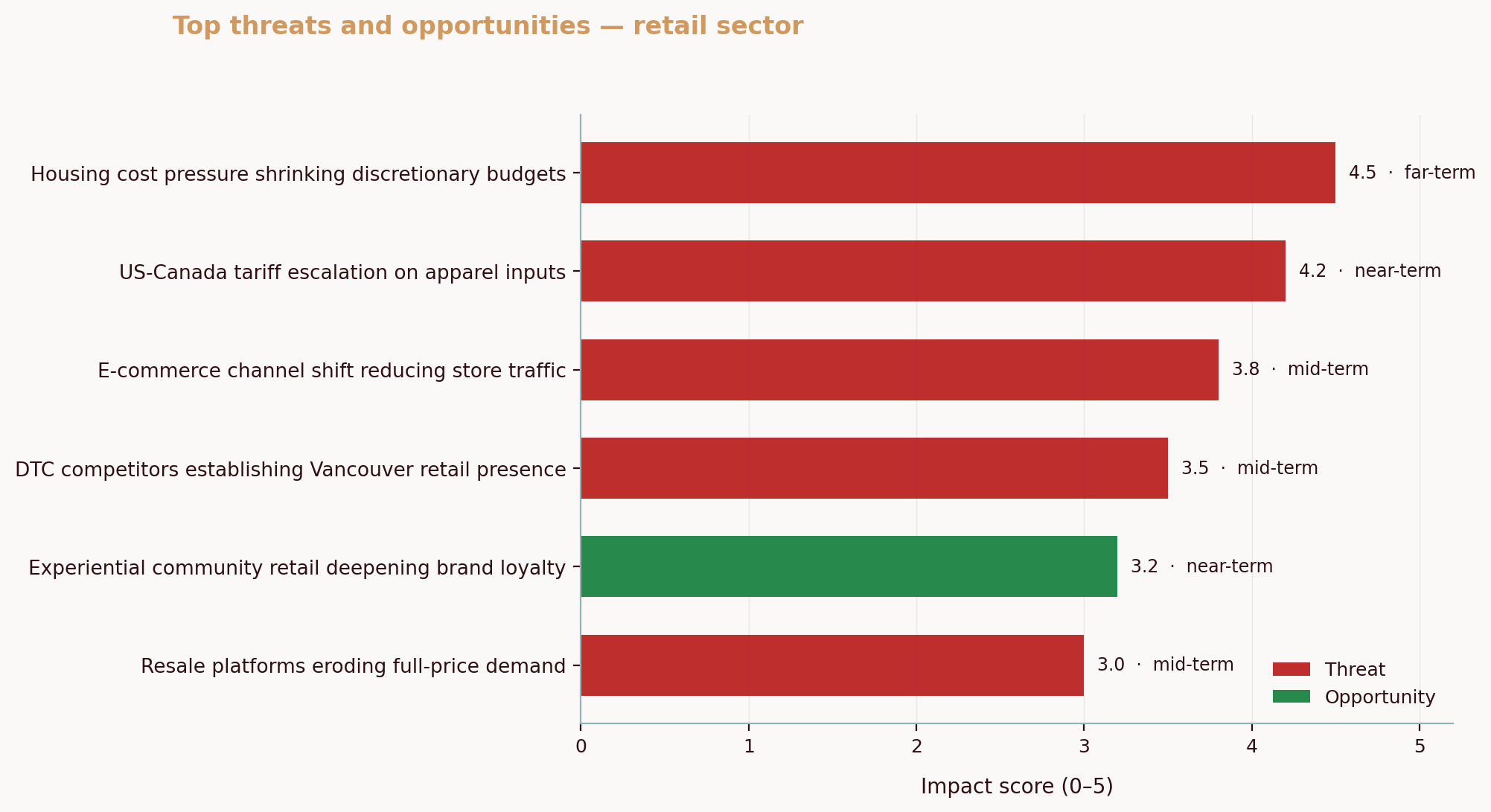
What does this look like in the wild? Across intelligence reports published in March 2026 by the Aurevon Intelligence Service, three Canadian SMB patterns stand out: in Calgary’s custom metal fabrication market, near‑perfect review scores have shifted the battleground away from “quality” toward content visibility, local supply chain proof, and demonstrated tech adoption; in Vancouver’s athletic wear conversation, a once‑dominant retailer’s share of voice is being eroded at the same time by global entrants on key streets and by influencer‑led brands online; and in Saskatoon’s sports‑bar scene, diners now press on three fronts at once (value, food‑safety assurance, and a more compelling atmosphere), putting pressure on any operator that wins on only one dimension. Those are three different industries and three different provinces, yet the pattern is the same: when the core product converges, the battle moves to experience, relevance, and proof.
Saturation also amplifies the importance of locality and fit. McKinsey’s 2025 State of the Consumer report flagged a renewed tilt toward local brands that better match needs in their market, and it urged companies to localize sourcing and decisions where possible. That is not a call for artisanal pricing. It is a nudge to show, not tell, how you align with the way customers live and buy in your region. (mckinsey.com)
There is a second force tightening the vise: consumers are more strained and more selective. Statistics Canada’s time‑series on well‑being shows deteriorating perceptions of quality of life through early 2024, which often translates into more deliberate, lower‑tolerance shopping. When money and time feel tighter, patience for friction collapses. Convenience becomes a promise you either keep or pay for in churn. (www150.statcan.gc.ca)
So the risk is real. Competing on interchangeable features drags you into a race for the cheapest ad click and the lowest price. The path out starts by shifting the question. Stop asking, “How do we convince them our product is better?” Ask, “Where in the journey can we remove effort, add confidence, or create a feeling no one else bothers to create?” If you are unsure who you are really up against for that journey, start with a simple field exercise that maps your customer’s actual choices, not the rivals you worry about. Here is a practical guide to get that right: How to Identify Your Real Competitors (Not Who You Think They Are). If you need a commodity market strategy that does not end in a price spiral, aim for service differentiation and proof rather than lower quotes.
2) The Importance of Customer Experience
Customer experience is not a slogan. It is the sum of interactions that tell a buyer whether you see them and whether you will look after them. It is also the most durable form of service differentiation. That is why experience has become a primary buying factor. PwC’s research reports that 73% of customers cite experience as important in purchase decisions, and they name speed, convenience, and helpful people as the core ingredients. Translate that to a slow checkout, a clumsy return, or a silent inbox, and you can watch your win rate drop with no product change at all. (pwc.com)
When you shift from features to experience, you shift from telling to proving. Consider two coffee shops with the same beans and the same machine. One remembers the regular’s name, offers a 90‑second mobile pickup window, sends a quick “roaster’s note” on Wednesdays, and replaces any off cup with a smile. The other does none of that. Same beans. Different story. People follow stories that reduce effort and raise confidence. Retailers like Trader Joe’s and brands like Zappos remind us that tone, thoughtful policies, and human support can turn routine transactions into loyalty. Airlines such as WestJet show how proactive updates and clear options ease stress during disruptions.
Here is the catch most teams miss: experience is multiplicative, not additive. It works like a chain. The slowest link sets the pace. You can be excellent at product and fail on response time, and the failure wins. That is why it pays to look at journeys, not touchpoints. The journey from first search to first support ticket is where loyalty is built or broken.
Experience also links to trust. Price volatility and surprise fees are not just irritants; they chip away at credibility. Gartner’s 2024 survey found that 80% of consumers view consistent pricing as more trustworthy, while 68% feel taken advantage of by dynamic pricing. That does not mean you cannot use targeted offers, but it does mean the perception of fairness lives inside your pricing behavior. If your promotions feel like a shell game, buyers will protect themselves. Trust falls, and with it, retention. (gartner.com)
Speed and convenience keep racking up proof points as loyalty drivers. The Retail Council of Canada reported in 2024 that half of consumers expect free, fast shipping during the holidays. Deloitte’s 2024 work on Canadian consumer sustainability similarly concluded that companies increasingly compete on speed and ease of delivery, not only on price or quality. If you run an e‑commerce store or a delivery‑heavy service, shaving 24 hours off fulfillment and making tracking transparent can be worth more than a new product line. Fast is a feature you can feel. (retailcouncil.org)
So what does this actually look like day to day? Map one high‑volume journey. Time it. Count the clicks. Identify every hand‑off. Then run a “remove, reduce, reassure” pass. Remove one step the customer should not have to do. Reduce one wait by setting and meeting a short, public SLA. Reassure at one key moment with proactive communication that answers the question before the customer asks it. See the difference?
This is also where smart competitive analysis pays off, not to copy rivals, but to find the gaps they leave. If you do not already track their public moves, this primer will help you do it without new software: How to Track Competitor Pricing and Marketing Without Expensive Tools. Then, to decide which gaps you can credibly own, use a simple SWOT to translate intelligence into moves: How to Do a Competitor SWOT Analysis for Your Small Business.
3) Seven Layers of Differentiation
With the terrain sketched, here are seven experience layers that help a business in a crowded market become unmistakable. You do not need all seven. You need the right few, delivered so consistently that customers can explain them for you.
1) Speed
Speed tells customers you value their time. It starts before checkout. Imagine a home‑service electrician in Mississauga that replies to new inquiries within 10 minutes during business hours, schedules in two clicks, and gives a two‑hour arrival window it actually hits. Before: voicemail, missed callbacks, and a four‑hour “sometime between 8 and 12.” After: instant confirmation, live ETA, and a photo of the tech. The job is the same. The experience is not. A lesson from retail reinforces the point: half of Canadian shoppers now expect free, fast shipping in peak periods, which suggests expectations have shifted across categories that involve delivery or dispatch. Translate that to your category as “cut the waiting, show the progress, and hit the promise.” (retailcouncil.org)
2) Convenience
Convenience is removing effort the customer would rather not spend. Consider a suburban physiotherapy clinic that offers extended hours, direct insurer billing, and a “first‑visit prep text” that gathers intake details the day before. The appointment feels easy. Less paperwork. Less uncertainty. For an online boutique, convenience could mean one‑tap reorders, buy‑now‑pick‑up‑in‑store within one hour, and an exchanges‑first policy that accelerates replacement before refund. Deloitte’s Canadian consumer work emphasizes that speed and convenience of delivery have become a frontline battleground, particularly as shoppers juggle price pressures with time scarcity. (deloitte.com)
3) Communication
Silence is a cost. Clear, proactive updates are a differentiator. A specialty bakery can send a “bake day” text the evening before pickup that shows the loaf, confirms the time window, and includes a quick note on how to store it. A trades contractor can send a morning‑of message with the crew roster and phone number for on‑site lead. Communication also signals respect. It smooths the rough edge on delays because you take customers into your plan, not your apology.
4) Personality
In copy, tone, and choices, a business can feel generic or specific. Personality does not mean jokes. It means a distinct point of view that customers can recognize. Picture an accounting firm in Halifax that writes plain‑English briefs for dental practices, posts quarterly “what CRA changed for clinics” roundups, and uses friendly, direct language in proposals. Or a bike shop that speaks like the Saturday group ride, not like an inventory spreadsheet. Personality is a filter for fit. It pulls the right buyers closer and sifts out the wrong ones. That saves you time. This is where brand personality becomes an asset customers can describe in a single line.
5) Specialization
Niches pay. A small renovation company that focuses on secondary suites and laneway homes in Victoria can build repeatable expertise, trusted vendor relationships, and a library of local permit templates. That tight focus compounds advantages. It also changes marketing from “we do it all” to “we do the one thing you are anxious about.” McKinsey’s 2025 consumer report underscored rising affinity for local fit. Specialization is fit, made visible. (mckinsey.com)
6) Guarantees
A real guarantee transfers risk from the buyer to you. It says, “If this fails, we will fix it, fast.” A Kingston HVAC service can promise heat restored within 24 hours for service‑contract customers or the next month of coverage free. A wedding photographer can guarantee gallery delivery within 14 days or provide 10 extra edits. Guarantees stop the price spiral because they shift the comparison from dollars to confidence. Use concrete terms. Publish them. Keep them.
7) After‑sale Experience
Most operators treat the end of the transaction as the end of the relationship. That is a leak. After‑sale moments are the best place to show care that rivals skip. A boutique fitness studio can send a first‑month “program tune‑up” video review. A landscaping company can drop a seasonal maintenance checklist and a two‑minute “what to watch for” clip. A software shop can run a 30‑day and 90‑day outcomes check, ask two focused questions, and turn patterns into improvements. When you close the loop, customers feel seen. That sticks.
So which layers should you choose? Start with your target market’s friction points and anxieties, not your internal preferences. Restaurants in tight markets need visible food‑safety signals and atmospheres that carry a night out, because value now includes safety and scene. Bars in mid‑market cities face that triple pressure today. Manufacturers with saturated review parity must show operational credibility and localization proof, because buyers are screening for availability and risk, not just claims of quality. Those directional hints match the proprietary Canadian SMB patterns from March 2026 referenced earlier: visibility and tech adoption in metal fabrication, defensive flanks opening around a once‑dominant retailer, and atmosphere plus safety in Saskatoon dining.
Here is a quick cross‑industry view to spark ideas.
| Differentiation Layer | Industry Example | Impact on Loyalty |
|---|---|---|
| Speed | Mobile bike repair with 2‑hour window and live tracking | Reduces no‑shows and increases repeat tune‑ups by creating reliability customers plan around |
| Convenience | Online boutique offering one‑tap reorders and instant exchanges | Cuts support volume and increases second‑purchase rate by making “fixes” effortless |
| Communication | Home renovation crew sending daily photo updates and next‑day plan | Lowers anxiety, reduces scope disputes, and boosts referrals from “kept in the loop” clients |
| Personality | Dental‑focused accounting firm with plain‑language briefs | Attracts ideal clients who value clarity, increasing retention and upsell |
| Specialization | Victoria laneway suite contractor with permit templates | Shortens project timelines and earns premium fees for niche expertise |
| Guarantees | HVAC service with 24‑hour heat‑restore pledge for subscribers | Moves buyer focus from sticker price to risk coverage, raising contract adoption |
| After‑sale Experience | Boutique fitness studio with 30‑day program tune‑up | Converts trial users into regulars by tying progress to guidance after purchase |
💡 Pro Tip
Consistency beats intensity. A slightly faster response time, a slightly clearer update, and a slightly more human voice, delivered every time, will outperform a flashy “surprise and delight” moment that shows up once a quarter and disappears. Choose two or three layers you can keep, then write the promise down where customers can see it.
If you want help choosing, revisit who you are actually competing against in your customer’s head at each step of the journey. The rivals in discovery are often not the same as the rivals at renewal. This walkthrough can sharpen the picture: How to Identify Your Real Competitors (Not Who You Think They Are). To turn those insights into clear strengths and vulnerabilities, refresh your SWOT with real data, not guesses: How to Do a Competitor SWOT Analysis for Your Small Business.
4) The Pitfalls of Price‑Cutting
Dropping price feels like the fastest lever you control. In saturated markets, it is also the most dangerous. Discounts train customers to wait. Frequent markdowns blur your real value until price becomes the only story you tell. Worse, price moves ripple through categories. If rivals match, your margin evaporates without any lasting change in demand. Harvard Business Review’s classic guidance on price wars holds up here: once the spiral starts, profitability collapses and exits are costly. The fight becomes about endurance, not value, which is the wrong game for most small businesses. (hbr.org)
There is a second cost, and it is less obvious. When your pricing feels erratic or opportunistic, trust frays. Gartner’s late‑2024 research showed that 80% of consumers perceive consistent prices as more trustworthy, while 68% feel taken advantage of by dynamic pricing. Trust is the subsidy that keeps customers from shopping you on every purchase. If you burn it, you pay in review skepticism and higher acquisition costs. (gartner.com)
So what do you do instead when a prospect says, “You are more expensive”?
- Shift the frame from price to risk, speed, and effort saved. If you are faster to start and faster to fix, quantify the time value, not just the project cost. Tell a compact before‑and‑after story that spotlights the hidden costs in the “cheaper” path.
Before: three voicemails, a week of waiting, and two reschedules. After: a 10‑minute booking, an on‑time crew, and a same‑day finish. - Turn price pressure into a scope conversation. Create a “good, better, best” that preserves your standards rather than a blunt discount that erodes them. If you must concede, change scope or timeline, not your promise.
- Publish a small number of “always on” value adds that anchor your premium. A next‑business‑day start guarantee for service contracts, a clean handoff checklist, or proactive status updates every 24 hours can be better than a cash rebate because they protect outcomes, not optics.
If you constantly face price pressure, you might be signaling the wrong differentiator. Use a simple competitor tracking habit to spot where rivals are leaning on price versus experience. This quick guide shows how to observe their public moves without buying new software: How to Track Competitor Pricing and Marketing Without Expensive Tools. For anyone wondering how to differentiate without lowering prices, the consistent path is to compete on service differentiation, guarantees, and visible speed rather than on margins.
One last thought on discounts. The occasional, targeted offer to the right segment can open doors. But as a habit, price‑cutting tells a story you do not want to tell. Your price is not the problem. Your proof is.
5) Communicating Value to Customers
Value communication is translation. You translate what you do into what the customer gains, avoids, or feels. In saturated markets, the best translation is specific and short.
Start with objection‑ready messaging. List the three most common hesitations you hear. For each, draft a one‑sentence response that swaps claims for outcomes. If someone says, “You’re higher than the other quote,” your reply should not be an apology. It should explain the parts of your promise they cannot get elsewhere: “We confirm within 10 minutes, we keep a two‑hour arrival window, and we document every step with photos you can share with your insurance provider.” That moves the conversation from price to certainty.
Next, build tiny proof. Screenshots of booking speed. A timer GIF of the two‑minute checkout. A post‑service text thread that shows a resolved issue in five lines. PwC’s ongoing research into customer experience points to speed, convenience, and knowledgeable help as the elements people use to judge value. If those are your strengths, show them directly in your materials rather than hoping buyers will infer them. Customers value more than price. They value saved time, clear updates, fair treatment, and confidence that problems will be fixed quickly. (pwc.com)
Storytelling does not mean a three‑minute brand film. It means telling the right short story at the right moment in the journey. A Saskatoon family restaurant might tell a 40‑word story on the menu about its food‑safety routine, then reinforce it with visible cues at the host stand. A regional retailer contested by global entrants might highlight local sourcing and live store events in geotargeted posts, plugging into the preference for local fit that researchers flagged. The throughline: pick stories that reassure the specific worry in front of the customer.
Finally, make your advantage easy to repeat. If you want word of mouth, give customers a line to use. “They reply in ten minutes.” “They finish on the day they promised.” “They send photos without being asked.” Clear beats clever.
To sharpen this into a habit, run this exercise on a whiteboard or a slide you can print for the team:
- Write three things you already do better than your closest rivals but never talk about.
- Rewrite each as a customer sentence that begins with “You get…”
- Add one tiny proof for each, ideally a timestamp or a visible action customers can see without asking.
Do this today. Then place those lines on your homepage, your quote template, and your appointment confirmation. If you want a structured way to pick which strengths to highlight next, update your SWOT with live competitor inputs: How to Do a Competitor SWOT Analysis for Your Small Business. And if your “real” competitor set still feels fuzzy, circle back here: How to Identify Your Real Competitors (Not Who You Think They Are).
Common Questions About Differentiation
How can I identify my unique differentiation layer?
Start where your customers already reward you. Pull three months of reviews, emails, and support tickets. Circle the words that repeat. Look for what people praise and what they assume as table stakes. If you see “quick,” “kept me updated,” or “easier than expected,” that is a hint you already win on speed, communication, or convenience. Another lens is competitive gaps. Compare the first five minutes of your process to your top three rivals. If you are easier to start with, that is a story worth telling. For categories affected by local preferences, factor geography into your differentiation. McKinsey’s 2025 consumer work suggests localization matters again, so “close to home” proof can be a deciding signal. (mckinsey.com)
Is it possible to implement multiple differentiation layers?
Yes, but stack them with intention. Think of your experience like a relay. If you try to sprint every leg, you will drop the baton. Pick two or three layers that reinforce each other. Speed plus communication is a strong pair for home services. Specialization plus personality is a strong pair for B2B professionals. Guarantees often amplify either pair by moving risk off the customer. The common mistake is scattering effort across seven initiatives that no one can feel. Consistency beats novelty, and small, repeatable promises compound into reputation. That is why half of holiday shoppers expecting fast, free shipping mattered outside of retail. It re‑trained expectations about what “good” looks like. Bring that standard into your category where it fits. (retailcouncil.org)
How do I communicate my differentiation effectively?
Use plain language, short proofs, and tight loops. Replace “industry‑leading” with a timestamped promise. “We confirm every new inquiry in 10 minutes during business hours.” Use customer quotes selectively, but ensure they match the layer you are claiming. If you lead on convenience, publish your “no‑hassle exchange” steps where people decide. If you lead on safety or reliability, show your checklist. And align your pricing behavior with your message. Gartner’s 2024 finding on trust and consistent pricing is a reminder that buyers listen to what you do, not just what you say. If you are wondering what customers value besides price, the reliable answers are speed, convenience, clear communication, fairness, and helpful people. (gartner.com)
What if my competitors start copying my differentiation strategy?
Good competitors copy tactics. Great competitors copy systems. Make yours a system. If you win on speed, write the 10‑minute reply SLA into scheduling, staff to hit it, and measure it daily. If you win on after‑sale care, schedule the 30‑day and 90‑day touchpoints and script the questions. The secret is that most copycats tire out. They launch an initiative; you run a process. Also, keep your ear close to the local market. When you sense a shift, say a new entrant opening two doors down or a vocal influencer moving the conversation, adjust your layers before you are forced to. That is what happens in dynamic city markets where global brands meet entrenched locals. The businesses that hold share are the ones that evolve the experience faster than rivals can imitate it.
[CTA] If you want a structured view of how competitors, channels, and local demand are shifting around your business, Aurevon’s Ecosystem Dynamics Report distills the moving parts into a single, decision‑ready brief. See how it works and what it includes at https://aurevon.ca/ecosystem-dynamics-report/.
Mitchell Ozmun
SMB Researcher, Business Analyst - Saskatchewan Born and Raised