7 Key Steps to Test a New Market in 2026: how to test a new market without overcommitting
The lease is signed. The sign is up. Opening week is crickets. Rent is due. That knot in your stomach? It’s the sound of untested assumptions colliding with reality. Expansion without validation burns cash and time, and it can bruise a brand you’ve spent years building. There’s a better way. Think soft launch and market validation with a minimum viable expansion that proves demand before you scale.
If you’re asking how to test a new market before you bet the business, start small and stack evidence. Geotargeted ads to gauge paid response. A region-specific landing page and preorders. Delivery or mobile service before a storefront. A weekend pop-up with a partner in the area. A temporary sublease while you watch foot traffic and ticket value perceptions. Track purchase behaviour for 90 days, then decide whether to scale for three to six months more. No guesswork. Just controlled experiments that protect your downside.
So the risk is real. What can you do about it?
Related: How to Conduct Market Research for Your Business Idea — Young Entrepreneurs Forum
Treating Market Expansion as a Hypothesis
Every expansion is a hypothesis: “If we offer this product to these customers in that place at this price, then we’ll acquire X customers per month at Y gross margin.” Treat it like any other high-stakes bet. State it clearly, then try to disprove it with the smallest, fastest test you can run. It’s the scientific method applied to growth. A market test is a time-bound experiment that uses small, real transactions to validate demand and unit economics in a specific region.
The cost of skipping this step is steep. Canadian owners are navigating tighter margins and higher operating costs, which raise the price of a wrong move. CFIB’s research shows input costs and insurance premiums have climbed well above long-run averages, with many firms reporting double-digit increases in key policies. When costs are already elevated, an untested expansion magnifies your exposure and ties up working capital you might need for payroll, inventory, or debt service. CFIB analysis on rising operating costs.
Survival data adds urgency. Government snapshots of employer businesses show that openings and closures ebb and flow with macro conditions, and that survival rates differ by size and sector. In other words, even good operators can get whipsawed by timing or local dynamics, which is exactly why you validate locally before you commit. See the federal summary of small business survival and openings/closures for context. Key Small Business Statistics 2024 (ISED).
Real markets move under your feet. In our proprietary intelligence work for Canadian SMBs, the competitive battleground often shifts for reasons you won’t catch in a spreadsheet. Example: in a Calgary custom metal fabrication market, near-perfect online ratings have become table stakes, so visibility, localized supply, and credible tech adoption now decide wins. Source: Aurevon Intelligence Service analysis, Canadian manufacturing SMB, March 2026. What does that tell a risk-averse owner? Focusing on “awareness” alone can be misleading, you need to measure intent and fulfillment capacity in that specific region.
Testing protects you from these shifting sands. It filters enthusiasm through reality: real buyers, real carts, real delivery routes. With that mindset in place, the next step is picking tests that trade dollars for learning at the best possible rate.
Low-Risk Testing Methods Ranked by Cost and Effort
You don’t have to sign a lease to learn whether a market will buy. Start with low-cost signals, then escalate only if the data says so. Below are six methods arranged from cheapest and fastest to costlier, hands-on pilots. Think of them as rungs on a ladder. Climb only when the next step is warranted.
1) Social media and search ads geotargeted to the area
This is your cheapest, quickest read on paid demand. Stand up a region-specific landing page with a clear offer, then run modest ad budgets (for example, $30–$50 per ad set) to isolated postal codes. Use platforms like Google Ads and Facebook Ads for precise geotargeting and audience hypotheses. Use unique promo codes for that city, a phone number with local area code routing, or a “reserve now, pick up later” option to turn interest into intent. This is demand testing, so measure cost per qualified lead, cost per checkout start, and cost per paid order. McKinsey’s research on pilot purgatory is a reminder to define what “good enough to scale” looks like before you start, so you don’t keep tinkering forever without a go/no-go. McKinsey on moving from pilot to scale.
2) Online sales to the region
If your product ships, turn on the channel and limit it to target postal codes. Marketplaces and your e-commerce site can both carry a “now serving [region]” banner and location-based shipping estimates. Shopify makes it easy to spin up a region-specific collection or shipping profile, and marketplaces let you cap exposure while you learn. BDC advises testing new foreign markets online first because marketplaces expose you to demand with minimal fixed cost. The same logic applies interprovincially. BDC on testing new markets via online marketplaces.
3) Partnerships with local businesses
Borrow trust and foot traffic before you buy it. A bakery inside a hardware store. A physical therapist colocated in a community gym. A SaaS firm cross-promoting with a complementary software reseller. Offer a revenue share or fixed fee for shelf or list placement. What you learn: which segments convert, what objections surface on the ground, and whether returns, replacements, or SLAs need local tweaks. When you look at competitors, map them precisely instead of relying on gut feel. This field guide helps you separate real competitors from noise: How to Identify Your Real Competitors (Not Who You Think They Are).
4) Pop-up events and local markets
A weekend presence gets you live conversations and real transaction data without the ongoing burn of a lease. Use pop-ups to test price sensitivity and messaging, collect local reviews, and verify logistics like restocking and staffing. If you need an ultra-lean start, announce a soft launch on community channels and classifieds like Kijiji to attract nearby buyers without heavy ad spend. Beware of “event bias” where festival energy inflates demand. Counteract it by tracking repeat intent: QR codes linking to a region-only offer that expires in 7–14 days.
5) Delivery or mobile service trial
Before you open a permanent location, run a delivery radius or a mobile unit. Restaurants deliver into adjacent neighbourhoods, trades dispatch a small crew to the new zone two days a week, B2B services schedule on-site demos in a tight cluster. This tests route density and service times. It also surfaces hidden costs such as parking, tolls, or client no-shows that are unique to that area.
6) Temporary space or short sublease
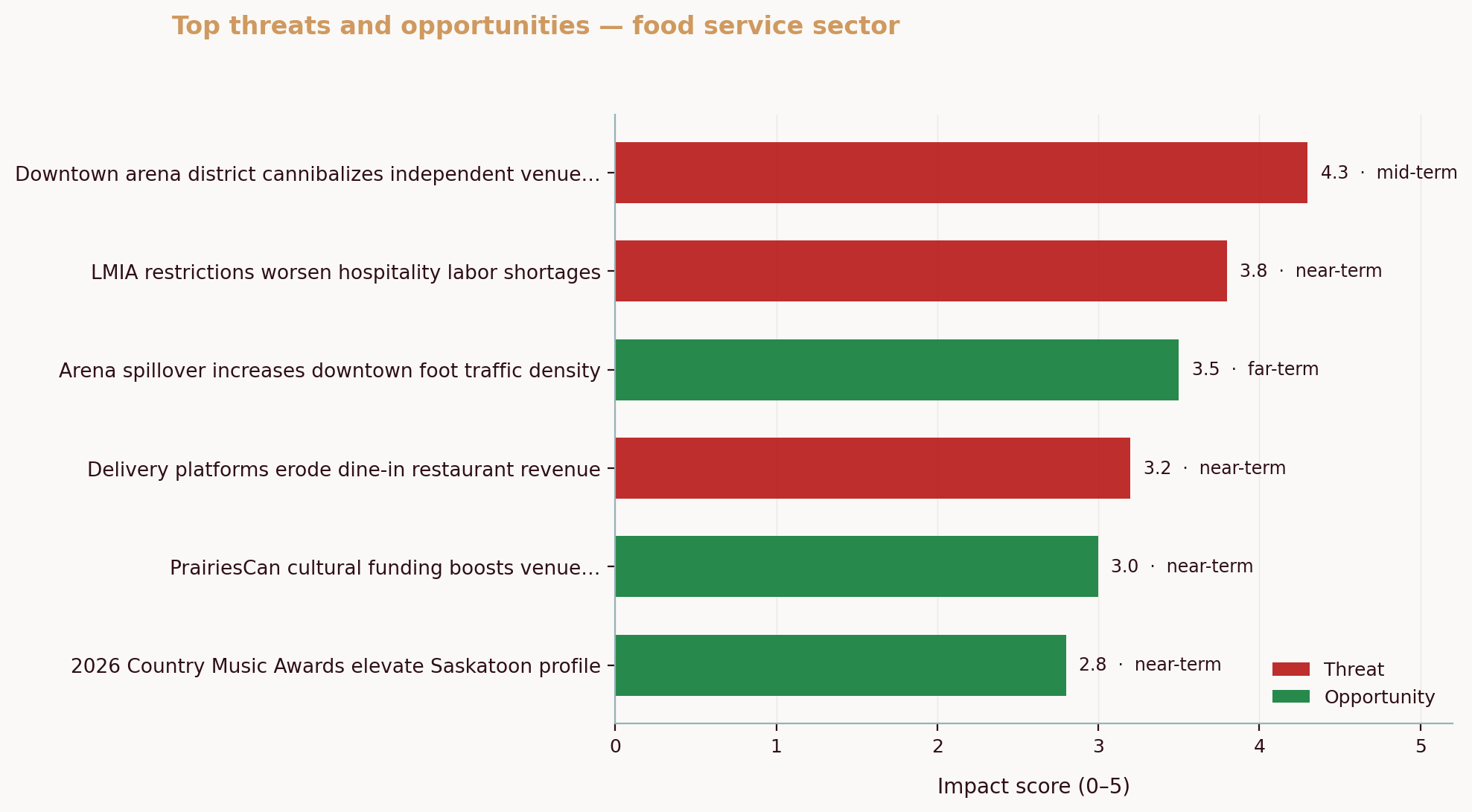
A three-month sublet or a seasonal kiosk gives you foot-traffic reality, comparable ticket values, and operational friction data like staffing, shrink, or after-hours access. In entertainment dining, for example, regional venue projects can reshape demand and value perceptions quickly. In our analysis of a Saskatchewan food service SMB, two forces were most likely to change its position: large-format venue development in a nearby city and consumer frustration with ticket value for paid events. Source: Aurevon Intelligence Service analysis, Canadian food service SMB, April 2026. Translation: run a short-term physical pilot before you commit to a full build-out when venue dynamics are in flux.
Here’s a quick comparison you can screenshot for planning:
| Method | Cost | Effort | Expected Outcome | Notes |
|---|---|---|---|---|
| Geotargeted ads + landing page | $ | Low | Early paid demand signal, lead quality, CPA | Use unique codes and local phone routing to track real intent |
| Online sales to region | $–$$ | Low–Medium | Actual orders, fulfillment times, return rates | Start with limited postal codes and region-specific offers |
| Local partnerships | $–$$ | Medium | Access to warm audiences, cross-sell data | Align on data sharing and revenue split in writing |
| Pop-up events | $$ | Medium | On-the-ground conversion, price tests | Control for event bias with time-bound follow-up offers |
| Delivery/mobile pilot | $$–$$$ | Medium–High | Route density, service SLAs, NPS | Schedule by micro-zones to minimize windshield time |
| Temporary space/sublease | $$$ | High | Footfall, basket size, ops friction | Three months is often enough for pattern detection |
💡 Pro Tip
Start with the lowest-cost test that produces a purchase or a clear buying commitment. This is pilot testing for a minimum viable expansion. Then escalate budget and complexity only if those paid signals survive a tougher test.
If partnerships are part of your plan, keep an eye on how competitors price and promote in the target area so you don’t chase the wrong benchmarks. This walkthrough shows practical ways to monitor rival pricing and campaigns without expensive software: How to Track Competitor Pricing and Marketing Without Expensive Tools.
What to Measure for Success
Likes don’t pay rent. Your testing plan lives or dies on whether you track buying behaviour, not just engagement.
Distinguish three layers of signal:
- Attention metrics: impressions, reach, views. Useful for ad optimization. Weak for market validation.
- Intent metrics: click-through rates, add-to-cart, qualified leads, booked demos, deposits. Stronger, but still not cash in the drawer.
- Revenue and retention metrics: paid orders, gross margin by region, on-time delivery rate, repeat purchase within 30–60 days, refunds. This is the evidence you scale on.
In plain terms, you know there is demand in a new area when intent signals convert into paid orders at unit economics that meet your thresholds. That is demand testing in action.
Set concrete thresholds for each method:
- Geotargeted ads: acceptable cost per checkout start and cost per paid order, plus a minimum number of unique purchasers to avoid flukes.
- Online sales: contribution margin after shipping and returns. Watch return reasons from that region to spot fit issues fast.
- Partnerships: conversion rate from partner traffic, partner-driven customer lifetime value, and cost per partner acquisition.
- Pop-ups: same-day conversion rate, average ticket vs. home market, plus redemption rate of post-event offers.
- Delivery/mobile: jobs per route hour, on-time completion, upsell percentage, net promoter score by zone.
- Temporary space: daily break-even, weekly repeat visitor rate (count unique cards or receipts), and staffing cost per $100 in sales.
A pattern to watch in crowded verticals: vanity signals can mask operational reality. In the Calgary metal fabrication example cited earlier, content visibility and proof of tech adoption now swing deals because review quality is indistinguishable across many shops. If your test only tracks clicks or calls, you’ll miss whether buyers actually award jobs to you at sustainable margins in that region. Measure awarded contracts and on-time delivery, not just inquiries. For a structured way to articulate threats and capabilities you’ll need in the new market, a simple SWOT can force hard tradeoffs: How to Do a Competitor SWOT Analysis for Your Small Business.
One useful analogy: think of engagement as applause and revenue as ticket sales. You can’t book a larger venue based on claps alone.
A 90-Day Testing Framework
Structure turns scattered tests into a decision. Use this 90-day arc to move from digital signals to physical proof, then to a go/hold/stop call.
Month 1: Digital validation
Goal: prove paid demand and early unit economics.
- Build a region-specific landing page with a single call to action. For product businesses, that’s “Buy now, ships to [region].” For services, that’s “Book a paid consult” or “Reserve an on-site demo with a deposit.” Use a local phone number redirect and region-only offer code so attribution is watertight.
- Run small geotargeted ad sets (search and social) across two to three audience hypotheses. Keep budgets modest and isolate variables: one message per ad set, one price per test. If you need to keep costs very low, start with search intent on Google Ads, then layer Facebook Ads retargeting only after you see cart activity.
- Layer in marketplaces or regional shipping on your e-commerce site. As BDC notes, marketplace channels are a low-risk way to test demand before committing to broad expansion, because the fixed cost is minimal and you can cap exposure. BDC on testing new markets online first.
- Scorecard: cost per checkout start, cost per paid order, conversion rate by audience, contribution margin after shipping, and refund rate.
Month 2: Physical presence, still temporary
Goal: pressure-test local operations and pricing.
- Partnerships: place product with one complementary retailer or broker a reseller arrangement for your B2B offer. Negotiate a short pilot with performance gates and a simple data-sharing agreement.
- Pop-up: book one to two weekends. Gather qualitative feedback and quantify it with post-event codes. If your category is affected by venue or retail clustering, be deliberate on location. In our 2026 retail analysis for a Vancouver athletic wear SMB, dominance of the local conversation was eroding due to national entrants on key shopping corridors and price resistance among younger buyers. Source: Aurevon Intelligence Service analysis, Canadian retail SMB, March 2026. Lesson: choose pop-up streets where your target segment actually shops, not where legacy traffic used to be.
- Delivery or mobile service: schedule two service days in the new zone. Route jobs by micro-area to cut drive time, and track on-time completion and job margin.
- Scorecard: jobs per route hour, pop-up ticket vs. home market, partner conversion, and net promoter score by zone.
Month 3: Evaluate, compare, decide
Goal: declare go, hold, or stop based on numbers, not narrative.
- Normalize the data. Remove obvious outliers, such as an ad set that accidentally targeted tourists, or a pop-up day with a street closure. Look for stable signals that persisted across two or more weekends or thousands of ad impressions.
- Compare to your home baseline. If your home market’s new-customer CAC (customer acquisition cost) is $70 and the target region is $95, can better targeting or creative bring it under $80? If the average ticket is 15% lower in the new market, can bundling or tiering fix it?
- Stress-test logistics. Delivery latency, stockouts, returns, and local regulations often kill margin. Check whether your best week in the new market would sustain payroll and rent under a fixed-space scenario.
- Set a funding plan. If you go forward, lock a 90-day runway with weekly checkpoint metrics and a clear “tripwire” rule. McKinsey’s caution about lingering in pilot mode applies across domains, define the conditions that force you to scale or shut it down so you don’t drift. McKinsey on pilot-to-scale pitfalls.
What does this look like in practice? Before: guessing, green-lighting build-outs based on a few excited emails, and calling it “momentum.” After: a ledger of paid orders, show-up rates, partner conversions, and route economics that either clear your thresholds or don’t. See the difference?
If competitive mapping uncovered new players you hadn’t considered, sharpen your list again so Month 3 decisions aren’t blindsided by “invisible” rivals: Identify Your Real Competitors.
Decision Criteria for Moving Forward or Stopping
Write your decision rules in plain language before you test. Then follow them.
Define success in units, not adjectives. For example:
- Go decision (open a permanent presence or scale spend): “We can acquire at least 60 new customers per month in [city] at a blended CAC of $85 or less, with average gross margin per order of 45%, a refund rate under 4%, and delivery within 3 business days. Pop-up to in-store ticket drop is under 10%. Repeat purchase within 60 days is at least 20%.”
- Hold decision (extend testing): “We are within 10–15% of our CAC and margin thresholds, but logistics or partner quality is inconsistent. We will continue delivery and partnerships for another 60–90 days while we optimize routing and negotiate better terms.”
- Stop decision (exit the test): “We cannot profitably acquire customers within 20% of our CAC threshold or sustain on-time delivery without overt strain on working capital. Price sensitivity and repeat intent are materially lower than our home market.”
A few stop-signal examples you shouldn’t ignore:
- Consistent negative contribution margin after shipping or service travel time, even when ads are tuned.
- Partner traffic converts 50% worse than your owned channels, and the partner won’t share basic data to improve the mix.
- Pop-up redemptions are strong but second purchases vanish, which means event ambience is driving sales, not durable demand.
One more check: measure risk against the current cost backdrop. CFIB findings point to higher operating and compliance costs that erode buffer room for trial and error. That means your stop lines should be crisp, and your go lines should include a cushion for cost shocks. CFIB research on small business pressures. For owners eyeing multi-province expansion, federal stats also show that openings and closures move with the cycle, timing your entry against that tide matters. ISED small business statistics.
Common Questions About Testing a New Market
What are the risks of entering a new market without testing?
You lock in fixed costs before you’ve proven demand or unit economics. That exposes you to negative contribution margins, cash burn, and reputational damage if you retreat publicly. The macro backdrop compounds it. Surveys of Canadian SMEs show owners wrestling with higher insurance and input costs, which leaves less room for error. Entering without a test means small mistakes become expensive ones. Running a 90-day pilot with clear thresholds keeps you off that ledge. For context on the current pressure cooker, see CFIB’s analysis of cost headwinds and the federal snapshots of openings and closures. CFIB analysis, ISED small business statistics.
How can I ensure my testing methods are effective?
Three steps. First, define success in advance, in numbers you can’t argue with, such as CAC, margin, on-time delivery, and repeat purchase. Second, design tests that force a buying commitment, not just a like or a signup. Deposits, preorders, and paid demos are better signals than newsletter joins. Third, beware of pilot purgatory. McKinsey’s work across industries shows many organizations stall in pilots because they never decide what level of proof triggers scaling. Put your tripwires on paper and respect them. McKinsey on pilot-to-scale pitfalls.
What if my tests show low interest in the new market?
Treat it as a gift. Low interest can signal a positioning problem, a price mismatch, or a channel issue. Adjust one variable at a time. Try a bundle or entry-level tier if price sensitivity is the issue. Shift channels if you’re invisible where buyers actually look. If two to three iterations still fail to produce paying customers within 20% of your CAC and margin thresholds, stop the expansion and redirect resources to higher-yield bets. You can revisit the idea later when conditions change. If you suspect competitors are shaping perception or pricing in that area, sharpen your landscape view before you try again: Track competitor pricing and marketing.
How long should I test before deciding to expand?
Ninety days is often enough to get both digital and physical signals. Spend Month 1 validating paid demand online, Month 2 running temporary physical pilots, and Month 3 comparing results to your go/hold/stop lines. If you’re within range but need more data, extend for another one to two cycles while you focus on the biggest blockers. For product companies, marketplace tests can continue in parallel so you keep learning at low cost. BDC’s guidance on using marketplaces to test new territory supports this staggered approach. BDC on online-first testing.
Next step for owners who want a concrete push today: pick one target city, spin up a single-region landing page with a unique phone number and offer code, and run $300 of geotargeted search ads this week. If you sell services, add a low-cost paid assessment specific to that region. You’ll know within ten days if you’re getting purchase-grade interest.
At the very end of this road, when you’re ready to formalize what you’ve learned into a market-entry decision, a single report can synthesize competitor moves, demand signals, and likely disruptors in the local ecosystem. If you want that strategic picture without hiring consultants, explore the Ecosystem Dynamics Report.
Mitchell Ozmun
SMB Researcher, Business Analyst - Saskatchewan Born and Raised