5 Data-Driven Steps to Validate Your Business Idea in 2026 — how to validate a business idea
You launch. Crickets. Ad spend burns. Confidence sinks. That’s what skipping validation looks like. The fix is simple in theory, tough in practice: slow down and prove demand first. If you’ve been searching for how to validate a business idea without guesswork, this guide gives you a defensible path you can follow today, with real examples and a scorecard that tells you when to move forward. Think of it as pre‑launch validation and business concept testing that preserves your cash and time.
Most founders don’t fail because they can’t build. They fail because they build for a market that doesn’t exist or won’t pay enough. A structured validation process reduces that risk and turns your conviction into measurable signals. We’ll walk through a five‑step framework you can run in a few weeks: define your customer, size the market with credible data, analyze competitors, test demand in the wild, and talk to customers until your assumptions break or hold.
Related: Use This PROVEN Formula to Validate Your Next Startup Idea — Rob Walling
1) Define Customer
Every strong validation begins with a clear “who.” Demographics tell you who they are on paper (location, income, job title), and psychographics tell you why they buy (goals, anxieties, triggers). You need both. Think of the pairing like latitude and longitude on a map: one alone gets you close; both put you on the exact doorstep. This is idea‑stage research that keeps you honest early.
Start by writing one primary persona and one counter‑persona. The primary persona represents your ideal buyer. The counter‑persona represents a person who looks similar but shouldn’t buy. This contrast forces precision. For a mobile dog grooming idea in Calgary, your primary persona might be “Dual‑income household in NW Calgary, two medium dogs, long work hours, values convenience over price.” Your counter‑persona might be “Retiree with one small dog who enjoys DIY grooming and price hunts.” See the difference?
Pain points should be specific, proximate, and expensive. “Wants cleaner teeth for the dog” is vague. “Hates losing half a Saturday to drive, wait, and pay for grooming” is specific, proximate (weekly), and has an implicit time cost. For a dentist SaaS, “needs analytics” is fuzzy. “Wants to reduce no‑shows by 20% and track hygienist chair utilization” is concrete and priced by impact.
Where do you find raw inputs to shape personas? Use reviews (positive and negative) on Google Maps, Reddit threads in relevant subreddits, and competitor FAQs to mine language. Pull phrases directly into your persona doc so you mirror the customer’s words, not your own abstractions. Then list your top five assumptions about this customer: channel, willingness to pay, switching friction, top‑3 jobs‑to‑be‑done (the outcome they hire your product or service to deliver), and the “deal‑breaker” risk.
Now give each assumption a test method and a kill‑switch. For example, “If fewer than 20% of surveyed dog‑owning households say they’d pay $85+ for mobile grooming, we pause.” Strong founders decide the red line before the data arrives. That discipline protects you from “just one more week” bias.
💡 Pro Tip: Creating detailed customer personas doesn’t just guide validation. It sharpens ad copy, landing pages, and interview scripts, which means you learn faster and waste less money later.
Bridge: You’ve defined who you serve. Next you need to know roughly how many of them exist and how many could reasonably buy.
2) Size Market
Market sizing is where many entrepreneurs drift into fiction. Keep it grounded, repeatable, and sourced. The basic stack looks like this:
- Use Statistics Canada to anchor population, households, and income for your geography. Start with the Census Profile for your CMA or city to pull “private dwellings occupied by usual residents,” which serves as a clean household proxy. For Calgary CMA, that figure is 563,440 households. (www12.statcan.gc.ca)
- Combine that with credible behavior rates to estimate demand. The Canadian Animal Health Institute reported that 60% of Canadian households own at least one cat or dog in 2022. For a top‑line “pet‑owning household” upper bound in Calgary, that’s ~338,000 households (563,440 x 0.60). You’ll refine to dog‑only later. (cahi-icsa.ca)
- For B2B ideas, lean on establishment counts. Innovation, Science and Economic Development Canada lists 17,513 employer establishments for “Offices of dentists” (NAICS 6212) in 2024, which is a crisp proxy for total potential customers for a dentist SaaS. (ised-isde.canada.ca)
So what does this look like when you compare ideas? Use a simple table that blends StatsCan households or ISED establishments with a behavior or adoption rate you can cite. Then label what you’ve calculated (TAM, SAM, or SOM) so you don’t confuse the total universe with your near‑term reachable slice. This is the backbone of startup feasibility, not a pitch flourish.
[Comparison table: market size estimate examples]
| Business Idea | Market Size Estimate | Source |
|---|---|---|
| Calgary mobile dog grooming | Upper‑bound TAM proxy: ~338,000 pet‑owning households (cat or dog). Refine by local dog ownership share and serviceable neighborhoods. | Statistics Canada, Calgary CMA households and CAHI 2022 Pet Population Survey. (www12.statcan.gc.ca) |
| SaaS for Canadian dentists | National TAM proxy: 17,513 employer establishments (dental offices). Segment by clinic size to define SAM. | ISED Canadian Industry Statistics, NAICS 6212. (ised-isde.canada.ca) |
| Saskatoon meal‑prep delivery | SAM proxy: households likely to order at least monthly. If Saskatoon has ~125,100 occupied private dwellings and ~27.4% of Canadians order through platforms monthly, initial SAM ≈ 34,000 households. | Statistics Canada, Saskatoon occupied dwellings and Retail Insider on Dalhousie AAL survey. (www12.statcan.gc.ca) |
Two guardrails keep you honest. First, cite everything. Second, write the formula beside your estimate so you (or an investor) can re‑run it later. If you want a deeper primer on rigorous sizing, bookmark BDC’s step‑by‑step market research resources and return after your first pass. BDC market research guide offers a clean workflow you can adapt. (bdc.ca)
Transition: Now that you know the rough size of the opportunity, you need to learn who else already owns attention and spend in that space.
3) Analyze Competition
A good competitor analysis is not a feature checklist. It’s a map of where customers already find solutions and what they believe is “good enough.” Start with Google Maps for local services (e.g., “dog groomer Calgary NW”) and capture the top 20 within a 5–10 km radius of your target neighborhoods. Record their positioning, pricing signals in photos and posts, hours, and volume/recency of reviews. For SaaS, search category terms plus “Canada,” then switch to LinkedIn Sales Navigator to profile customer logos and team size.
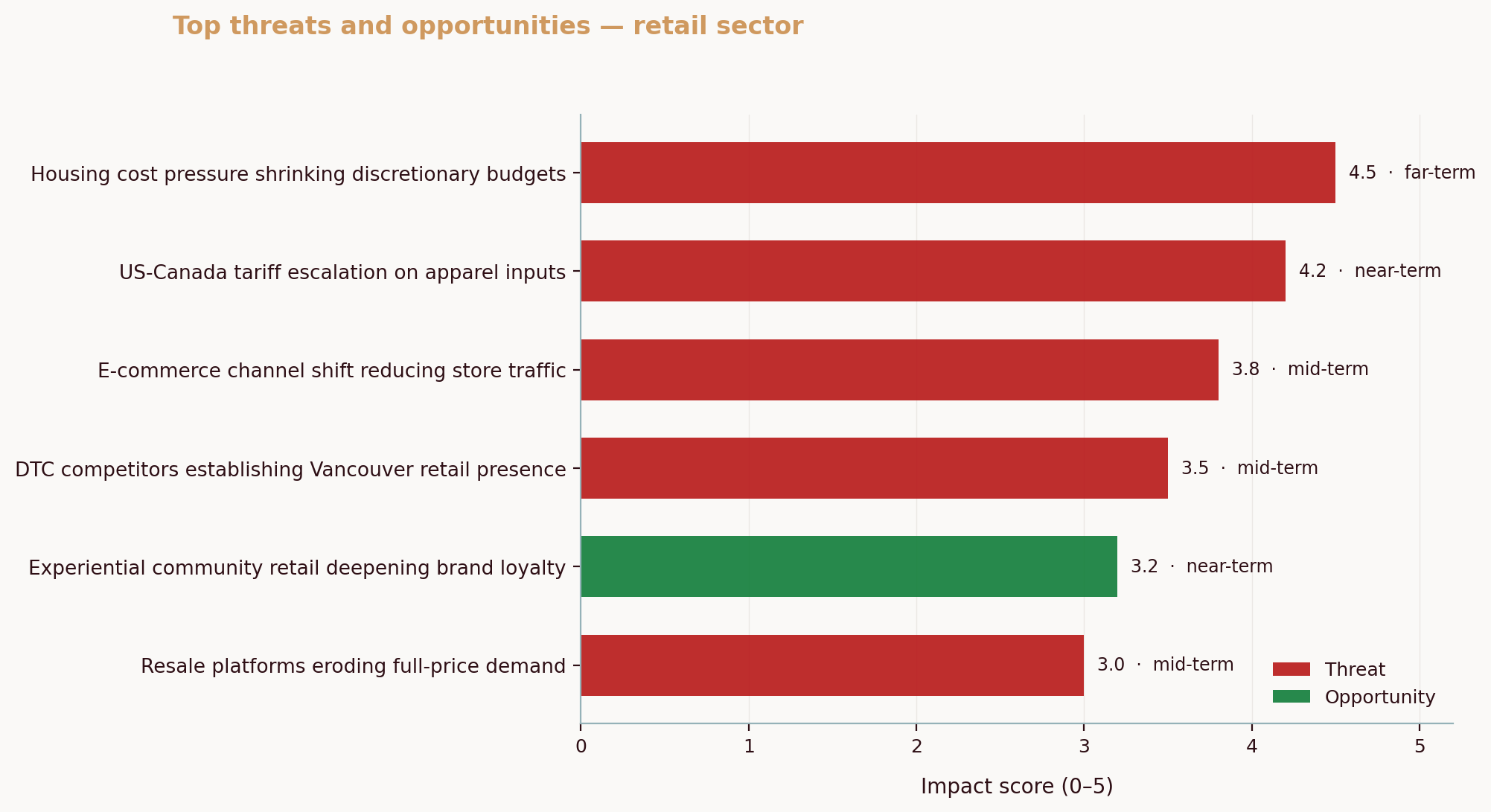
Here’s the pivot many founders miss: when quality ratings cluster near perfect scores, the battleground moves. In the Aurevon Intelligence Service analyses of a Calgary custom metal fabricator (2026‑03), a Vancouver athletic wear retailer (March 2026), and a Saskatoon sports bar (March 2026), we found that saturation and near‑uniform reviews shift competition from “prove quality” to “win visibility, localize supply, and show operational proof,” while hospitality operators feel simultaneous pressure on value, food safety assurance, and atmosphere. Those patterns tell you what to highlight in your tests: visibility drivers for manufacturing and cost/safety/experience trade‑offs for dining.
Your job is to plot density and momentum. Density shows how crowded a radius is. Momentum shows who’s gaining share of voice. If you’re short on time, use a quick “review velocity” metric: reviews in the last 90 days divided by total reviews. It’s not perfect, but it hints at who is acquiring customers now.
Add a working table to keep yourself organized. The numbers below are placeholders to show structure; replace them with your findings.
[Comparison table: competitor density example (illustrative)]
| Competitor Name | Location | Market Share |
|---|---|---|
| Groomer NW Co. | Calgary – Varsity | Illustrative: 18% of top‑10 review share in 5 km radius |
| Clean Paws Mobile | Calgary – Brentwood | Illustrative: 12% of top‑10 review share |
| Bow River Grooming | Calgary – Kensington | Illustrative: 9% of top‑10 review share |
What does this mean for you? If one or two players dominate visibility, differentiation via channel might beat differentiation via features. For example, a dog grooming startup could own “evening and Sunday slots” in two specific postal codes, pair that with before‑and‑after TikTok reels, and price slightly above market to signal reliability. For a dentist SaaS, go narrow on the job‑to‑be‑done: “automated recall + waitlist fill” rather than an all‑in‑one practice OS.
If you need a structured playbook, BDC’s guidance on how to conduct a competitive analysis breaks the work into five clean steps you can complete in a week. (bdc.ca)
Bridge question: Knowing the landscape, how do you prove that real people will click, book, or pay?
4) Test Demand
Testing demand is where your idea stops being a hypothesis and starts accruing evidence. Think of it like sending two salespeople to pitch the same client: your landing page and your price. If either fails, the client says no. Your goal is to design micro‑tests that isolate each. This is market demand validation in action.
Start with search interest to avoid launching into a seasonal slump. Google Trends gives you an “interest over time” index (0–100) you can compare for topics and geographies, which helps you avoid misreading a short‑term spike as durable demand. Use it to check whether “mobile dog grooming Calgary” has steady or lumpy interest across the year, then plan tests in rising periods. The documentation here is a concise primer if you need a refresher. Google Trends overview. (developers.google.com)
Next, spin up a one‑page landing page that states your promise, one or two proof points, and a clear CTA. Keep it ugly and fast. For appointments, measure click‑through to a calendar. For SaaS, measure sign‑ups to a waitlist or a “book a 10‑minute consult.” Buy $50–$150 of geographically targeted search and social ads to bracket initial click‑through rates. Then A/B price anchoring by showing a monthly plan on one variant and a per‑visit price on the other. The point isn’t perfect math. It’s to see where curiosity turns into intent. For consumer products, a lightweight pre‑order test or even drafting a Kickstarter project page in private preview can act as an early signal of interest without committing to a full campaign.
Surveys are helpful when they’re anchored to behavior, not opinions. Ask, “When did you last pay for a groom?” or “How many no‑shows did your clinic have last week?” If the answer is recent and costly, you’re closer to pain. If it’s abstract and distant, keep digging.
Pre‑sales are the gold standard for service businesses. For a local meal‑prep service in Saskatoon, test a limited run: 50 boxes, two menu options, one delivery window. Cap it. Scarcity forces decisions and reveals operational snags before you scale. For a dentist SaaS, offer a 60‑day pilot to five clinics on the condition that each provides weekly metrics and a testimonial if KPIs are met.
A data‑driven aside: the most cited autopsies of failed startups point to “no market need” as the top cause of failure. You’re fighting inertia with evidence. Read CB Insights’ running summary of failure patterns if you need a nudge to test before you build. Why startups fail: top reasons. (cbinsights.com)
Pivot: Tests on screens are only half the story. The other half happens face to face.
5) Talk to Customers
Interviews convert numbers into nuance. Done well, they expose why someone did or didn’t buy, which is the only truth that matters. You’re not looking for compliments. You’re trying to surface frictions, incentives, workarounds, and triggers.
Structure each 25‑minute conversation in three acts:
1) Context. “Walk me through the last time you [booked grooming / scheduled a recall].” You’re anchoring on a real event, not a hypothetical.
2) Decision. “What almost stopped you? What did you compare?” Now you’re mapping friction and alternatives.
3) Willingness to pay. “If I could remove X and Y, what’s that worth monthly? What price would make you hesitate?” Get ranges, not approvals.
Aim for 10–20 interviews per customer segment. Record verbatim quotes (with permission), tag them by theme, and create a “top five objections” list you can target in your next landing page or ad set. For the Calgary dog grooming idea, you might hear: “Evenings only,” “Anxious dog, needs calmer handling,” “No hidden add‑ons,” “Text me when 15 minutes out.” For the dentist SaaS, you might hear: “We can’t add tools that create duplicate data entry,” or “No‑shows spike during school holidays.”
What about bias? Replace “Would you buy this?” with “When would you choose this over your current option?” and “What would make you switch today?” People are poor forecasters of their future behavior, but good narrators of their past.
That brings us to your validation scorecard. Rate your idea 0–1 on each criterion below. Add them up. If you’re at 7 or higher, proceed to a paid pilot. If you’re below 7, adjust and retest. Treat this as a rolling check on startup feasibility.
- Specific persona defined and reachable (channel identified)
- Data‑anchored market sizing (with sources and formulas)
- Clear competitive gap that customers actually care about
- One measurable pain point tied to money or time
- Evidence of demand: ≥2% CTR on ads or ≥10% waitlist conversion
- Early price signal: prospective buyers don’t flinch at anchor
- Pre‑sale or pilot secured (even if small)
- Interview depth: 10–20 real conversations logged and tagged
- Operational feasibility for first 90 days (fulfillment, support)
- One “Do this today” action completed
Do this today: draft a one‑page landing page promise for your idea, buy $50 of ads in one postal code, and recruit five interviews from clicks who didn’t buy. It’s a small loop with a big learning yield.
See how this actually works in practice?
- Calgary dog grooming: Before, owners spent hours driving and waiting. After, a mobile service that texts ETAs, shows transparent pricing, and offers Sunday slots in two neighborhoods gets 12 pre‑orders from 150 clicks.
- Dentist SaaS: Before, a clinic managed recalls with sticky notes and calendar hacks. After, an automated recall + dynamic waitlist fills three hygiene hours per week across a two‑month pilot, converting one of five pilot clinics to paid.
- Saskatoon meal‑prep: Before, vague “healthy dinners” messaging. After, a 3‑meal “back‑to‑rink nights” package targeted at families with kids in hockey converts 30 of 200 landing page visitors, then holds 60% reorder in week two.
One final note on patterns across Canada: our proprietary analyses showed saturated local markets with near‑uniform top ratings shift competition toward visibility, localized supply, and proof of technology adoption (Calgary metal fabrication), while hospitality faces a triple squeeze from value expectations, food safety assurance, and experience design (Saskatoon sports bar). In Vancouver retail, we saw a leader’s conversational share eroded simultaneously by big‑box entrants and influencer‑driven DTC brands amid pushback on premium pricing. Those signals tell you what to test and where to dig first.
Common Questions About Validating a Business Idea
How do I know if my business idea is good?
Look for a tight trio of signals: a specific persona with a costly, recent pain, a simple test that earns clicks or pre‑orders at a price you can sustain, and interviews that confirm why people chose you over their current option. If your scorecard hits 7 or higher and a small paid pilot converts, you’re on the right track.
What are the steps to validate a business idea?
Keep it short and sequential: define a clear customer, size the market with credible sources, analyze competitors to find where you can win, run small demand tests with price signals, then interview buyers to refine or kill assumptions. That sequence is repeatable for pre‑launch validation in most categories.
How do I test a business idea for free?
Use free or near‑free tools and channels: Google Trends to time your category, a simple landing page on a free tier, a waitlist form, relevant subreddit or community feedback threads, and cold outreach to 20 prospects for interviews. If you have a consumer product, a no‑cost draft of a Kickstarter page or a private pre‑order form can serve as early business concept testing. Google Trends overview. (developers.google.com)
What percentage of businesses fail from lack of market research?
There isn’t a single statistic that isolates “lack of market research” as a stand‑alone cause. The closest widely cited proxy is “no market need,” which CB Insights consistently finds to be the top reason for startup failure, typically reported by roughly one third to two fifths of failed startups depending on the cohort. Treat that as a reminder to validate demand early. CB Insights summary. (cbinsights.com)
What are the risks of not validating a business idea?
Skipping validation means you’re flying without instruments. The most common crash is building something for which there’s no market fit, which ends in wasted capital and time. Industry post‑mortems repeatedly identify “no market need” as the primary failure driver, a pattern that hasn’t disappeared even in boom times. A few weeks of structured validation can save years of sunk cost. CB Insights summary. (cbinsights.com)
How long does the validation process take?
Plan on a few focused weeks. In week one, define your personas and pull core data. Week two, build the landing page, run small ad tests, and book interviews. Week three, run five to ten interviews, adjust messaging or price, and, if traction emerges, set up a paid pilot. If your context is complex (e.g., multi‑stakeholder B2B), you may need another cycle, but the cadence remains the same.
Can I validate multiple ideas at once?
You can shortlist options, but run tests sequentially. Parallel tests split attention and blur your signals. Prioritize by expected learnings per dollar and per day. Validate one, then either commit or kill it before moving to the next. That’s how you avoid collecting half‑baked data that proves nothing.
What if my validation results are negative?
That’s a win if you act on it. Negative results tell you which assumptions failed: wrong segment, weak message, painful price, or poor channel. Use your interview notes to pivot the promise or the audience, and rerun a lighter test. If your scorecard still sits below 7 after two cycles, shelve it and free your time for the next idea.
If you want a deeper dive on market sizing mechanics or a repeatable approach to competitive analysis, these references are worth keeping handy: BDC’s practical guide to market research and their five‑step competitive analysis playbook. They pair well with primary data sources like Statistics Canada, Google Trends, and ISED’s establishment counts for a robust validation stack. (bdc.ca)
Final step: pick one assumption from your scorecard, design a test you can run in 72 hours, and run it. Learning beats guessing.
Aurevon’s Ecosystem Dynamics Report turns the kind of data and patterns in this article into action for Canadian SMBs. If you’re ready to pressure‑test your market with current signals on competitors, demand, and local dynamics, explore the Ecosystem Dynamics Report here: https://aurevon.ca.
Mitchell Ozmun
SMB Researcher, Business Analyst - Saskatchewan Born and Raised