When to Expand Your Business: 5 Key Indicators for Growth
Orders stack up. Phones ring off the hook. Your best employee calls in sick, and suddenly your “busy month” turns into missed deliveries, unhappy clients, and refunds you can’t afford. The rush felt like validation, then it felt like a trap. Grow now and you might snap a key process. Wait too long and the window closes.
That window matters. Knowing when to expand your business is the difference between compounding gains and bleeding cash. Expand too early and the operational cracks widen. Expand too late and a better-prepared rival takes the prize. This guide shows the specific expansion signals that mean you’re ready to scale and the red flags that say, “Not yet.” Getting growth timing right comes from business growth readiness, not gut feel.
Related: 5 reasons why people aren't buying from your small business (& actionable steps to increase sales💸) — monica razak
1. Cautionary Tales of Expansion
A Halifax home-renovation firm took on a second crew after a handful of big contracts landed in the same quarter. The owner upgraded tools, leased a larger shop, and hired a site lead who could “figure it out.” The second crew launched during peak season. Then the callbacks started. Materials were double-ordered because no one owned inventory. The site lead made ad hoc decisions that clashed with how estimates were written. When two customers asked for discounts for missed timelines, word spread on local Facebook groups. Cash thinned as warranty fixes ate margins. By winter, the firm was carrying more space than it needed and less trust than it could afford.
Now flip it. A Vancouver e‑commerce brand selling premium athleisure watched carts and newsletter signups jump for months but held off on new SKUs and retail pop-ups until “the economic clouds cleared.” A rival opened a small experience store near a busy transit hub, used pop-up data to refine sizes and fabrics, then locked in a steady stream of TikTok creators. By the time the original brand tried a cautious kiosk, prime foot-traffic slots were booked and influencer mindshare had moved on. The brand kept growing, just not as fast, and not as profitably.
Two patterns stand out. First, growth doesn’t forgive unclear processes, it magnifies them. Adding a second location when your first still runs on tacit knowledge is like installing a second engine on a plane mid-flight. If the controls aren’t standardized, more thrust just creates wobble. Second, demand growth alone is not a strategy. Market windows close, and competitors don’t wait for your perfect timing. Even in periods when firms report fewer capacity constraints nationally, the firm that tests and learns first often defines the category in consumers’ minds. Canada’s Business Outlook Survey for late 2025 shows many companies felt they could meet demand without major bottlenecks, a backdrop where slower movers can still be out-hustled by rivals who experiment earlier. Business Outlook Survey—Q4 2025, Bank of Canada.
So you face a twin risk, misreading readiness or misreading timing. The fix is to separate green lights from red flags, then act with precision.
2. Green Light Signals for Expansion
If you’re asking when to scale a small business responsibly, look for five “go” signals. These are scaling indicators that raise your odds of sustainable growth and reflect real business maturity.
Consistent demand overflow. A real green light isn’t a single viral week. It’s persistent excess demand that your current footprint can’t absorb. Think waitlists you can’t clear for months or a sustained backlog even after overtime and minor process tweaks. Here’s how this actually works in practice, track rolling 12‑week order volume, average lead times, and the percent of inquiries you decline. If you’ve declined at least 10 percent of qualified demand each month for three to six months because of capacity, you’re seeing signal, not noise. The Bank of Canada’s survey data on firms’ ability to meet demand can be a useful macro compass. When most firms say they can meet demand, localized overflow on your side often indicates a real edge that’s worth pressing. Bank of Canada Business Outlook Survey data.
Stable profitability. Expansion needs profits that aren’t fragile. Watch gross margin stability after returns and rework. Monitor contribution margin by product or location, not just company-wide. If a pop-up or pilot channel already matches or beats your core unit economics for two or more quarters, that’s momentum you can bank on. Canada’s small business survival data show that the mix of goods- and service-based firms affects staying power, which is another reason to favor measured proof over optimism. The federal Key Small Business Statistics report highlights that three-year survival rates differ by sector, with goods producers typically holding up better than service firms. If you’re in services, make your margins extra sticky before scaling. Key Small Business Statistics 2024, ISED.
Repeatable systems. If core tasks live in one person’s head, expansion simply multiplies guesswork. Before adding headcount or sites, document how you quote, schedule, buy, fulfill, and follow up. Then test whether someone new can run the playbook without you. An analogy helps, franchising your process inside your own company. If a new team can deliver 90 percent of your core output quality using written SOPs, you’re closer to scale-readiness. Include simple dashboards so your future self can “manage by exception,” not hover over every ticket.
Cash reserves or access to capital. Growth eats working capital. Inventory arrives before revenue. Payroll lands every two weeks. A practical test, model a three-month surge that adds 25 percent more volume. Can you cover the cash gap without starving existing operations? The Business Development Bank of Canada (BDC) points out that rapid top-line spikes can strain receivables and force expensive financing if you’re not prepared, which is why moderating growth to align with cash conversion can be smarter than chasing the biggest spike. Consider whether a conventional line of credit or targeted programs like the Canada Small Business Financing Program (CSBFP) fit your plan and risk profile. BDC on handling fast growth.
Market opportunity aligned with your edge. Expansion isn’t just “more of the same.” It’s “more where our moat matters.” In an analysis via the Aurevon Intelligence Service of a Calgary custom metal fabrication business (March 2026), near-perfect customer review parity across competitors shifted the battleground from quality assurance to three levers, being more visible in buyer searches, anchoring local supply chain commitments, and showing real adoption of shop-floor automation like CNC and welding robotics. In markets like that, the “green light” for growth was not generic demand, it was the ability to prove localized reliability and visible tech capability in bids. See the difference?
One more lens on timing, the business environment. Recent Canadian data show entry rates fell while closure rates rose in 2023, with tighter monetary conditions raising the bar for sloppy expansions. If you still hit your targets in that climate, that’s information. If you only look good when money is easy, that’s a warning. Statistics Canada, Business and employment dynamics 2023–2024.
Bridge to what comes next, green lights don’t eliminate risk. They just tell you you’re likely pushing in the right direction. What can still derail an expansion? The red flags below.
3. Red Flags Indicating Unpreparedness
Cash flow pain you can feel. If you’ve ever delayed a supplier payment to make payroll, you’re not ready to expand capacity. Growth front-loads costs and back-loads cash. A bigger pipeline with slower collections multiplies the gap. BDC’s guidance on fast growth is blunt about this point, high-velocity sales without a plan for receivables can trigger a crunch that halts production at the worst time. BDC on handling fast growth.
Key person dependency. If your best project manager, head baker, or lead stylist is the only one who can “fix” issues, scaling copies their bottleneck. A helpful analogy is sports, it’s like sending two salespeople to pitch the same client. You don’t double the close rate, you create confusion about who leads. Train for redundancy before adding volume. As a quick audit, list five critical decisions in a typical week. If more than three require the same person, your capacity isn’t real.
Unclear processes that rely on heroics. If your scheduling is “whoever’s free,” your purchasing is “text the rep,” and your marketing is “boost the post,” nothing scales. Document one process per week for a month. If documentation reveals disagreements on “the right way,” you’ve found a silent tax on growth. That tax compounds.
Inconsistent quality. Complaints travel faster than ads. When you add a second location or a new channel, variance multiplies. In our Intelligence Service study of a Saskatoon sports-bar concept (March 2026), we saw diners pressing on three fronts at once, value for money, visible food safety, and more compelling atmospheres. Thin margins plus rising expectations create a triple pressure point that punishes sloppy rollouts. If your current location can’t defend quality against that trio, expansion will amplify the gap.
Ego as the prime mover. Wanting a bigger office because a competitor has one is not strategy. Wanting a national footprint because “it’s time” is not a reason. A useful test, write down your decision drivers, then remove anything you can’t tie to measurable demand, stable unit economics, or a clear moat. If most of what’s left is status, press pause.
A quick macro check rounds this out. Since early 2024, more Canadian businesses have been exiting than entering, which raises the stakes of costly mistakes and also opens selective opportunity for those prepared to move surgically. In other words, the environment punishes loose bets and rewards disciplined timing. CFIB, Canada’s Entrepreneurial Drought—Part 1.
With those hazards in view, you need a way to score your readiness that’s sharper than gut feel.
4. Readiness Scorecard
Think of this as your pre-flight checklist. It doesn’t tell you where to fly, it tells you whether the plane is fit to leave the runway. Rate your business on five factors from 1 to 5 where 1 means “rarely true,” 3 means “sometimes true,” and 5 means “reliably true.”
- Consistent demand overflow. Do qualified customers wait because you lack capacity even after productivity tweaks? Are you regularly turning away business?
- Stable profitability. Are your unit economics steady after returns, rework, and discounts, not just on paper but in the bank?
- Repeatable systems. Could a new hire follow your SOPs and hit 90 percent of target quality in 30 days?
- Cash cushion or credit access. Can you fund a 25 percent volume spike for three months without starving operations?
- Market opportunity fit. Does the expansion channel or geography reward your specific edge, not just “more of the market”?
Here’s a simple way to visualize it.
| Factor | Score (1-5) | Interpretation |
|---|---|---|
| Consistent demand overflow | 1–2: Noise or seasonality. 3: Some signal, verify with pilots. 4–5: Sustained backlog, strong candidate for capacity increase. | |
| Stable profitability | 1–2: Margins fragile, postpone. 3: Narrow buffer, fix leakage. 4–5: Resilient unit economics, safe to scale tests. | |
| Repeatable systems | 1–2: Tribal knowledge rules, codify first. 3: Partial SOPs, train for redundancy. 4–5: Playbooks work without founder, green light. | |
| Cash cushion or credit access | 1–2: High risk of crunch, build reserves. 3: Conditional, stage growth. 4–5: Buffer in place, proceed with guardrails. | |
| Market opportunity fit | 1–2: Chasing generic demand, rethink. 3: Some fit, sharpen positioning. 4–5: Clear moat-to-market match, move. |
How to read your total, add the five scores for a maximum of 25.
- 21–25: You’re ready to grow business capacity with staged bets. Draft a 90‑day plan to add one constrained resource and one channel test.
- 16–20: Conditional readiness. Tackle your lowest-scoring factor first, then run a tightly scoped pilot.
- 11–15: Premature. Focus on margins, SOPs, and cash discipline. Re-score in 60 days.
- 5–10: Stay small by design for now. You can still raise prices, prune offerings, and strengthen positioning. This is how leaders decide to grow or stay small with intent rather than drift.
Do this today, schedule a 45‑minute working session this week with your operations lead and finance partner. Score each factor independently, compare gaps, and pick one action to lift the lowest score by one point in the next 30 days. Small lifts compound.
🔑 Key Takeaway
Understanding readiness beats guessing on timing. Use the scorecard to get out of your head and into shared, testable facts. Treat it as a simple system for expansion timing and growth timing.
One last context check you can keep in your back pocket, federal data show sectoral survival patterns differ and that tighter monetary conditions in 2023 raised the cost of mistakes. That explains why green lights tied to durable unit economics and documented processes matter even more right now. ISED KSBS 2024. Statistics Canada business dynamics.
5. Middle Ground Strategies for Growth
You don’t have to jump off a cliff to learn how high you can climb. There’s a middle path that tests expansion without betting the company.
Low-risk pilots. Before signing a second lease, run a month-long pop-up or mobile version of your service. Think of it as a tasting menu rather than opening night. If you’re a service firm, try extended hours two days a week and measure throughput, satisfaction, and staff burnout. Log learnings daily. A successful pilot has two traits, it pays its own way and it generates a playbook you can repeat.
Hiring part-time to manage overflow. A part-time coordinator who owns scheduling, vendor follow-ups, or customer success can unlock surprising capacity. The test is simple, does adding 20 hours a week let you fulfill a meaningful chunk of backlogged demand without spiking error rates? If yes, you’ve found operational leverage without fixed-cost shock.
Add one service that tightens your moat. Pick an adjacent service that improves outcomes for your best customers and increases switching costs. For example, a landscaping firm might add pre-season irrigation audits rather than racing into a second crew. Before, you sell mowing and hope clients stick. After, you lock in spring audits, secure recurring work, and smooth demand. Want help mapping competitors and white space as you consider that add-on? Study how to define the actual players in your category and their capabilities using this field guide to competitive sets, which can prevent chasing the wrong foil. How to Identify Your Real Competitors (Not Who You Think They Are).
Partner to share risk. If you lack foot traffic, collaborate with a complementary business for a co-branded pop-up. A bike shop could partner with a local café for a weekend fitting clinic. You each bring audience, you both learn what converts. Before formalizing, run a fast SWOT on the partner and the joint offer to spot mismatches without paying tuition. Here’s a practical template tailored to small firms. How to Do a Competitor SWOT Analysis for Your Small Business.
Instrument your tests. What does this actually look like? Define three metrics that decide go or no-go, a unit margin threshold, a service-level target like “95 percent on-time,” and a cost-of-acquisition ceiling. Track them in a simple sheet and review weekly. To sense-check price moves and messaging during your pilot, track how rivals adjust their offers. You don’t need pricey software to start, use these simple methods to monitor competitor pricing and promotions. How to Track Competitor Pricing and Marketing Without Expensive Tools.
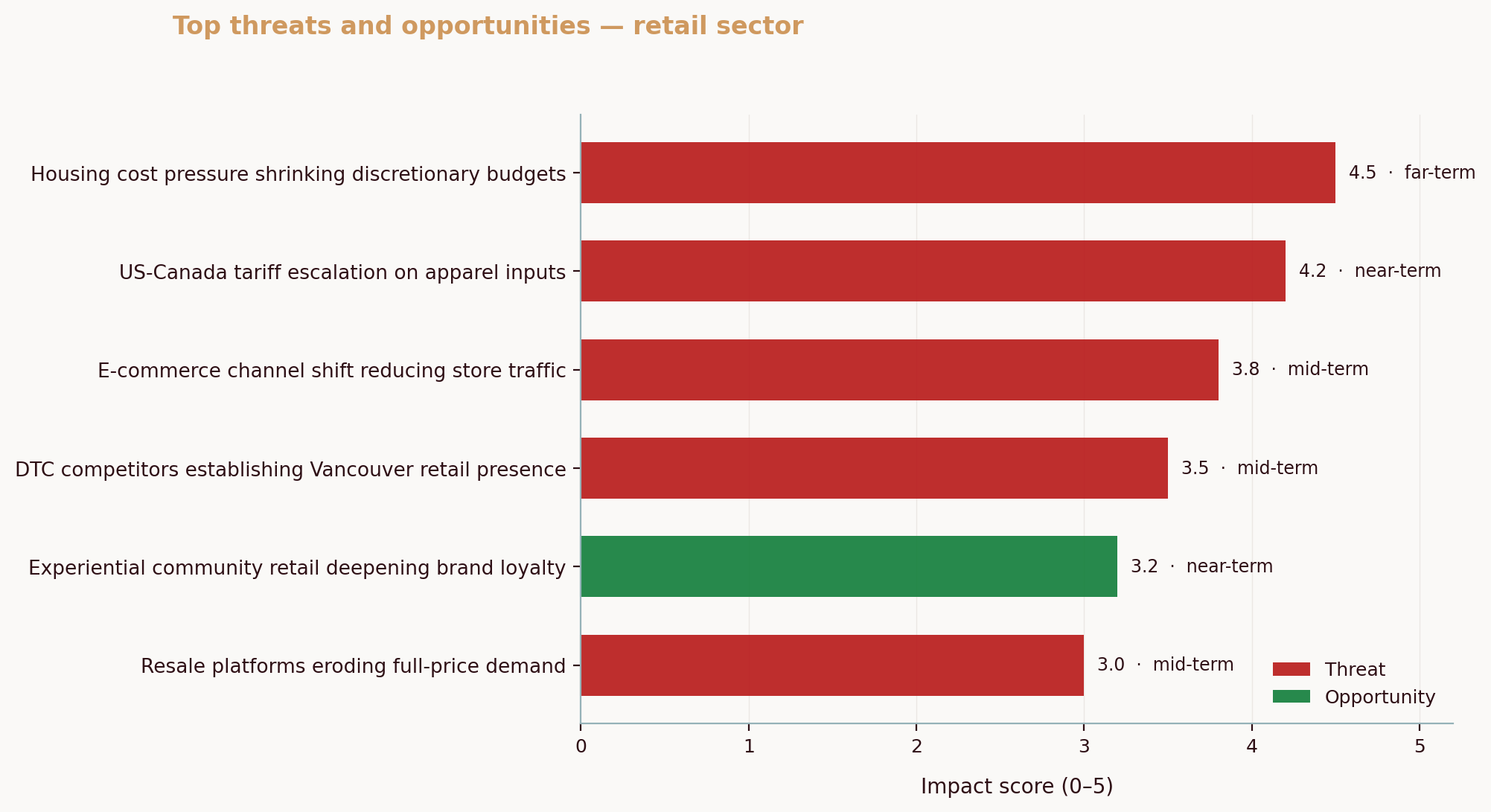
One more proprietary lens on timing, when we analyzed a Vancouver retail player’s share of local social conversation earlier this spring, dominance began to erode from different directions at once, including international entrants opening nearby and influencer-led competition undercutting premium positioning. In markets that move this fast, micro-tests that validate price, channel, and message can be the difference between scaling a strength and subsidizing a weakness. That context, paired with national surveys showing many firms can currently meet demand, supports a thesis of “calibrated sprints” over blind leaps. Bank of Canada BOS data.
If you’ve read this far, you know the stakes. The remaining question is practical, how do you pressure-test your decision before committing?
Common Questions About Expanding Your Business
What are the main indicators that suggest I should expand my business?
Look for persistent demand you can’t satisfy with current capacity, plus steady margins after real-world friction like returns or rework. You’ll also want documented processes that produce reliable quality without the owner making every call, a cash buffer or credit line sized to cover the working-capital surge, and a market opening aligned with your actual edge. These are the practical signs to expand business, the kind you can measure. Recent Canadian data that show different sector survival patterns and tightening conditions are your backdrop, not your destiny. If you can win on these indicators in that climate, you’ve probably earned the right to add capacity. ISED KSBS 2024. Statistics Canada business dynamics.
How can I assess if my business is ready for expansion?
Use the readiness scorecard. Rate five factors from 1 to 5, demand overflow, profitability, repeatability, cash, and market fit. Add your scores. Totals of 21 or more signal strong readiness for a staged rollout, 16–20 suggest a conditional go with one constraint fix first, and anything under that says press pause. Treat it like a pre-flight check. If your lowest score is systems, write one SOP per week and train for redundancy before adding volume. This is a clear approach to answer “How do I know if my business is ready to grow?” and to translate expansion signals into action. Want more context on who you’re really competing with as you weigh market fit? Start here. Identify your real competitors.
What risks should I consider before expanding?
Top risks include cash crunches as inventory and payroll outpace receivables, single points of failure when too much know-how sits with one person, fuzzy processes that turn into inconsistent service, and motivations anchored in ego rather than strategy. The risks of expanding too soon also include quality drift and reputational spillover that make recovery expensive. Remember that since early 2024 more Canadian firms have been exiting than entering, which means mistakes can be costlier but disciplined moves can gain share as rivals stumble. Build guardrails and rehearse your failure modes on paper before you launch a pilot. BDC on fast-growth cash strains. CFIB analysis of entry and exit trends.
Are there low-risk ways to test expansion?
Yes. Run a pop-up or time‑boxed service extension, hire part-time for the most constrained role, or partner with a complementary business for a joint offer. Instrument your tests with three simple metrics and decide in advance what success looks like. It’s the difference between gambling and learning. Need a fast way to sense-check rival pricing and promotions while you test? Use these no-cost approaches. Track competitor pricing and marketing.
Ready to act with evidence rather than instinct? The Ecosystem Dynamics Report can help you validate where demand is compounding, how rivals are actually winning, and which channels reward your edge. Get the details and sample outputs here, Ecosystem Dynamics Report.
Mitchell Ozmun
SMB Researcher, Business Analyst - Saskatchewan Born and Raised