Unlock Growth: A Simple Business Plan for Small Business Owners in 2026
Stop writing plans no one reads. Stop waiting for “perfect” research while competitors steal your lunch. You don’t need a 50-page binder. You need a simple business plan for small business outcomes that fits on one page, delivers business clarity, and drives action. Use it as your small business strategy template for the year.
Here’s the move: answer five questions on a single sheet, then use it as a filter for every decision. Who do you serve? What do you do for them? Why choose you? What are the three priorities this year? How will you measure success? Write it down, review it every quarter, and let it guide your yes/no. That tiny plan becomes a business roadmap your team can carry in their heads, not just their inbox.
Related: Entrepreneurship Made Simple: 4 Easy Ways To Start Your Own Business | Chinkee Tan — Chinkee Tan
Debunking the Myth of Long Business Plans
Many owners assume business planning must be encyclopedic, full of forecasts nobody will revisit. That belief lingers from loan-application checklists and MBA templates. For day-to-day running of a small firm, the opposite is often true: brevity sharpens focus and strategic direction. A one-page plan forces trade-offs, which is exactly what strategy needs.
There’s a hidden cost to long plans: they lock you into a story about the future that feels precise but isn’t. As Roger Martin argued in Harvard Business Review, detailed planning can create the illusion of certainty while dulling the hard choices that make strategy work in the real world. The takeaway isn’t to skip planning, but to plan for clarity and commitment rather than false precision. The Big Lie of Strategic Planning
Why does this matter to you right now? Because small businesses make up the vast majority of employer firms in Canada, which means your rivals are more like you than unlike you. Clarity about customers and priorities separates the owners who move fast from the ones who get stuck polishing documents. (See: Key Small Business Statistics.) Do small businesses need a business plan? Yes, because even a short, one-page plan creates shared direction and measurable accountability without the drag of overplanning. For most owner-managed firms, one page is enough for weekly execution and quarterly review, then you expand only when lenders or partners require detail.
Real examples underline the point. When we analyze Canadian SMBs, the battle rarely hinges on another 20 pages of planning. It’s whether the owner can state, in plain language, who they serve and what they will do in the next 90 days. In March 2026, the Aurevon Intelligence Service found two patterns that reward short, focused plans: in Calgary’s custom metal fabrication scene, near-perfect online ratings push competition toward findability, local supply guarantees, and visible tech adoption; in Saskatoon’s casual dining, customers demand better value, stronger safety signals, and more compelling atmospheres at the same time. Owners who wrote a crisp, one-page plan about those shifts moved faster than those stuck in planning purgatory.
Think of long plans like a travel novel. Inspiring, but heavy in your glove compartment. A one-page plan is a folded field map. It gets dirty, and it gets you where you need to go.
Table: Long Plan vs One-Page Plan (What Helps an SMB More, Most Days)
| Aspect | Long, Formal Plan | One-Page Plan |
|---|---|---|
| Purpose | Satisfy lenders, present full story | Drive daily choices and alignment |
| Speed to update | Slow, infrequent | Fast, quarterly or ad hoc |
| Decision filter | Vague, high-level | Clear, testable yes/no |
| Team adoption | Low (few read it) | High (everyone can recite it) |
| Risk | False precision; shelfware | Misses detail you only need for funding |
With the myth out of the way, let’s put the five questions to work.
Introducing the Five Essential Questions
A concise plan lives and dies by five answers. Each one forces clarity. Together, they create direction.
First: Who are we for? Not “everyone in our city,” but a specific buyer you can picture. If you sell to “homeowners,” break it down. Is it busy dual-income families in older neighborhoods? Condo boards near transit hubs? Your answer steers everything from pricing to channels.
Second: What do we do for them? Use outcomes, not only activities. A landscaping firm that “mows lawns” is a commodity. One that “keeps heritage front yards camera-ready in 20 minutes a week” signals value and speed. Say the job the customer is really hiring you to do.
Third: Why choose us? This is your edge, stated without fluff. The edge might be a guarantee, location advantage, specialty equipment, or a service promise the market actually cares about. If you can’t explain it in a sentence, you don’t have it yet.
Fourth: What are our three priorities this year? Three, not ten. Priorities are bets. They should cut through noise and move the numbers that matter. A good test: if your calendar and budget do not look different next quarter because of a priority, it isn’t a priority.
Fifth: How will we measure success? Pick leading and lagging indicators. A lagging indicator is the result (revenue, profit). A leading indicator is activity that predicts the result (qualified quotes per week, table turns per hour). Keep the list short and visible.
These five questions act like a compass. They won’t tell you each step, but they point you the right way when choices multiply. And choices will multiply. CFIB’s Business Barometer, which tracks small business sentiment each month, shows how expectations swing with costs, labor, and demand. In those swings, owners with a one-page compass steer faster and more calmly. CFIB Business Barometer
So what does this actually look like when you fill it out?
Filling Out Each Section with an Example
Consider a hypothetical landscaping company in Mississauga. The owner runs on instinct, has no written plan, and spends most of each spring saying yes to everything until crews and cash are both strained. Here’s how a one-page plan could change that.
Who are we for? The firm chooses “busy homeowners in mature neighborhoods who want tidy, low-maintenance front yards” as the target. Why that focus? Older blocks have large, established gardens that need consistent care, and the customers value time more than DIY savings. Narrowing the segment also simplifies routing and crew training. Before: “Anyone with grass.” After: “Time-starved homeowners with mature gardens within 6 km of our yard.”
What do we do for them? Instead of “full-service landscaping,” the company states: “We deliver curb-appeal maintenance in under 25 minutes per visit, so clients never have to think about it.” This outcome-based phrasing sets up productized services: weekly trim-and-tidy, monthly bed refresh, seasonal mulch. It also hints at a speed promise that matters to the client and to route density.
Why choose us? The edge becomes a simple combo: a 10-minute arrival window texted the night before, a photo proof after each visit, and a “storm recovery” add-on within 48 hours after severe weather. None of these is fancy. All are visible to the buyer. The company also stops offering one-off hardscape projects that blow up schedules. The edge is ease and reliability, not trying to be everything.
What are our three priorities this year? Here’s a practical set that fits the business and the seasonality:
1) Build two dense routes (Tuesdays and Thursdays) in the same three neighborhoods.
2) Launch the seasonal mulch package and sell it to 30% of weekly clients.
3) Cut average on-site time from 34 minutes to 20 minutes through crew pairing and a revised checklist.
Notice what got cut: patios, backyard redesigns, and citywide marketing. Those may be future bets, but they’re not this year’s focus.
How will we measure success? Keep it brief and balanced:
- Leading indicators: number of quotes issued weekly in the target neighborhoods; percentage of clients on recurring service; average minutes per visit.
- Lagging indicators: monthly route revenue; gross margin per route; churn rate.
Now apply the plan when reality hits. A commercial plaza manager calls in May with a lucrative one-time cleanup across town. It’s tempting. The plan says: if it doesn’t serve our chosen segment, build a route, or boost margins on recurring work, it’s a no. The plaza can become a winter hours lead, but it doesn’t hijack spring.
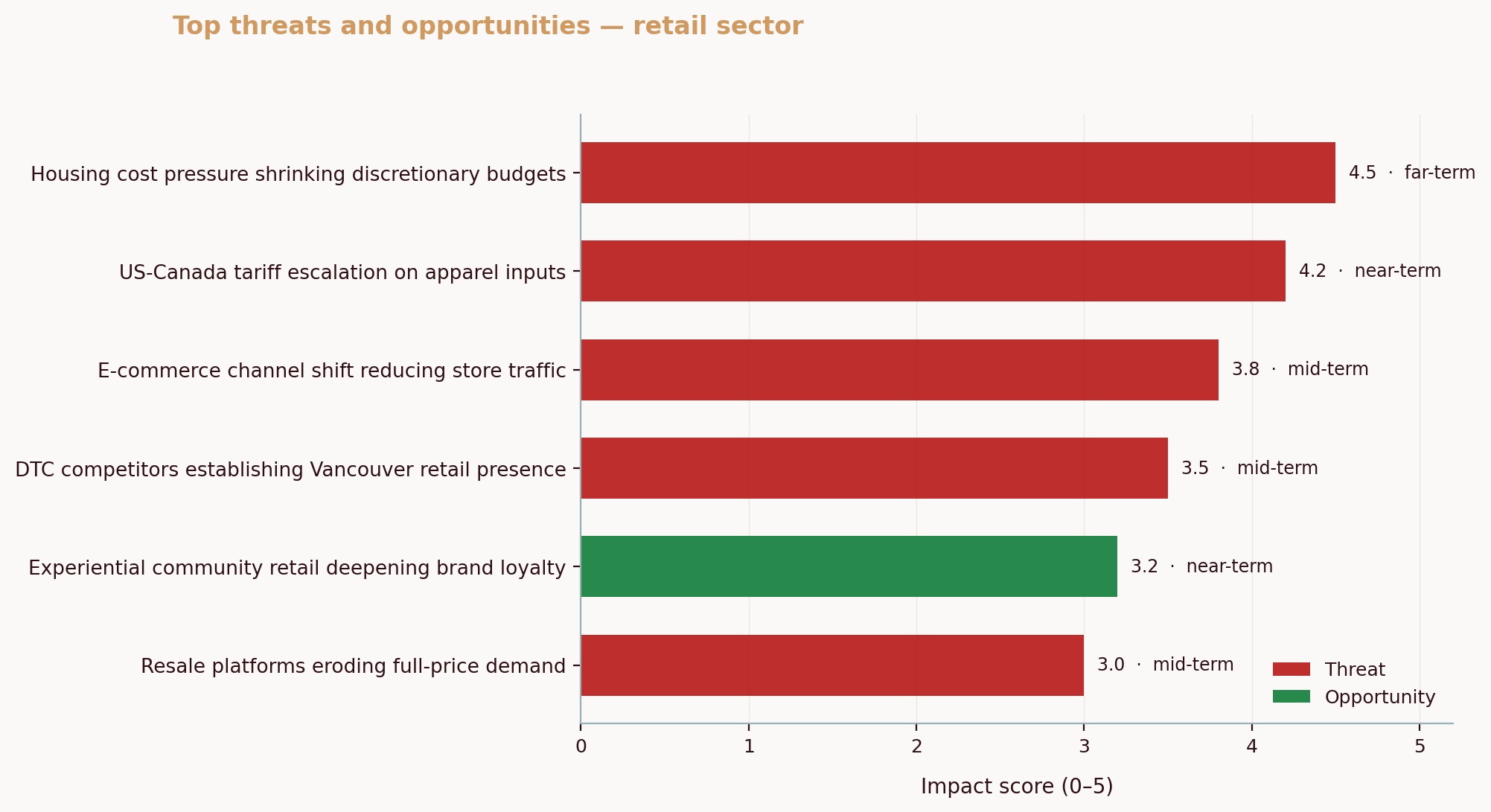
Add market context without overcomplicating the plan. In that March 2026 batch of analyses mentioned earlier, one Vancouver athletic wear retailer sat at roughly 40% of social conversation in the city, but its share was being chipped away by new brick-and-mortar entrants and influencer-led brands pressuring price and novelty. That’s the kind of pressure that can pull a small retailer into chasing every promo channel. A one-page plan keeps the retailer anchored to the few channels and offers that match its edge, instead of sprinting after every trend and burning cash.
Here’s a quick way to write your own answers today, which is how to write a simple business plan without overthinking:
- Block 20 minutes.
- For each question, write one sentence. Not three. One.
- Read it out loud. If a crew lead or front-of-house manager wouldn’t understand it, rewrite it.
- Put the page where you’ll see it daily: on the wall near dispatch, taped inside a cash office cupboard, or pinned in your team chat.
If you want to write a basic business plan, start with these five sentences, then add only the minimum proof or numbers needed to make a decision. See the difference? You’ve moved from a foggy wish list to a focused brief that tells people what to do next.
🔑 Key Takeaway
A one-page plan clarifies purpose, priorities, and proof of progress without drowning you in detail. It becomes a lens for decisions, not a document to admire, and it anchors strategic direction when conditions change.
Table: 90-Day Opportunity Fit Scorecard (Use with Your One-Page Plan)
| Fit Criterion | Question to Ask | Green Light |
|---|---|---|
| Target customer | Does this serve our defined customer segment? | Yes |
| Edge alignment | Does this showcase our “why us” in a visible way? | Yes |
| Resource impact | Can we do it with current crews and tools? | Yes |
| Priority match | Does it advance one of our three annual priorities? | Yes |
| Measurability | Will it move at least one metric we track weekly? | Yes |
If you can’t mark four greens, you probably have a distraction, not an opportunity.
How to Use the Plan Effectively
Writing the plan is step one. Living it is what pays.
Start with a rhythm. Review the plan every quarter on a fixed date. Fifteen minutes is enough if you’re ruthless. Update the three priorities only if the ground has shifted under your feet, not because a shiny object appeared. Treat this as business direction planning, not paperwork. Tie the review to something that already happens, like payroll or month-end.
Make it a team tool, not a leader’s secret. Share the plan with everyone who influences customers: the dispatcher who sets routes, the assistant manager who does scheduling, the person who replies to DMs. Ask each one, “What would you do differently next week because of this plan?” Write down the answers and fold them into your next action list. If your team can’t recite the who/what/why without notes, the plan isn’t simple enough.
Use it to filter. When a supplier pitches a new product line, hold it against the page. Does it help serve your chosen customer better? Does it strengthen your edge? Does it move one of the three priorities? If not, you can decline politely with a reason that aligns your team: “Not this year. It doesn’t advance our top three.”
Plug in light research where it matters. You don’t need a 40-slide market study to sharpen a one-page plan, but you do need to know the few realities that shape your year. Banks and government lenders still expect complete documentation for loans, which is exactly when to prepare a longer plan and detailed cash flow. For daily operations, your one-pager plus a simple dashboard beats a tome you won’t update. How to write a business plan (BDC)
If you like frameworks, pressure test your answers in a Lean Canvas or the Business Model Canvas to surface gaps and assumptions. When lenders or partners need a full narrative, expand those same answers in a planning tool like LivePlan so the long form stays coherent and connected to your one-page plan.
That dynamic explains why those Calgary and Saskatoon patterns mattered so much in March 2026. The Calgary fabricators didn’t need 25 pages about the macroeconomy to act; they needed to state, on one page, “win on discoverability, local suppliers, and tech signals,” then assign owners to each. The Saskatoon bars needed to pick a lane on value, safety proof, and vibe, update menus and floor plans, and measure table turns and spend-per-head weekly. Short plan, fast moves.
Want help sharpening the competitive bits of your page? Use these guides when you’re defining “why us” and “who we’re really up against”: identifying real rivals beyond the obvious is more practical than debating total addressable markets. Start here: How to Identify Your Real Competitors (Not Who You Think They Are), then map strengths with a focused SWOT: Competitor SWOT Analysis for Small Business. To keep tabs on pricing and promos without blowing the budget, try the step-by-step methods in Track Competitor Pricing and Marketing Without Expensive Tools.
Do this today: schedule a 20-minute “plan print” with your leads. Bring your one-page draft, ask where it’s unclear, and agree on the three metrics you’ll look at weekly. Put the next review date on the calendar before you leave the room.
When a Longer Plan is Necessary
A one-page plan is the operating system for most weeks. Sometimes you need more. When you’re asking an outside party for money or sharing risk, detail becomes the price of admission.
Funding and loans. Banks and government-backed programs often require multi-year financial statements, cash flow projections, and sensitivity scenarios. That’s not bureaucracy for its own sake; lenders are assessing repayment risk. This is when you expand your one-pager into a full narrative with supporting schedules, appendices, and market validation. Using the one-page plan as the spine helps keep the long version coherent instead of bloated. See program expectations and lender requirements here: Canada Small Business Financing.
Partnerships and leases. When you negotiate a distribution partnership or a long lease, counterparties will want documented assumptions, responsibilities, and contingencies. Your simple plan becomes a summary in the front of the deal deck, with appendices describing operational processes, service levels, and dispute paths.
Larger bets. If you’re entering a new city, spinning up a second brand, or acquiring a competitor, you’ll need deeper diligence. This is where a market sizing appendix and more robust competitive analysis earn their keep. Keep the one-pager as your north star while you build the larger case.
Think of it like building a house. The one-pager is your sketch that everyone can see from across the room. The long plan is the permit set you file with the city and the bank. Both are valuable in the right moment. Neither replaces the other. And when you’re not chasing capital, operating from the one-pager keeps your crew moving.
Two quick cautions as you expand: don’t reverse-engineer numbers to impress a reader, and don’t bury the three annual priorities under a pile of minor goals. The plan should still tell a story anyone on your team can narrate without notes.
For more context on how SMB conditions shift through the year and why agility matters, check the monthly sentiment and constraint tracking that many owners watch: CFIB Business Barometer. It’s a reminder that your long plan supports big moves, while your short plan keeps the weekly engine humming.
Common Questions About Simple Business Plans
What should be included in a simple business plan?
Keep it to five building blocks, each in plain language. Start with who you serve, which should be specific enough that you can picture real customers by name or street. Then define what you deliver for them in terms of outcomes, not only tasks, because buyers hire results. State your reason to be chosen in one sentence that your newest employee can repeat. Choose three priorities for the year that change your calendar and budget, not just your mood. Finally, name a small set of metrics you will track weekly and monthly to know whether the plan is working. If you need help sharpening competitive clarity while you write, use this field guide on rivals: Identify Your Real Competitors. For length, one page is plenty for operations, and you expand only for funding or formal partnerships.
How often should I update my business plan?
Quarterly works for most small firms because it matches the rhythm of cash cycles, marketing seasons, and hiring waves. A 15-minute review each quarter is enough to validate the three priorities, swap one if something material changed, and confirm the metrics you’re watching still predict results. If you operate in a volatile category where demand shifts faster, run a lightweight monthly check to adjust leading indicators without resetting the full plan. The quarterly cadence aligns with common bank and advisor touchpoints too, so you can speak clearly about direction when asked. For a deeper market pulse to inform those reviews, look at the Canadian Survey on Business Conditions summaries and related releases from Statistics Canada.
Can a one-page business plan help secure funding?
A crisp one-page plan helps you pitch the essence of your business, and it often opens the door. For actual underwriting or due diligence, you’ll almost always need a longer document with full financials, customer evidence, and scenario tests. Treat the one-pager as the executive summary that leads the reader into a more complete package. Banks, government programs, and many private lenders publish checklists that go beyond five answers, covering collateral, cash flow projections, and management profiles. Use the one-pager to keep the long version coherent and readable, not to replace it. See BDC’s guidance on what lenders look for in a formal plan: Write your business plan (BDC).
Is a simple plan suitable for all types of businesses?
For most small companies, yes, because the one-pager governs weekly execution, not external compliance. Service firms, trades, retailers, cafés, micro-manufacturers, even niche software shops benefit from a simple plan that clarifies target buyers, edge, priorities, and metrics. When conditions shift, the short plan is easy to update and share. That said, if you’re entering a regulated field or one with complex capital needs, keep the one-page plan for internal alignment while you prepare the longer documents partners and regulators require. If you’re unsure who you’re really competing with as you write, sharpen that view with a quick SWOT on actual rivals: Competitor SWOT Template and keep a watchlist fresh with low-cost monitoring methods: Track Competitor Pricing and Marketing.
Ready to put your one-pager to work? Draft it now, pin it where your team will see it, and commit to your first 90-day review on the calendar.
Aurevon’s Ecosystem Dynamics Report helps Canadian SMB owners ground those five answers in current market reality without hiring a consultant. If you want competitive signals and local trend summaries you can fold into your one-page plan, see the Ecosystem Dynamics Report at aurevon.ca and decide if it fits your next review.
Mitchell Ozmun
SMB Researcher, Business Analyst - Saskatchewan Born and Raised