How to Analyze Your Business Landscape for 2026 Success (business strengths and weaknesses analysis)
Your phone buzzes. A customer DM about a late order. A competitor’s ad undercuts your price. A staffer calls in sick. Small things, stacked. Margins shrink. Momentum stalls. The fix isn’t another to‑do list. It’s a clear read on what you do best, what drags you down, where the gaps are, and what might hit you next.
That clarity comes from a simple, practical scan of your own shop, a business self‑assessment you can run with your team. List what you reliably do better than rivals (strengths), what customers grumble about or you’ve been avoiding (weaknesses), trends or unmet needs you could credibly serve (opportunities), and outside forces that could cut into your sales (threats). Use this business strengths and weaknesses analysis to get past gut feel. Ask your team, pull your reviews, and hold your operation up against two real competitors. Then decide where to focus for the next 90 days.
Related: 10 Reasons Why Your Small Business Will Fail - and How To Avoid These Tragic Mistakes — Philip VanDusen
1) Understanding the Importance of Business Strengths and Weaknesses
When you know exactly where you’re strong and where you’re exposed, choices get easier. Pricing, hiring, marketing channels, product focus, each pulls from the same root question: what advantage are you leaning on and what liability are you removing? Treat this as an operating habit, not a workshop exercise. Strengths are not trophies; they’re the engines you should fuel. Weaknesses are not failures; they’re friction you can remove.
Consider the stakes in 2026. Small firms make up the vast majority of employer businesses in Canada and employ millions, which means your edge (or lack of one) swings real payroll and real communities. Statistics Canada’s latest counts show more than a million employer businesses in the country, with the smallest firms dominating by number. That scale cuts both ways: crowded markets reward clarity and punish drift. Canadian business counts and recent small‑business briefs from StatsCan underscore how expectations and operating conditions shift quarter to quarter. Industry Canada (now Innovation, Science and Economic Development Canada) adds policy context that affects day‑to‑day operations, so keep an eye on updates alongside StatsCan releases. If you aren’t adjusting your plan to your own strengths and gaps, you’re planning against a moving target. Analysis on small businesses in Canada
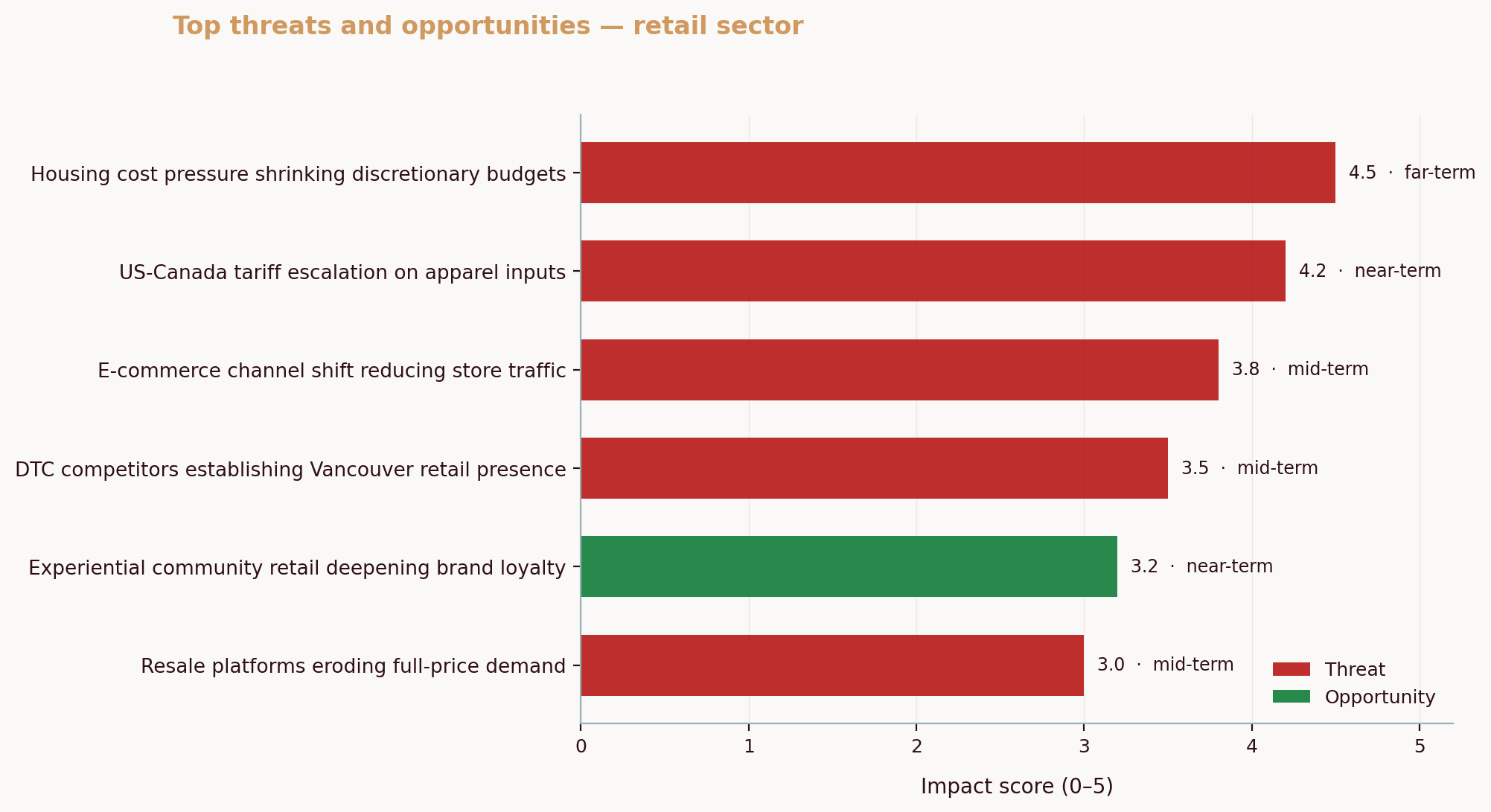
Real‑world implications are showing up in the field. In two recent Canadian SMB intelligence analyses via the Aurevon Intelligence Service, a Calgary custom metal fabricator faced a market flooded with near‑perfect review scores, which pushed differentiation toward content visibility, localized supply chains, and visible tech adoption. A Vancouver athletic‑wear retailer dominated social chatter but saw share eaten at once by big‑box entrants on Robson and Metrotown and by influencer‑fueled upstarts squeezing premium pricing. Translation: when quality converges, advantage shifts; when attention fragments, pricing power fades.
External conditions add pressure. Credit conditions have been tight and uncertain, and while major forecasters expect some easing, financing for smaller firms remains sensitive to policy moves and risk appetite. The OECD’s 2026 overview of SME financing notes that policy rates eased in several economies through 2025, yet conditions stayed uneven for entrepreneurs. If your margins rely on cheap capital or forgiving vendors, that’s a threat you need to name. OECD: Financing SMEs and Entrepreneurs 2026
So what does this mean for you? Strengths and weaknesses are not labels; they’re levers and alarms. Knowing them shapes everyday decisions: which product to push this month, which process to fix first, which customer segment to stop chasing. With that in mind, let’s start by isolating your strengths.
Bridge to action: If you can name your top two strengths without peeking at your data, you might be guessing. Let’s ground it.
2) Identifying Your Business Strengths
Start with the wins you can prove. A strength is a repeatable advantage that matters to customers and is hard for rivals to copy quickly. Think less “we care” and more “we deliver X outcome faster, cheaper, or with fewer headaches.” It might be a prime location with walk‑in traffic, a service with zero returns over six months, or a team that consistently turns quotes around in under two hours. Ask: would a customer pay more, wait longer, or drive farther for this? If the answer is yes, you’re close to a real edge.
An example helps. Imagine a neighbourhood bakery. Orders spike on weekends because your sourdough stays fresh longer than the shop down the block. Regulars recommend your cheese buns in local Facebook groups. The owner of a nearby café buys your croissants wholesale because “ours don’t hold up by noon.” Those are signals. If you also find that catering inquiries are increasing from offices on payday Fridays, you’re seeing the beginning of an adjacent strength: reliable, office‑friendly items.
How do you gather proof without a research department? Read your last 50 reviews and tag the words that repeat. Collect the top 10 support tickets you resolved in under an hour. Export sales by SKU or service line and look for what carries gross margin, not just volume. Interview five repeat customers and have one rule: ask them what you do better than their other options and where you’re simply “fine.” Cross‑check your claims against competitors’ public promises and actual execution. This is where a simple competitor scan (locations, pricing, stockouts, response times) earns its keep. If you need a primer on finding the right comparison set, this playbook helps: identify your real competitors.
Here’s a quick filter I use in practice: does the “strength” show up in behaviour, not just words? A strength customers act on beats praise they forget. If you want to formalize this, treat it like a light strength analysis that looks for evidence in repeat purchases, speed, quality, and referrals.
Strength or noise? A fast comparison
| What you see | Likely a strength | Probably just noise |
|---|---|---|
| Repeat business at full price | Yes, customers value it | Maybe not, if driven by lack of alternatives |
| Customers drive past rivals for you | Yes, behavioural proof | No, if it’s only convenience that week |
| Prospects cite you during competitor calls | Yes, you set the bar | Not if it’s from a one‑off promo |
| Shorter delivery cycles month after month | Yes, operational edge | Not if due to seasonality only |
Methods matter because bias creeps in fast. Owners tend to overrate “friendliness” and underrate cycle times, defect rates, and on‑time delivery. Your team sees the workarounds you’ve normalized. Customers feel the friction you’ve tuned out. Bring all three into the room, and you’ll start to see the pattern.
🔑 Key Takeaway
Focus on your unique value propositions to stand out in the marketplace. Make them measurable, test them against real customer behaviour, and double down where you win for reasons that matter.
Transition question: You’ve named two or three strengths that pass the behaviour test. What about the hard part, the weak spots that drain margin and patience?
3) Recognizing Your Business Weaknesses
Weaknesses are the recurring issues that cost you sales, reputation, or time. They show up as avoidable refunds, late deliveries, confusing pricing, or staff turnover in a single role. The key is to treat them like leaks in a roof. Left alone, a slow drip ruins the floorboards. Fixed early, it’s a small patch and a dry house.
Start with your own avoidance list. What do you delay? In small businesses, avoidance is data. If you’ve postponed updating your website “until after busy season” for three seasons, that’s a signal. If your bakery still has no online ordering because “phone works fine,” you’re not in the same game as the shop that just nailed corporate lunch delivery. If your repair shop quotes “I’ll text you later” instead of using a simple estimate template, you look less reliable than you are. Multiply by a hundred interactions and it becomes a reputation.
Common pitfalls show up across sectors. Owners over‑index on new leads while neglecting response speed to existing customers. Teams accept “that’s just how our POS works” and keep double‑entering data. Managers treat social media mentions as fluff and miss the early warnings that demand is shifting. Industry data backs the pressure to pay attention: Canadian small business optimism improved late in 2025 but remained cautious heading into 2026, reflecting tight margins and sensitivity to costs. That mood affects purchasing, staffing, and risk tolerance, which in turn exposes operational gaps you might otherwise ignore. CFIB Business Barometer update
How to surface the truth without blame? Make it safe to say what’s broken. Gather anonymous input from frontline staff. Ask three blunt questions: where do we make customers wait, where do we make employees wait, and what do we redo twice a week? Pull a month of refunds and returns, and tag the causes. Compare your last 30 lost deals and highlight the reasons that appear more than twice. Then, talk to your least satisfied customers. If they complained about packaging, pickup windows, or unclear warranties, that’s gold. Fix those before you chase the next big marketing idea. This is practical weakness identification, not a blame session.
The impact is direct. A Saskatoon sports bar facing value‑seeking diners, higher safety expectations, and demand for better atmospheres will see foot traffic shift to rooms that meet all three. That triple pressure means menu engineering, cleanliness cues, and vibe upgrades aren’t “nice to have.” They’re the difference between families choosing you or the tavern down the street.
Bridge from pain to potential: Once you’ve named your leaks, the question becomes how to turn the fixes into fuel. That’s where opportunities live.
4) Leveraging Strengths and Addressing Weaknesses for Opportunities
Opportunities aren’t always “new markets.” Often, they’re the obvious moves you finally make at full speed. The trick is to use strengths as springboards and weaknesses as guides. A bakery with loyal regulars and durable pastries can add office catering on weekday mornings, because the product already travels well and the customer base already advocates. A repair shop with fast diagnostics but clunky estimates can build a “2‑hour answer or $20 credit” promise and automate estimates, turning a weakness into a hook. A retailer with strong in‑store conversion but weak digital presence can film five 30‑second product demos a week and repost them where the local conversation actually happens.
Spotting the openings takes pattern‑recognition more than spreadsheets. Ask three tests of any opportunity: does it multiply a proven strength, does it neutralize a costly weakness, and does it align with a real customer signal? If the answer is yes twice and maybe once, pilot it. If you need structure, a starter matrix keeps you honest. Treat it as lightweight opportunity mapping you can revisit each quarter.
Quick planning grid: five prompt questions per quadrant
| Strengths: ask yourself… | Weaknesses: ask yourself… | Opportunities: ask yourself… | Threats: ask yourself… |
|---|---|---|---|
| What do customers drive past others to get from us? | Where do we make customers or staff wait? | Which adjacent use‑case are customers already hinting at? | Which external changes would shrink demand for our core offer? |
| Which offers carry the highest gross margin and lowest complaint rate? | What are the top three refund or redo causes? | What would make switching to us a no‑brainer for our best prospect? | What new entrant, technology, or policy could undercut our advantage? |
| What processes consistently beat competitor timelines? | Where do quality issues recur even after “fixes”? | Which cross‑sell solves a current customer problem this month? | What supply, cost, or credit shocks would we struggle to absorb? |
| What channels bring in customers who return within 60 days? | What tasks do we repeatedly defer? | Which partnerships would unlock distribution we lack? | What dependency (single vendor, landlord, platform) is brittle? |
| Which teams or people consistently exceed targets? | What information do customers always call to clarify? | What would we try if we had to double revenue from one product line in 90 days? | What’s the single point of failure in our operations? |
So what does this actually look like? A before and after makes it real.
| Scenario | Before | After |
|---|---|---|
| Bakery with loyal regulars | Weekend lineups, no online ordering, corporate inquiries ignored | 48‑hour catering menu with per‑person pricing, order form live, delivery within 5 km before 10 a.m. |
| HVAC service with fast diagnostics | Technicians great on site, quotes sent “later,” low close rate | Instant quote from a standard menu, “2‑hour quote promise,” SMS approvals, close rate up |
| Retailer with strong in‑store sales | Social mentions rising, website thin, rivals out‑spending on ads | 5 video demos weekly, staff “fit check” posts, store pickup same day, local search share up |
If you’re wondering where to begin, choose one of each: the single strength to double down on and the single weakness to fix in the next 90 days. Put dates and owners on both. Today’s move: book a 45‑minute session with your team and fill the grid above. End with two commitments only: one strength you’ll amplify now, one weakness you’ll eliminate now. See the difference?
To gauge whether your opportunity is defensible, study who you’re really up against and how they position. This field guide helps you name the true comparison set, not the comfortable one: identify your real competitors. And if you want a light intro to competitor quadrants without the jargon, use this primer: competitor analysis template for small business.
Pivot to risk: Growth moves work best when they’re protected. That means scanning for outside hits you don’t control.
5) Identifying External Threats to Your Business
Threats live outside your four walls, but they land on your P&L. New entrants, bigger brands moving into your street, platform policy changes, rising insurance or energy costs, supply constraints, and shifting consumer sentiment can change the math overnight. Think of it like running two salespeople to the same client. One is your growth plan. The other is the market, pitching reasons your plan won’t work. You need to listen to both.
Competition is the obvious one. In crowded categories, review scores and “quality” can converge. That pushes the battle to where your rivals are loudest or more visible, and to proof that your operation uses modern tools customers trust. In an Alberta metalworking cluster with near‑perfect public ratings, shops that win are getting found more, showing local supply chains, and signaling tech maturity (for example, CNC and robotics). If you act like a ghost, you become one.
Consumer pushback on price is another. In retail, Canada’s 2025‑2026 cycle featured fresh entrants and fast‑moving influence channels that punished “premium just because.” If your brand took share in local chatter last year, expect attacks from three sides: international chains opening nearby, niche DTC players hyped by creators, and tired customers questioning why your hoodie costs more. The counter isn’t to cut price blindly. It’s to define where your value lives, then earn attention where your customers already are.
Macroeconomic and policy shifts belong on your threat list too. After a period of elevated policy rates, forecasters expect uneven easing and lingering cost pressure, with SMEs still feeling financing constraints more sharply than large firms. That’s not a forecast to fear; it’s a prompt to shore up cash conversion cycles and vendor terms. The OECD’s latest scan of SME financing conditions points to gradual easing but tight spreads for riskier borrowers. If your model assumes fast, cheap credit, revisit it now. OECD: Financing SMEs and Entrepreneurs 2026
Regulatory and administrative burdens also chew through small firm capacity. Member surveys and policy reviews consistently show paperwork hours and compliance costs pressing on hiring and expansion decisions. When owners feel stretched, they delay the experiments that could drive growth. That’s a strategic threat, not just an annoyance. Keeping your scope tight, building reusable checklists, and scheduling one process cleanup per month are small acts that create room for offense. For context on shifting owner sentiment and priorities into 2026, check these snapshots from the field. CFIB Your Voice survey series
Many threats telegraph themselves in competitor moves long before they hit your sales. Track store openings, ad themes, discounts, and hiring spikes without buying fancy tools: public job postings, Google Business Profiles, inbox promos, and Google Trends are a rich feed. This walkthrough shows how to pull that intelligence week by week: track competitor pricing and marketing. Treat this as an ongoing competitive assessment, not a one‑off task.
One more framing: threats are only “external” until they land. Assign an owner for each serious risk and a trigger that prompts a response. Example triggers: “If a chain signs a lease within 1 km,” “If our primary supplier’s lead time moves from 4 to 7 days,” or “If our ads fall below a 2% click‑through for two weeks.” When the trigger fires, you act, not debate.
Bridge to clarity: You’ve mapped strengths, named weaknesses, turned two into opportunities, and flagged your top three outside hits. Questions remain. Good ones.
Answering Your Business Strengths and Weaknesses Questions
How often should I conduct a strengths and weaknesses analysis?
Quarterly works for most small firms. A lot can change in 90 days: competitor pricing, your top‑line mix, staff availability, even the platforms your customers use. A quarterly rhythm gives you enough time to test a fix or double down on a strength, then see if it moved the needle. It also lines up with common financial reviews, so you can connect the dots between what you thought was a strength and what actually produced margin. Business conditions have been shifting quickly the last two years, which is why many owner surveys and economic snapshots are now published monthly or quarterly. Align your operating cadence with that reality. BDC State of Entrepreneurship 2025
What if my team doesn’t agree on our weaknesses?
That disagreement is a clue, not a problem. Create a fast, low‑stakes way to capture input from different roles. Start with an anonymous form that asks three questions: where do we make customers wait, where do we make teammates wait, and what do we redo? Then hold a 30‑minute session to group the answers by theme. Use data to break ties: refunds by cause, average response times, return reasons, late deliveries by route. If debate lingers, pilot two fixes for two weeks and measure the result. The team that sees an error rate fall or a five‑star review climb will align quickly.
Can strengths and weaknesses change over time?
Absolutely. A strength can fade when competitors copy it, when customer expectations rise, or when technology moves. A weakness can vanish after one focused fix. That’s why treating this as a living practice matters. In retail, for example, a brand that once owned attention might find itself out‑shouted by global chains and influencer‑backed labels within a single season. In manufacturing, when everyone’s public ratings cluster at the top, the battleground moves to visibility, supply chain proof, and tech signals customers trust. Shifts like these are common and predictable cycles, which argues for your own quarterly check‑in.
How can I prioritize which weakness to address first?
Use a simple two‑axis filter: customer pain and cash impact. Pick the weakness that, if fixed, reduces complaints or time‑to‑delivery right away and improves margin within one quarter. That might be online ordering for a food business, a faster quote workflow for a trades firm, or clearer pricing tiers for a service shop. If you’re stuck between two, choose the one that unlocks an opportunity from your strengths. For instance, if your fastest‑selling product line has repeat issues with packaging, fix packaging first so you can launch a bundled offer next month.
What is a SWOT analysis in simple terms?
It is a structured look at four lists you already understand: strengths (what you do better), weaknesses (what slows you down), opportunities (where you can credibly expand or improve), and threats (outside forces that could hurt results). Keep it practical and evidence based. One page, four boxes, three bullet points each is enough for a useful reset.
What business opportunities should I look for?
Start with the ones your customers are already hinting at. Look for adjacent use cases with repeat demand, bundles that raise average order value, and distribution partnerships that move your best sellers faster. Use search data to validate interest in your region, even a quick scan of Google Trends can confirm whether attention is rising or falling for your category.
Final nudge: Name your one strength to amplify and one weakness to fix this quarter on a sticky note. Put dates beside both. Then act.
Aurevon’s Ecosystem Dynamics Report distills the kind of market and competitor patterns you just mapped into a clear, Canada‑focused brief you can act on in 90 days. If you want a deeper scan without hiring consultants, learn more at aurevon.ca.
Mitchell Ozmun
SMB Researcher, Business Analyst - Saskatchewan Born and Raised