How Small Businesses Use Data to Beat Bigger Competitors
The rush hits at 8:05 a.m. Your café sits across from a global chain. Their app chimes. Your line stalls. A regular glances at the clock, then walks across the street. Lost ticket. Lost habit. That’s the fear. Yet it’s also the opening: when small business beat bigger competitors by reading local signals faster, acting on them today, and turning community trust into a compounding edge.
You don’t need a national budget to outmaneuver a national brand. You need tight loops between what your neighborhood is doing and what you do next. Three data levers tip the field: faster action on local insights, richer feedback from real relationships, and hyper-local knowledge large chains struggle to copy at scale. Use them together, and you compete with big business on your terms.
Related: How Small Business Can Beat the Larger Competition - 10 Winning Strategies for Success — Philip VanDusen
The Competitive Landscape for Small Businesses
Competing with giants is not optional. National chains set category expectations on price, convenience, and hours. They pour money into brand awareness and benefits programs that can soak up casual demand. In Canada, small and medium‑sized enterprises carry most private‑sector employment, which means the contest is everywhere, on every main street. That scale of participation also means the upside from a better playbook is huge. Government data shows SMEs account for the majority of private‑sector jobs, underscoring how local competitive outcomes directly affect paycheques in each community. Key Small Business Statistics 2024 and its companion tables detail that weight. When you win a block, the economy feels it. When you lose it, your city does too. PDF summary. This is the small vs large business competition that plays out on your block every day.
What does this mean for you? Data matters not because it produces perfect forecasts, but because it shortens the distance between an observed shift and a useful response. Think of data as traction. At street level, traction beats horsepower.
The pressure is real. Canadian business owners report persistent cost and demand swings, yet the opportunity side is expanding. New entrants and a rebound in self‑employment mean more variety in local offerings, more testing, more niches becoming viable. That’s a crowded field, but also a field with room to move if you can read it early. BDC’s 2026 study on self‑employment’s rebound frames the moment: entrepreneurship is rising, and with it the rewards to fast learning.
A useful first step is to clarify who you’re really up against on each mission—breakfast coffee, weekday fitness, last‑minute gifts—since your “true” competitors often differ by daypart or occasion. If you haven’t done that recently, run this exercise: identify your real competitors before you try to beat them.
Comparison matters, so let’s make it concrete.
| Where Size Helps Corporations | Where Smaller Firms Have the Edge |
|---|---|
| National ad buying and loyalty budgets | Granular local data, block‑by‑block |
| Supplier power and unit costs | Faster decisions without committees |
| Brand familiarity | Community trust and word‑of‑mouth proximity |
Data-Driven Strategies for Competitive Advantage
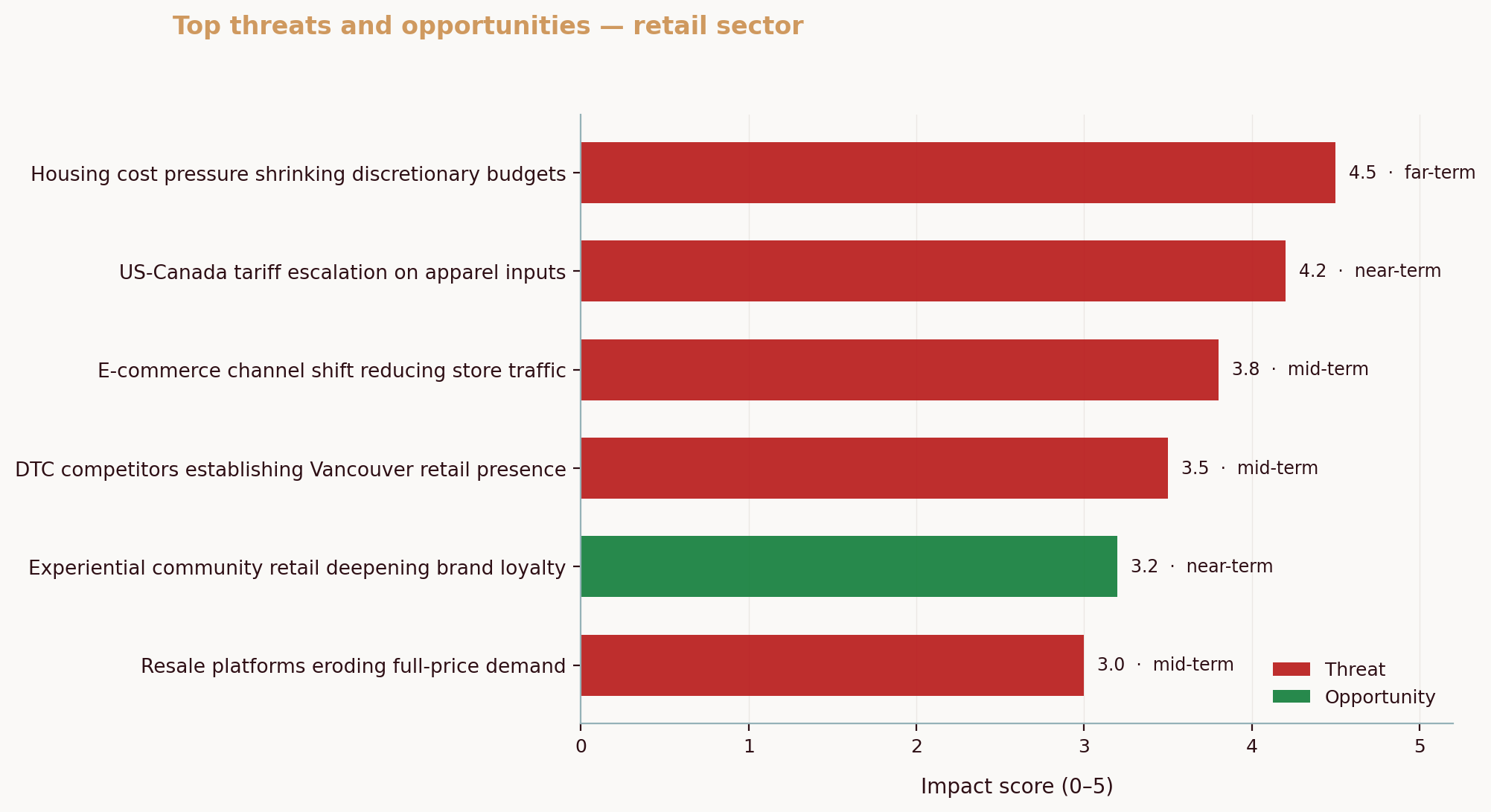
Hyper‑local intelligence is your radar and your hyper‑local advantage. Instead of tracking category trends in the abstract, monitor what’s shifting within a 10‑minute walk or drive: footfall near your door by hour, weather‑linked demand, school calendars, nearby construction, and recurring community events that change traffic patterns. For example, across multiple Canadian SMB intelligence reports we ran via the Aurevon Intelligence Service, two patterns stand out. In Calgary’s custom metal fabrication scene, review scores are so uniformly high that the real battleground isn’t “quality” but being found first, with clear proof of technology adoption and local supply chain reliability (AI welding, CNC automation, Alberta policy ties). In Vancouver athletic wear retail, a previously dominant local player saw its share of social conversation slip as JD Sports and Decathlon grabbed foot traffic while influencer‑led brands like Vuori and Alo shaped premium perceptions and pricing pushback. Translation: in saturated review landscapes, your findability and proof‑points become the leverage; in fast‑moving fashion districts, conversation share and price narratives shift weekly.
Speed of response converts radar into wins. A nimble café that sees office occupancy spike on Tuesdays can staff up and push pre‑order slots that morning. A studio gym that notices rainy‑day bookings drop can turn on a “bring‑a‑friend for free tonight” message by noon. The edge is not tools. It’s the clock. Smaller teams can decide at 10 a.m. and ship at 10:30. That is an agile business strategy expressed in minutes, not months.
Customer proximity multiplies your data. Chains collect huge volumes, but most of it is thin and national. You collect fewer points, but they’re dense: first names, true preferences, context about why someone churned or came back. Treat those details like a private dataset and design micro‑tests from them: one‑week trials on a new pastry time slot, a 14‑day class format experiment, a 90‑minute late‑opening pilot after a concert at the arena. See the difference?
Niche depth beats category breadth. A chain optimizes for the average. You can become the best for a narrow use case: the pre‑hike espresso stop with trail maps by the register, the powerlifting‑forward gym with calibrated plates and chalk, the boutique that stocks Canadian‑made technical layers in odd sizes. Think of niche depth like sending two salespeople to pitch the same client: the generalist smiles; the specialist answers the question before it’s asked. This is how niche market dominance begins, one sharply defined use case at a time.
Community trust lowers your customer acquisition cost. When your Facebook group says your kitchen swapped in a safer supplier after a recall and your GM replies by name, the reassurance spreads. This is not brand sentiment; it is permission to try your next offer.
🔑 Key Takeaway
Use local signals to make one practical change this week. Then measure it. Data doesn’t need to be big to be decisive.
Today’s action: list five hyper‑local signals you can track without buying anything (foot traffic at three times of day, top five search queries in Google Search Console, sentiment on ten recent reviews, weather vs. sales, nearby event calendar). Pick one hypothesis and test it for seven days. For more structure on sizing rivals and gaps, borrow from a competitor SWOT for small business and a low‑cost playbook to track competitor pricing and marketing.
Real-World Success Stories: Small vs. Large
Consider these composite case studies, built from public market behaviours and Canadian SMB patterning.
Local coffee shop vs. Starbucks. A neighbourhood café beside a chain analyzed pass‑by counts and weekday order mix. Tuesdays and Wednesdays showed higher office return, but mobile pre‑orders lagged. The owner mapped heat on review keywords and learned that “fast pickup” and “seasonal” drove shares in the area, while “points” mentions clustered to the chain. They ran two data‑led moves: a 7:30–9:30 a.m. express pickup shelf with a visible timer, and a seasonal rotation sourced from a nearby farmer’s market, amplified on local Instagram geo‑tags. Before: long waits and regulars defecting on busy mornings. After: average morning ticket up 11%, churned regulars returning twice a week, and UGC with the café’s geotag doubling in four weeks. Conversation share beat corporate convenience because “fast here, seasonal here” felt personal and was easy to copy daily.
Independent gym vs. GoodLife. A downtown studio faced aggressive presales from a new big‑box location. They scraped public class listings and compared nearby workplaces’ hybrid schedules. Noon slots under‑performed; 6 a.m. and 6 p.m. over‑flowed with waitlists. Member DMs showed a recurring request: “strength‑only track, no cardio block.” The owner re‑allocated 20% of timetable to pure strength tracks, built a six‑week cycle with visible progression, and published leaderboards to members’ private Discord. The final touch was a micro‑corporate offer for three local offices with staggered hours. Before: price comparisons lost to the chain’s amenities. After: member lifetime value rose on strength program stickiness, and corporate pods filled what used to be a dead mid‑day. The niche got sharper; the big‑box promise stayed broad.
Boutique vs. national retail chain. A fashion boutique along a high‑traffic street sat between a national athleisure brand and a global sporting goods chain. Social listening showed the boutique owned a big slice of local mentions, but price pushback was rising as global entrants opened nearby. Inventory turns were average, but a few Canadian‑made technical pieces sold out instantly after TikTok features. The owner stopped fighting on full assortments and built a “capsule wall” to showcase five rotating Canadian technical items with origin stories and repair options. They synchronized drops with local running club calendars and forecasted sizes from Instagram poll data. Before: pricing objections and diffuse merchandising. After: faster turns on the capsule wall, fewer markdowns, and a story shoppers repeated to friends. This mirrors what our analysis flagged in Vancouver’s athletic wear conversation: local share can erode from multiple directions at once, so winning means anchoring a distinct story and pacing your drops to local attention cycles.
Hospitality owners will recognize a cousin of this pattern. In our analysis of a Saskatoon sports‑bar market, diners demanded three things at once: better value, stronger food‑safety signals, and more compelling atmospheres. Operators who hard‑coded those into their weekly checks thrived; those who treated them as slogans struggled. That’s the triple‑pressure reality many main‑street categories now face.
Want to sharpen these plays in your context? Revisit who your “real competitors” are by occasion using this guide, then map your next move to the local signal that matters most this month: find your true competitive set.
The OODA Loop Advantage for Small Businesses
The OODA loop (observe, orient, decide, act) comes from fighter‑pilot training. In business, it’s a way to organize speed: sense a change, frame it against your reality, choose a response, then ship it and learn. Smaller firms win because their loop is short. A barista sees rain, or a coach hears a 7 a.m. complaint. That is “observe.” Orient happens when you compare those signals to your plan and constraints: staff on hand, prep capacity, promo calendar. Decide is a call you can make alone or with one teammate. Act is the offer that hits your board and socials within the hour. If you want a small business vs big business strategy that scales, make the loop visible, practiced, and easy to repeat.
Large firms can observe more broadly, but orientation and decision‑making slow as information climbs layers and crosses functions. That’s not a knock on scale; it’s physics. Your advantage is fewer handoffs and smaller blast radius if you get it wrong. You can try again tomorrow. Shortening this loop is the SMB competitive advantage over corporations, because fewer steps mean faster experiments and quicker learning.
| Decision Loop Step | Typical SMB Timing | Typical Corporate Timing |
|---|---|---|
| Observe (signal spotted) | Real time, in‑store or online | Daily/weekly dashboard |
| Orient (frame meaning) | Minutes, one owner check | Multi‑team alignment meeting |
| Decide (pick action) | Same day | Committee or approval queue |
| Act (ship change) | Same day to next day | Next sprint or campaign cycle |
Question for this week: which of your four steps is slowest? Shrink that one by half. A useful trick is to pre‑define “if‑then” plays so orientation and decision are nearly automatic: “If school holidays start, extend Saturday hours by 90 minutes and move kids’ snack bundles to the front.”
Affordable Market Intelligence for Small Businesses
Market intelligence used to mean a consultant, a slide deck, and a big invoice. Now, many inputs are free or priced for smaller operators. Start with zero‑cost sources: your POS exports to segment baskets by time; Google Search Console to see which queries are pulling you into local intent; Instagram and TikTok geo‑tags for conversation share; Statistics Canada’s dashboards for local business counts and seasonal patterns; and the Competition Bureau’s market studies for how category dynamics change under pressure. These two links are a strong foundation you can check quarterly: Statistics Canada business counts and analysis and the Bureau’s reports and studies page.
On the paid side, subscription briefings and industry snapshots that used to be enterprise‑only are now available in SMB tiers. The Canadian Chamber’s Business Data Lab also tracks adoption of data‑centric tools across sectors, useful context when you benchmark your own progress. Policy notes on AI and data use and BDC’s research on entrepreneur trends help you time investments as conditions shift. BDC outlook. CFIB’s monthly Business Barometer adds sentiment you can compare to your block‑level results, a helpful cross‑check when you plan the next quarter. If you want a hands‑on framework to start tomorrow, pair a quick competitor SWOT with weekly “street checks,” and log the outcomes.
Common Questions About Competing with Larger Businesses
How can a small business compete with a big company?
Clarify the exact mission you’re competing on by daypart, then use block‑level signals to adapt faster than a chain. Staff and stock to local rhythms, sharpen one niche where you can be the obvious best, and show your work in public to build trust. Treat your OODA loop as a habit, not a one‑off.
What advantages do small businesses have over large companies?
Four stand out: hyper‑local advantage in sensing demand, faster decisions without committees, community trust that lowers test costs, and the ability to go deep in a niche instead of serving the average. Together, these create a local business competitive edge that compounds.
How do local businesses compete with chains?
Win the ten‑minute radius. Track weather, school calendars, and nearby events, then time offers and hours accordingly. Partner with neighborhood groups, lean on geo‑tagged content, and fix small frictions in real time, like opening an express pickup shelf on peak days.
Can data help small businesses compete?
Yes. The data advantage small business teams hold is density and recency. Your smaller, context‑rich observations let you test specific moves quickly and keep only what works. That feedback loop, not a massive dashboard, is what levels the field.
A final step you can take this week: pick one block‑level signal and set a standing Friday check with a one‑line rule for next Monday’s change. Speed compounds.
Looking for a structured, affordable briefing to anchor those weekly moves? Aurevon’s Ecosystem Dynamics Report distills hyper‑local competition signals and category shifts into concrete next steps for Canadian SMBs. See how a single town‑level report can inform your next 90 days: https://aurevon.ca/reports/ecosystem-dynamics/
Mitchell Ozmun
SMB Researcher, Business Analyst - Saskatchewan Born and Raised