London specialty retail: How experience boosts profit in 2026
A tough truth first. Many Londoners say they want provenance and wellness, yet they comparison‑shop on price. Still, there’s daylight. Consumers say they’ll pay an average 9.7% more for sustainably produced or sourced goods, according to PwC’s 2024 Voice of the Consumer. If you’re in London specialty retail for spices and tea, that gap between intention and action is your margin opportunity—if experience and proof make the premium feel earned. PwC 2024 Voice of the Consumer. (pwc.com)
Related: How to Start an Ecommerce Business in 2025 (FREE COURSE) — Andy Stauring
1. State of London specialty spice & tea market: consumer trends, competitors, and pressure points
London’s independent spice and tea shops sit at wellness, craft, and culture crossroads. Shoppers enter for turmeric blends that actually taste bright, or sencha that isn’t flat. They seek products signaling wellbeing without pseudoscience. The experience matters: tasting, scent, texture, story. In London this is experiential retail at street level, delivered through quick, high‑impact interactions that feel like discovery rather than a lesson. Because demand is discretionary, high‑street footfall by neighborhood can swing weekly, shaping wellness retail trends and staffing choices.
Competition is familiar: supermarkets with private labels compress margins, online marketplaces undercut on price, and markets like Borough Market trade on discovery. Independents fill the gap where story and sensorial quality beat mass consistency, but they also absorb fragile costs, small batches, seasonal availability, and limited buying power. For independents, these challenges are predictable and solvable if you build proof into the experience.
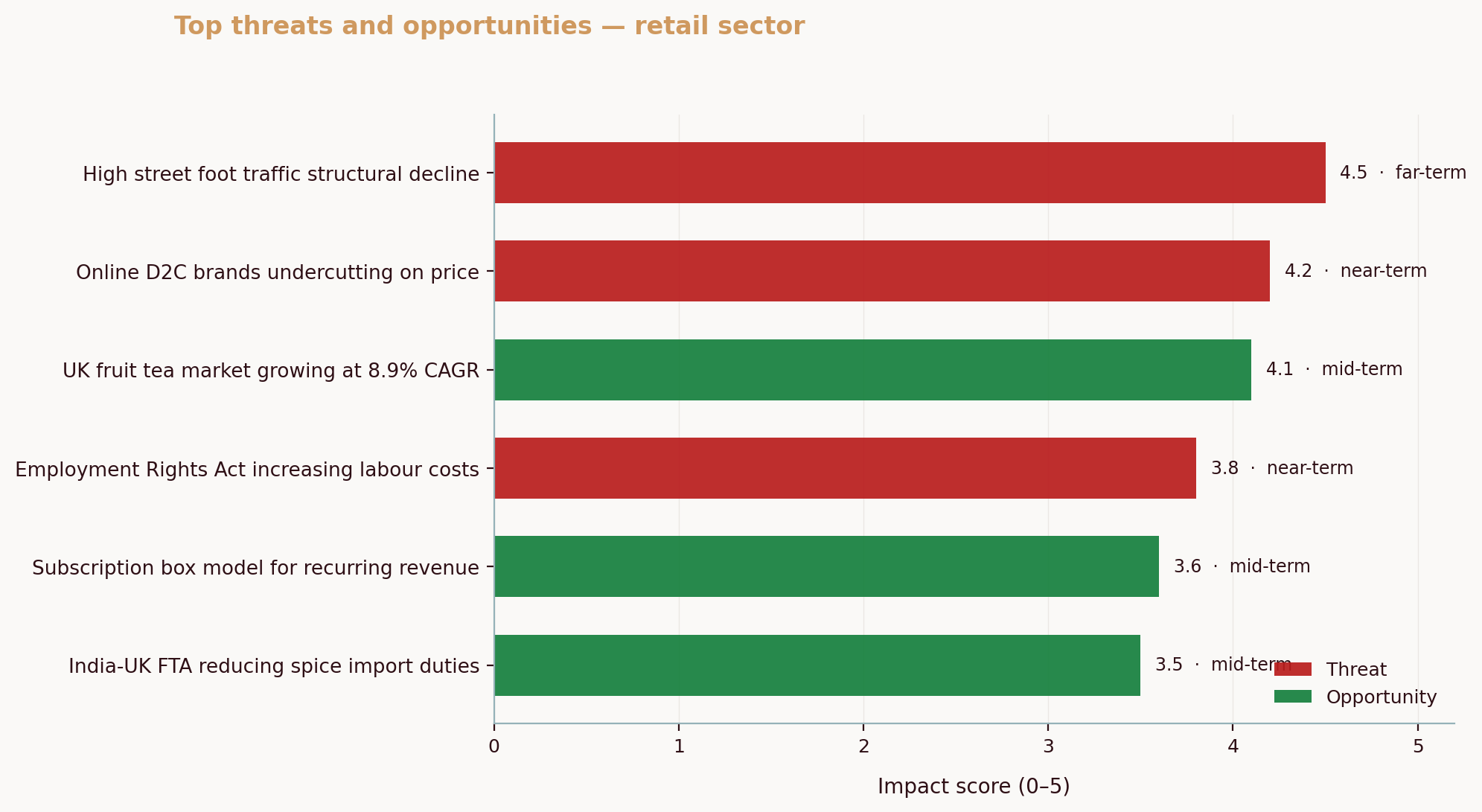
Pressure has intensified for four reasons. Price undercutting from online retailers pushes customers to treat spices and tea as commodities. Structural drift in high‑street traffic reduces casual walk‑ins. Authenticity is under the microscope and consumer demands rise. Only 4% of Britons say they completely trust a product’s sustainability logo, while one in five identify as willing to spend more on sustainable options—claims must be evidenced. That skepticism is healthy and sets the bar for proof. Fourth, import frictions and UK trade policy affect lead times and landed costs for small batches, narrowing room for error. YouGov: British attitudes toward sustainability, 2024. (yougov.com)
If you’re weighing competitors and substitutes, map who you actually lose customers to, not who you fear most. A quick reset using this field guide to identify your real competitors will sharpen your next move.
2. Why premium pricing needs clear justification for independents
Independent shops carry higher per‑unit costs: direct relationships, fresher stock, smaller MOQs. On the shopper side, premium signals a promise of better taste, wellness alignment, ethical origin, or all three. The job is translating higher operating costs into perceived, demonstrable value at the shelf and in the cup.
Think of price as a contract. Customers ask, “What am I getting that Tesco can’t or won’t show me?” When the answer is concrete (live tastings, roast or grind dates, batch codes, harvest notes), price objections soften. When it’s vague, they default to unit price.
The gap to close is operational, not just marketing. Install trust signals that are easy to verify and pair them with quick, digestible education. Prefer credibility that outpunches cost. These moves help with premium pricing that surfaces in daily shelf conversations.
| Trust signal | Customer credibility | Estimated implementation cost | Operational complexity | Recommended first-step |
|---|---|---|---|---|
| Batch/lot codes on jars | High | Low | Low | Add printed labels linking code to receipt note |
| Harvest or pack date | High | Low | Low | Print date on shelf tag and product card |
| Supplier audit summary | Medium | Medium | Medium | Request one‑page attestations from importers |
| Third‑party lab results (adulteration, microbiology) | High | Medium | Medium | Start with top 10 SKUs and post PDFs via QR |
| Tasting notes + staff script | Medium | Low | Low | Train 2‑minute script per hero SKU |
| Chef endorsement or recipe | Medium | Low | Low | Add a laminated “chef’s way” card by the SKU |
Want to keep the conversation on your terms? Script staff prompts and trial them A/B style, then review outcomes with a simple competitor SWOT to see where you can win consistently.
3. How education and transparent sourcing create a defensible premium
Education and provenance aren’t fluff; they’re conversion mechanics. In specialty food, experiential retail means structured tastings, scent‑led discovery, short demos, and micro‑classes that help shoppers feel confident about flavor and origin. A guided comparison of commodity cinnamon versus verum from Sri Lanka reframes value in 30 seconds. Provenance stories, backed by batch data and visible dates, shift the shopper’s risk calculation; the product becomes a documented choice. The transparent sourcing benefits are immediate: fewer objections and faster yes decisions at the till.
Across 5 Canadian retail SMBs analyzed via the Aurevon Intelligence Service, three themes repeat: experiential retail appears in every report; price undercutting by online players is a top‑three threat; stores with stronger public reputations (median Google rating 4.6, p10–p90 range 4.16–4.67) weather price conversations more calmly because trust is pre-installed. That’s the pattern to emulate: proof plus experience reduces price elasticity. (Sample‑level findings summarized from March 2026 analyses.)
Which trust signals land hardest? Start with what shoppers can see and verify on their phones: batch codes that resolve to a page with supplier name, region, and harvest or pack date; short lab summaries for hero lines; a one‑page supplier profile; clear tasting notes; and, when available, chef endorsements tied to a recipe card. Each is a receipt for your price. Wellness product marketing should anchor on sensory outcomes and verifiable origin rather than abstract promises.
Design experiences with layers. A weekday “two‑sip” station comparing sencha steeped at two temperatures teaches precision. A five‑seat Saturday mini‑class on single‑origin pepper runs 30 minutes, ends with a simple recipe, and offers a premium bundle at checkout. The move is to make education feel like discovery, not school. These are practical experiential retail strategies that compound over time.
A London case worth studying: Bird & Blend’s flagship format puts a tasting bar and a 100‑flavour wall up front, turning passersby into tasters, then buyers. That space choice is the strategy. Bird & Blend flagship and tasting bar. (brasierfreeth.com)
💡 Pro Tip
Use QR‑enabled provenance cards that load a 60‑second farmer intro or a one‑page PDF with batch notes. It feels premium, costs very little after setup, and beats a generic “ethically sourced” icon.
If you want additional context on where to invest, note that European shoppers’ willingness to pay for quality and freshness has ticked up, even as many trade down in other categories. That split personality is your opening for taste‑first education. McKinsey State of Grocery Europe 2025. (mckinsey.com)
4. Barriers: addressing price sensitivity and authenticity scrutiny head on
Common objections are predictable: “It’s cheaper online,” “How do I know where this comes from,” and “The supermarket version tastes fine.” Operational risks are real too. Full transparency can be costly, small suppliers may lack formal audits, and overclaiming invites accusations of greenwashing. The remedy is low‑friction proof and precise language. This is the authenticity in retail test that matters most at the moment of choice.
Start with what you can verify weekly. Post pack or roast dates, batch codes, and simple tasting notes on‑shelf. When you can’t obtain full chain‑of‑custody, say so and cite what you do have, like importer certifications or origin affidavits. British consumers already distrust vague eco‑logos, which means clarity beats slogans. YouGov: trust in sustainability logos, 2024. (yougov.com)
Now, the price fight. Invite comparison. Run side‑by‑side tastings or blind samplings that make flavor, aroma, and mouthfeel obvious. Back it with a measurable guarantee, allow returns on unopened packs within 14 days or offer paid micro‑samples. If a shopper wants a supermarket price, offer a tiered bundle where the premium SKU carries the education and proof, and a good‑better option satisfies value seekers. Keep staff focused with a short decision tree they can use under pressure, then review weekly with notes from this guide on tracking competitor pricing.
5. Practical recommendations and quick‑win playbook for experience + transparency
Five moves to trial over the next eight weeks. Treat them as experiential retail strategies you can pilot quickly.
1) Publish a tasting calendar. Two 30‑minute sessions per week, one tea, one spice. Cap at eight attendees. Pre‑book in store. Track attendee conversion and average basket.
2) Add provenance cards with QR batch tracking to your top 15 SKUs. Each card lists supplier name, region, batch or harvest date, and a link to a one‑page note. Start with the highest‑margin lines.
3) Train staff using three micro‑modules: 2‑minute origin story, 2‑minute flavor script, 1‑minute price justification. Print pocket cards. Review wins and stumbles in a 10‑minute stand‑up.
4) Offer micro‑classes. Charge a modest fee redeemable against purchase. Include a simple “chef’s way” recipe as a takeaway for one spice or a precise steeping guide for one tea.
5) Secure partner certifications or summaries where possible. If audits are out of reach, ask for signed supplier statements, then post them via QR with plain‑English translation.
Measure what matters. For pilots, track conversion lift among tasting participants, premium SKU sell‑through, average basket for “educated” customers, repeat purchase within 45 days, and qualitative comments. Use in
Mitchell Ozmun
SMB Researcher, Business Analyst - Saskatchewan Born and Raised