How Vancouver Clinics Win 2026: Reviews and Cosmetic Content Drive Vancouver dental marketing
A clinic sits two blocks from yours. Same hours. Same fees. But their phone rings twice as often. Not magic. Math. In Vancouver’s saturated market, practices that pass 500 Google Reviews and publish steady cosmetic before‑and‑after visuals capture more local clicks and calls than peers stuck under 200 reviews. Pair high review volume with visible transformations and you bend demand toward your chair. That is the core of Vancouver dental marketing, and it works on modest budgets. Treat it like compounding online reputation management supported by visual social media content and you create a durable advantage.
Why does this specific mix win? Because search engines reward credibility signals while humans stop for pictures. Google’s own local ranking guidance says more reviews and positive ratings help your Business Profile show up higher, which drives discovery and taps intent already nearby. Meanwhile, Canadians overwhelmingly research on phones, so your profile and feed are the front door at the very moment someone is choosing. Miss that moment and you gift a patient to the clinic down the street. Cosmetic dentistry marketing then finishes the job, since transformation visuals reduce uncertainty and nudge action. (support.google.com)
Related: West Coast Women's Clinic | Corporate | Vancouver Video Production | Citrus Pie Media Group — Citrus Pie Media Group
Vancouver dental market dynamics: why every channel must perform
Competition in Metro Vancouver is dense, and mobile behavior raises the stakes. In 2022, about 95% of people in Canada used the internet and 84% had mobile data plans, which means patients comparison‑shop in minutes while standing outside a SkyTrain station. Policy adds another layer. As the CDCP dental care plan rolls out, price transparency and perceived value shape dental consumer behavior for non‑covered services like whitening and veneers, so clinics that earn trust quickly and showcase cosmetic outcomes convert more of that interest. If your profile lacks recent social proof or your gallery lacks real outcomes, you drop from contention before the first call. That is market saturation at work, and it is one of the classic healthcare SMB challenges. (canada.ca)
That explains why relying on a single tactic rarely moves the needle. Your review footprint creates trust at a glance. Your cosmetic content earns the pause and the tap. Together they form an engine that works even when you are not posting ads. Want help deciding whom you are actually up against for that tap? Use a clear lens on rivals with how to identify your real competitors, then frame your position with a quick competitor SWOT analysis. In short, the strategies that work best in saturated dental markets are consistent review generation, simple transformation visuals, and fast, policy‑safe responses that keep profiles fresh.
Why review volume matters: search visibility, social proof, and the local pack
More reviews and better ratings do not just look nice. They increase the odds your clinic appears in the Google 3‑pack for “dentist near me” and pull more clicks once you appear. Google states it plainly, more reviews and positive ratings can help your local ranking. That visibility compounds because star ratings influence behavior. A foundational Harvard Business School study found a one‑star rating lift increased revenue 5–9% for independent businesses, and a meta‑analysis across 28 studies reported that review volume and valence have significant positive effects on sales. The industries differ, but the buying psychology carries to local health services where trust and risk loom large. For dental clinics, online reviews are one of the highest‑leverage inputs for ranking and conversion because they compress the time between discovery and booking. (support.google.com)
In Vancouver, practical thresholds help you frame goals. Breaking 100 reviews signals legitimacy. Moving past 300 marks category commitment. Crossing 500 creates a moat because you are now clearly “most chosen” in the area. Track the inputs that get you there, monthly review growth rate, average rating, response time, and the share of reviews mentioning priority services like whitening or implants. Want additional context on how rivals are growing their proof assets? See how to track competitor pricing and marketing.
💡 Pro Tip
Prioritize steady monthly review growth over one‑time spikes; algorithms and humans both reward consistency.
Here is a practical comparison of review‑building options for a small Vancouver clinic.
| Tactic | Estimated monthly effort | Typical monthly review yield (Vancouver SMB) | Compliance/privacy notes |
|---|---|---|---|
| Front‑desk ask with QR card at checkout | Low (train 2–3 staff, 10 minutes/day) | 5–15 | No incentives; ask every patient, not only happy ones. (support.google.com) |
| Post‑visit SMS with direct Google link sent within 2 hours | Medium (automate in PMS/CRM) | 10–25 | Avoid “review gating” or filtering unhappy patients. (support.google.com) |
| Follow‑up email at 7 days with care tips + request | Low | 3–10 | Include privacy notice and opt‑out. |
| In‑office tablet handoff after successful appointment | Medium (sanitize workflow) | 8–20 | Do not coerce; patients must post on their own accounts. |
| Quarterly “community care” campaign (newsletter + signage) | Medium | 5–12 | No contests or rewards tied to reviews, see Competition Bureau guidance on deceptive endorsements. (competition-bureau.canada.ca) |
How cosmetic transformation content captures attention and converts
Cosmetic transformation content means authentic before‑and‑after visuals with short case context, patient goal, procedure, timeframe, and outcome. Think of it as attention currency. Reviews get someone to your profile, transformations keep them there long enough to act. It is like sending two salespeople to the same consult, one vouches for your character, the other opens the portfolio.
What formats work locally? Short vertical videos (10–30 seconds) of veneers or whitening sequences perform well on Instagram and in Google Posts, and a clean “Smile Gallery” on your site builds depth for higher‑intent searchers. Keep the recipe simple, consistent lighting, identical angles, neutral backdrops, minimal editing, and consent that covers social and web use. If you are short on time, batch four cases into one monthly reel and one gallery update. See the difference?
This content does more than attract attention, it sets expectations, which reduces buyer risk. Add one line that teaches, not sells, “Micro‑abrasion and home trays brightened two shades in two weeks.” You can also mix one explainer per month about emerging interests like AI diagnostics dentistry to signal modern care without overselling tech. In marketing terms, AI‑assisted imagery and chairside scans make conditions and outcomes easier to understand, which supports case acceptance for cosmetic dentistry marketing. The goal is steady, trustworthy visibility that pairs with the review engine.
Aurevon Intelligence Service finding: anonymized local evidence
Across 15 Canadian healthcare practice SMBs analyzed via the Aurevon Intelligence Service, we found two patterns relevant to Vancouver clinics. First, reputation underperforms in many markets, across 14 businesses, the median Google rating was 3.3 with a p10–p90 range of 2.93–4.17, and the median review count was 185 with a p10–p90 range of 32–918. In plain terms, surpassing 500 reviews in a city cluster puts you beyond the 90th percentile of your peer set and squarely in the trust spotlight.
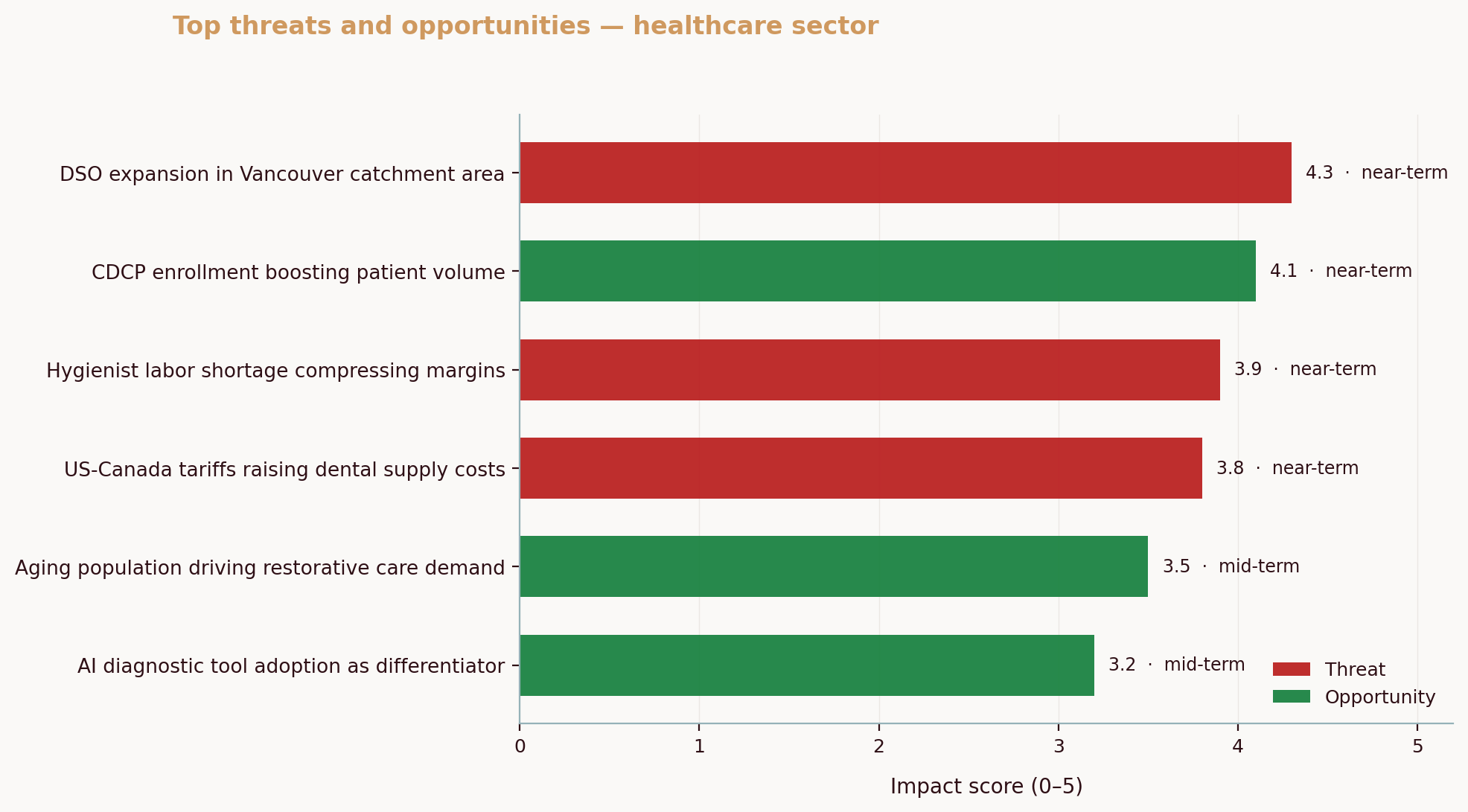
Second, “Reputation And Rating Vulnerabilities” repeatedly surfaced as a top threat, while “cosmetic dentistry” and “vancouver dentistry” appeared as recurring themes. In our analysis of a Vancouver healthcare practice, the most significant pattern was the reliance on patient experience and cosmetic outcomes to differentiate in a crowded local field. That mirrors what patients reward, volume of credible reviews plus visible transformations. As CDCP adoption expands and BC dental regulatory reform continues, these signals help you navigate shifting dental consumer behavior without escalating ad spend. The sample is anonymized and drawn from local data, which protects identities while surfacing practical signals clinics can act on.
Affordable, repeatable tactics and compliance checklist for reviews and cosmetic content
Here is how a resource‑constrained clinic can build momentum without risking penalties. Start with a 12‑week sprint. Week 1, print a QR code that opens your Google review form and train your front‑desk script, “Were we helpful today? A quick review helps local families find us.” Week 2, set up automated SMS requests two hours post‑visit, then a friendly email seven days later. Week 3, create a one‑page consent for marketing photos and a simple “Smile Gallery” template. Do this today, place the QR stand at reception and add the SMS step to your appointment workflow.
Stay inside the lines. Google prohibits incentivized reviews and review gating. The Competition Bureau warns that businesses can be liable for fake or employee‑posted reviews. British Columbia’s regulator emphasizes informed consent and professional standards in public‑facing communications, which matters for publishing patient images amid BC dental regulatory reform. Keep a signed consent with explicit social and web rights before posting any photo or video. When negative reviews land, respond within 48 hours with empathy, facts, and an offline resolution path, public professionalism often softens future readers’ concerns. Think of this cadence as disciplined online reputation management. (support.google.com)
Which cosmetic formats and placements earn local attention efficiently?
| Content format | Production cost/time | Best platforms (local reach) | Expected attention/conversion impact |
|---|---|---|---|
| Photo before/after with one‑line case note | Very low, 10–15 min/case | Google Posts, website gallery | High attention for cosmetic interests; strengthens intent on site. |
| 15–30s vertical video (whitening or veneer series) | Low, 20–30 min/case | Instagram Reels, YouTube Shorts | Strong thumb‑stop; good DM/call prompts. |
| Carousel “3 cases, one fix” | Low, 30–40 min/month | Instagram, Facebook | Builds perceived capability across variations. |
| Explainer still + caption (e.g., AI diagnostics dentistry) | Very low, 10 min | LinkedIn, website blog | Trust builder for tech‑curious patients. |
| Patient testimonial video with consent | Medium, 45–60 min | Website, YouTube | Powerful but ensure no incentives and full consent. (competition-bureau.canada.ca) |
For broader planning and monitoring rivals’ moves, see how to identify your real competitors, build a crisp competitor SWOT, and keep tabs with low‑cost competitor tracking.
Answering Vancouver dental clinics’ top questions about reviews and cosmetic content
How many Google reviews do we realistically
Mitchell Ozmun
SMB Researcher, Business Analyst - Saskatchewan Born and Raised