How Calgary Builders Win in 2026: Labor Shortages and Market Pressure in the Calgary construction market
The phone rings again. A permit is stuck. A client texts about delays. Another sub pulls out. In today’s Calgary construction market, booming demand means one slip can snowball into a lost review, then a lost month of leads. The firms that win now treat this boom as a reputational stress test, not a land grab, in a period of construction market competition sharper than many owners expect.
Calgary’s record homebuilding and suburban growth are real tailwinds, yet they’re colliding with labour gaps and tougher online scrutiny. That mix raises the bar for every estimate, schedule, and walkthrough. Here’s how to protect trust and still grow.
Related: Start Your Home Building Construction Business In Canada | Building Homes & Apartments — Ali Salman - Global Franchise Authority
Calgary’s record housing construction: scale, drivers, and what it means for SMBs
Calgary has set back‑to‑back housing records, with CMHC noting the city’s activity hit new highs in 2025 as apartment starts surged and multi‑unit projects led the way. The 2026 Spring Supply reporting frames Calgary as one of Canada’s leaders in ramping new homes, continuing the momentum seen through 2024. Calgary’s housing construction growth is fed by population increases, with Statistics Canada counting Calgary among the CMAs with the fastest growth rates from July 2023 to July 2024. That inflow keeps pipelines full, even as the mix tilts toward higher‑density and rental builds across the broader Calgary housing market. (cmhc-schl.gc.ca)
For small and mid‑sized residential builders, this scale translates into full calendars and thinner margins. Permits and starts generate opportunity, but they also amplify complexity: more neighbors to coordinate, more inspections, more multi‑trade handoffs. Local industry groups, including BILD Calgary Region, have underscored the pace and its operational strain as 2024 closed with record starts. Large primes like PCL Construction and other Alberta general contractors are busy on major multi‑unit and civic work, which can draw core trades away from SMB scopes. The takeaway is simple: demand is strong, yet the penalty for slippage is rising just as quickly. (bildcr.com)
Immediate operational impacts: surging demand, intense bidding, and compressed margins
When inquiries spike, estimates move faster and bid lists get longer. That dynamic can compress pricing power for Calgary general contractors, especially when owners prioritize short timelines over robust scope validation. Schedule pressure ripples into sub availability, which encourages risky sequencing choices and “good enough” handoffs that later become punch‑list headaches and construction quality issues.
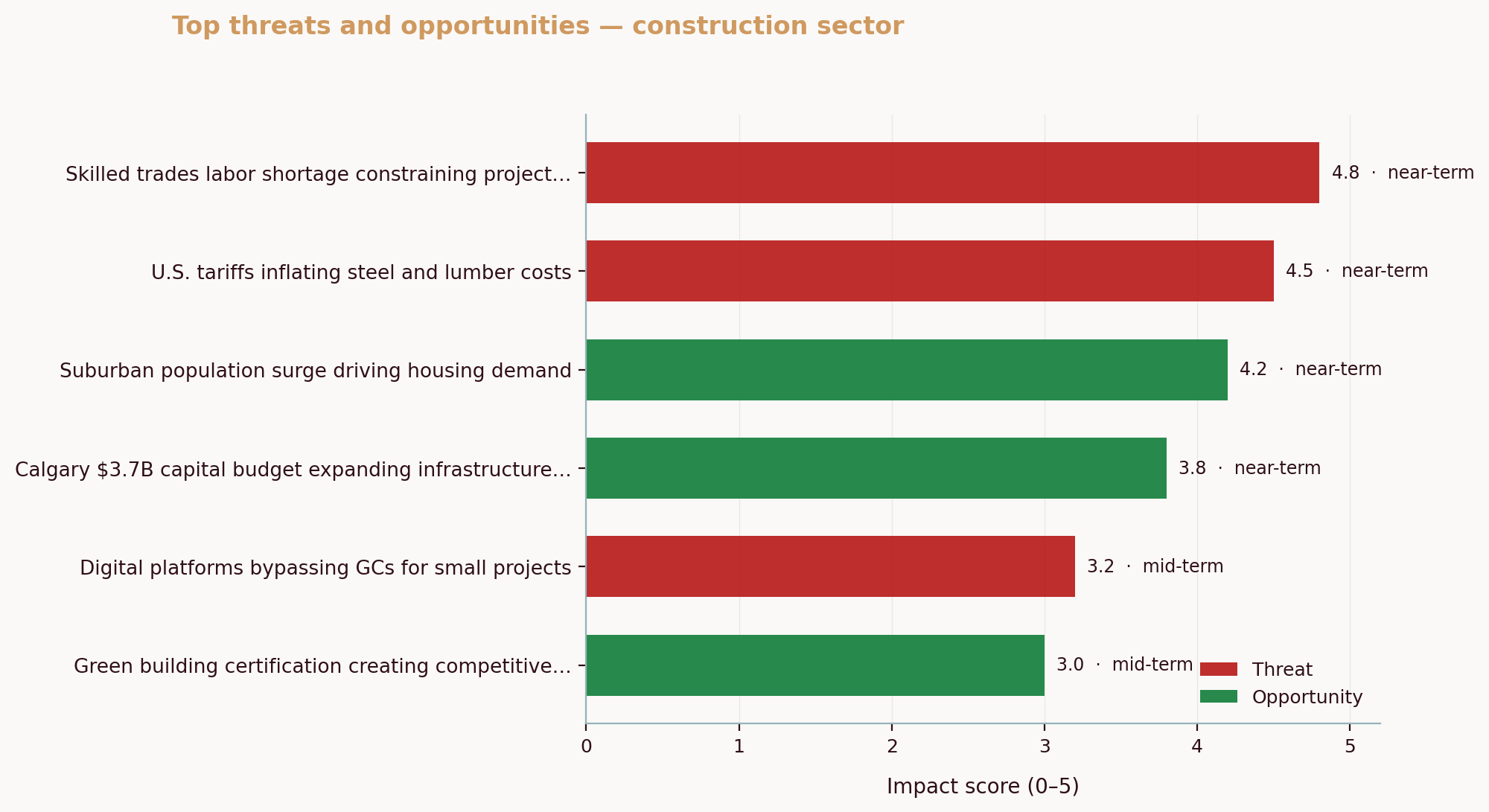
Two forces intensify this squeeze. First, macro tariff actions have kept material‑cost volatility on the table, which complicates bid holds. Second, the city’s own housing strategy is catalyzing categories like backyard suites Calgary, adding many small projects that soak up specialty trades. Both factors increase the cost of being wrong on time, cost, or quality. For leaders tracking US tariffs construction effects, volatility in inputs reinforces the need to define bid‑hold periods clearly. (bankofcanada.ca)
Here’s how the speed‑versus‑quality trade‑off plays out on the ground.
| Decision axis | If you prioritize speed | If you prioritize quality | Short-term impact | Medium-term reputational impact |
|---|---|---|---|---|
| Estimating | Fewer RFIs, quicker bids | More clarifications, tighter scopes | Win rate may pop for “fast” clients | Complaints drop as expectations match reality |
| Scheduling | Overlap trades, minimal buffers | Stagger crews, explicit contingencies | Faster starts, more change orders | Fewer delays tied to rework and inspection fails |
| Sub selection | Lowest price, earliest slot | Vetted subs with past-performance gates | Lower immediate cost | Higher review consistency and referrals |
If competition feels fuzzy, tighten your field view with a living map of rivals and their positioning using how to identify your real competitors and update it monthly.
Labour shortages in Calgary: causes, schedule impacts, and workmanship complaints
Labour gaps in 2026 aren’t just cyclical. Retirements, migration shifts, and pandemic‑era exits have left persistent holes in key trades. Provincial trackers show Alberta leading the country in interprovincial migration for more than three years, yet demand still outpaces supply in many construction roles. CMHC and City analyses link trade scarcity to longer build times, particularly as multi‑unit work soaks up core trades. Calgary suburban expansion adds pressure on site supervisors and inspectors as greenfield phases stack up. (alberta.ca)
What does this mean for your projects? Expect longer lead times for electricians and finishers, greater variance in crew skill, and higher sub turnover. That last variable is a quiet killer: inconsistent crews trigger more callbacks, which trigger more schedule revisions and more client check‑ins. It is a loop that lengthens project timelines. The material side isn’t helping either, with U.S. duties on Canadian softwood lumber higher on average after 2025 administrative reviews, plus a new 10% measure on certain products in October 2025, all of which keep budgets twitchy. (trade.gov)
Consider this vignette from a typical Calgary renovation lead. The GC secures foundation and framing quickly, but the tile sub cancels the week before install. The GC slots a new crew, then spends three extra site visits on layout corrections. Before: one clean handoff, one inspection. After: two rework days, a two‑week timeline slip, and a testy client text thread. See the difference?
To keep perspective amid the rush, review the competitive context with a fresh competitor SWOT analysis and identify where capacity, not price, is your true constraint. This is the heart of general contractor challenges in 2026.
Reputation dynamics: rising review-count thresholds and the amplification of complaints
Review‑count thresholds are the minimum number of public reviews consumers expect before they trust a contractor. In hot markets, these thresholds climb because buyers see more competitors and scan more profiles. A single negative review then carries outsized weight if your sample is small, and ranking visibility tilts toward firms with both volume and recency.
Recent survey work shows consumers now expect faster owner responses and pay close attention to how recent reviews are. That compresses the window to contain issues and rewards teams that publish new, detailed reviews every month. Think of it like sending two salespeople to pitch the same client: the one with a thicker, fresher portfolio starts with the room. Managing customer reviews in construction is now an operational discipline, not a side task. (brightlocal.com)
| Metric | Low review‑count (baseline) | Rising threshold scenario | Practical implication for SMBs |
|---|---|---|---|
| Trust signal | 8–15 Google reviews, mostly old | 30–50+ mixed‑format reviews, mostly recent | Under 20 reviews looks “untested,” even at 4.8★ |
| Complaint weight | One 1★ post can pull avg by 0.2–0.3 | Diluted by larger sample and detailed owner replies | Faster, public responses reduce damage window |
| Discovery | Sporadic local‑pack visibility | More consistent map and organic presence | Review velocity now functions like a demand moat |
If you need help mapping who you’re really up against in search and maps, revisit how to track competitor pricing and marketing and pair it with a monthly “review velocity” check.
Data and practical strategies for Calgary general contractors: evidence-backed steps to protect trust and win reliably
Across 39 Canadian construction firm SMBs analyzed, the median Google rating was 5.0, the mean 4.78, with a p10–p90 range of 4.3–5.0. Yet the median Google review count was only 15, and a “critically low online review volume” threat appeared in 24 reports with high impact. Source: Aurevon Intelligence Service analysis — Canadian construction SMB — 2026-03. These numbers signal an uncomfortable truth: many credible firms still look untested online, which magnifies the sting of a single complaint.
Four tactics turn this stress test into advantage:
1) Build scheduling resilience. Add explicit buffers by phase, not a blanket pad. For example, add two working days to electrical rough‑in and three to finishing if your last three projects slipped there. Publish both “expected” and “contingency” timelines in proposals. This transparency prevents surprise‑driven rating drops and helps you avoid “rushed” change orders that clients interpret as corner‑cutting.
2) Upgrade client communication. Pre‑commit to milestone check‑ins and publish how you’ll respond if something slips: who calls, by when, what choices the client gets. Make it visible in the contract and in progress emails. The act of planning visible accountability softens how a delay is perceived.
3) Flex your workforce model. Lock a small, cross‑trained core for quality‑critical scopes, then supplement with pre‑vetted subs who accept your scopes, finish standards, and photo documentation norms. Keep a standing “A/B/C” bench for each trade with rate cards and capacity notes. It is capacity hedging, not chaos.
4) Professionalize review quality management. Move from “ask more reviews” to a playbook: tag which clients to invite, when to invite, and what specifics to reference in the ask. Aim for steady monthly review velocity, timely owner responses, and a mix of text and photo reviews to increase credibility. Current research shows consumers reward recency and response time. (brightlocal.com)
💡 Pro Tip
Reserve one full weekend per month in your template schedules strictly for rework and callbacks. That small buffer reduces same‑week complaint spikes and protects your public ratings.
To push from reactive to strategic, stress‑test your landscape using how to identify your real competitors and keep that list current with a quarterly competitor SWOT analysis. Then track rivals’ messaging and promo swings with the methods in how to track competitor pricing and marketing, updating your bid‑hold assumptions when tariffs or policy shifts move material costs. The Bank of Canada’s 2025 outlook scenarios flagged tariff‑related headwinds that still echo in 2026. (bankofcanada.ca)
Answering Calgary contractors’ top questions about the boom and reputation risk
How much should I inflate schedules to account for labour shortages without losing bids?
Be strategic: add modest, clearly
Mitchell Ozmun
SMB Researcher, Business Analyst - Saskatchewan Born and Raised