Toronto housing market 2026: Data-backed broker tactics
Open house. Full sign‑ins. No offers. Days tick by while the neighbour’s semi sells in a week. That’s the two-speed story playing out across the Toronto housing market 2026, a bifurcation with soft high-rise sentiment beside resilient low-rise and select town pockets. Sidelined buyers respond to transparent, hyper-local facts they can verify and act on, grounded in visible residential real estate trends they can test on the street.
This year’s split is stark: condos are weighed down by investor exits and heavier carrying costs, while low-rise segments in specific school and park catchments show faster turnover. TRREB’s early-2026 figures confirm extended listing durations alongside price pressure for apartments, and CMHC’s outlook points to ongoing weakness in the GTA’s condominium pipeline. Bank of Canada communications keep rate-sensitive buyers cautious, even as detached and town streets with scarce supply see tight micro-markets. CMHC mortgage insurance rules, along with qualification stress tests, concentrate budget ceilings for insured borrowers, nudging demand toward specific buildings and streets where transparency reduces risk. Layer in GTA housing affordability constraints and employment confidence that can be influenced by export order volatility and CUSMA trade policy, and you get a buyer pool that needs block-level certainty before acting. The opportunity is precise: meet buyers where they hesitate, with clarity they can audit. TRREB January 2026 Market Watch PDF. CMHC Housing Market Outlook 2026. Bank of Canada April 29, 2026 decision. (realestatebygill.com)
Related: Toronto's housing market faces new reality as buyers gain leverage — CityNews
Define the two-speed Toronto housing market in 2026: what’s hot, what’s cooling, and why it matters
Two-speed this year means different velocities by property type and streetscape. Low-rise houses in family-demand corridors and some fee-simple towns turn briskly where resale inventory is thin and walking-time access to parks and schools is strong. By contrast, many condo towers face longer days on market, deeper negotiations, and investor-driven listings. Urbanation’s Q1 read shows standing new-construction condo inventory at a record, which spills into resale psychology and pricing. Mortgage insurance requirements and carrying-cost math compress budgets for insured buyers, while uneven resale supply shapes expectations for conventional borrowers, and together these factors drive the split. For operations, that means separate cadences, disclosures, and negotiation frames for each micro-market. Urbanation Q1‑2026 inventory update. (urbanation.ca)
Here’s a quick comparison to anchor team playbooks:
| Property type | Market velocity (absorption/DOM) | Primary sidelined buyer profile | Top 2 buyer priorities | Recommended brokerage tactic |
|---|---|---|---|---|
| Low-rise houses | Faster than city average, shorter DOM in park/school catchments | Upsizers and move-within buyers seeking stability | School/park proximity; resale liquidity | Pre-list micro‑sets with 6–12 month same-street sales; transparent offer ranges |
| Townhomes/split-level | Mixed speed by corridor, faster where fees are low | First-time move‑ups, downsizers seeking less maintenance | Fee predictability; transit access under 15 minutes | Fee history brief + utility estimates; two-video pack linking home to nearby transit |
| Condos | Slower in investor-heavy towers, assignments add supply | First-time buyers and value investors needing certainty | Building governance/fees; noise and unit mix | Building-level “health sheet,” buyer-ready comps, and staged inspection credits |
Why it matters: it’s like sending two sales teams to one client with different pain points. The one that names risk at the block, building, and park level wins. Revisit competitive framing using this guide on identifying your real competitors.
Profile the sidelined buyer pool: who they are, why they’re waiting, and what they’ll pay for
The “wait list” is diverse. First-time buyers seek clearer comps, conditional buyers can’t align sale and purchase timing, downsizers want fee certainty, and cash-ready investors cherry-pick buildings with strong boards. Across 12 Canadian real estate brokerage SMBs analyzed via the Aurevon Intelligence Service, we found “buyer’s market” recurring in 16 reports, with “west end toronto” appearing in 9 reports—evidence attention clusters around specific corridors. In the same sample, Google ratings skew high (median 5.0; mean 4.81), but median review counts sit at 45, which means thin trust signals can still cap conversions. (realestatebygill.com)
What do these buyers actually pay for? Commute time framed as minutes, not maps. Private outdoor space, or adjacency to green. Transparent monthly costs (mortgage, fees, utilities). And resale liquidity expressed as recent same‑block turnover, not city averages. CMHC flags condo‑segment risk, while StatsCan’s 2026 Toronto CMA estimate shows flat year‑over-year population growth, a reminder that broad demand signals don’t rescue weak micro‑locations. Translation: buyers want depth where they plan to live. That pool reflects pent‑up demand that releases when pricing, fees, and comps line up in a single tile. For insured borrowers, mortgage insurance rules and debt-service criteria cap maximum purchase power, and they prioritize buildings or blocks with predictable fees and documented maintenance because budget headroom is limited. For an overview of insurance concepts, see CMHC’s primer on mortgage loan insurance. CMHC condo risk analysis. Statistics Canada Daily, Jan 14, 2026. CMHC mortgage loan insurance. For qualitative colour from a local brokerage, see Zoocasa’s 2026 predictions. BREL team posts are another useful barometer of on-the-ground buyer questions in core neighbourhoods. (cmhc-schl.gc.ca)
With that buyer in mind, map your actual competitors in each tile (the 3–5-street cluster you’ll target) using a lean approach to identify your real competitors and a quick competitor SWOT to anticipate their messages.
How transparency plus hyper-local data reduces buyer friction and maps to priorities
Sidelined buyers aren’t information-starved. They’re uncertainty-sensitive. Hyper-local proof reduces that uncertainty fast: street-level turnover rates, micro-supply counts within two blocks, walk-time to transit and parks, and 6–12-month same-street comps with condition notes. Package these into pre-listing data packs for each property: a one-pager with the comp set, a building or block health sheet (governance, fee history, maintenance items), and a map with annotated green-space and transit times. In condos, add a plain-English fee trajectory with board minutes excerpts. This is not just good disclosure, it is essential local data for real estate marketing because it aligns content to buyer priorities by tile.
Provenance matters. Cite TRREB for sold data, CMHC for supply context, and Bank of Canada for rate assumptions, with hyperlinks embedded and a short assumptions footer. When you share ranges, show how they were derived. One more step changes the conversation: publish buyer-ready comps on property microsites and hand them out at opens. The result is counterintuitive: clearer disclosures often accelerate offers because they compress decision cycles. Bank of Canada rate signals in late April 2026 kept policy settings steady, which means buyers will continue demanding micro-proof, not macro promises. If affordability is tight, note insured versus conventional scenarios directly in your range sheet so buyers see how mortgage insurance requirements affect total monthly cost. BoC April 29, 2026. Pair your content with a field test on tracking competitor pricing and marketing. (bankofcanada.ca)
Tactical playbook for brokerages: operations, sales scripts, and KPIs to capture buyer pent-up demand
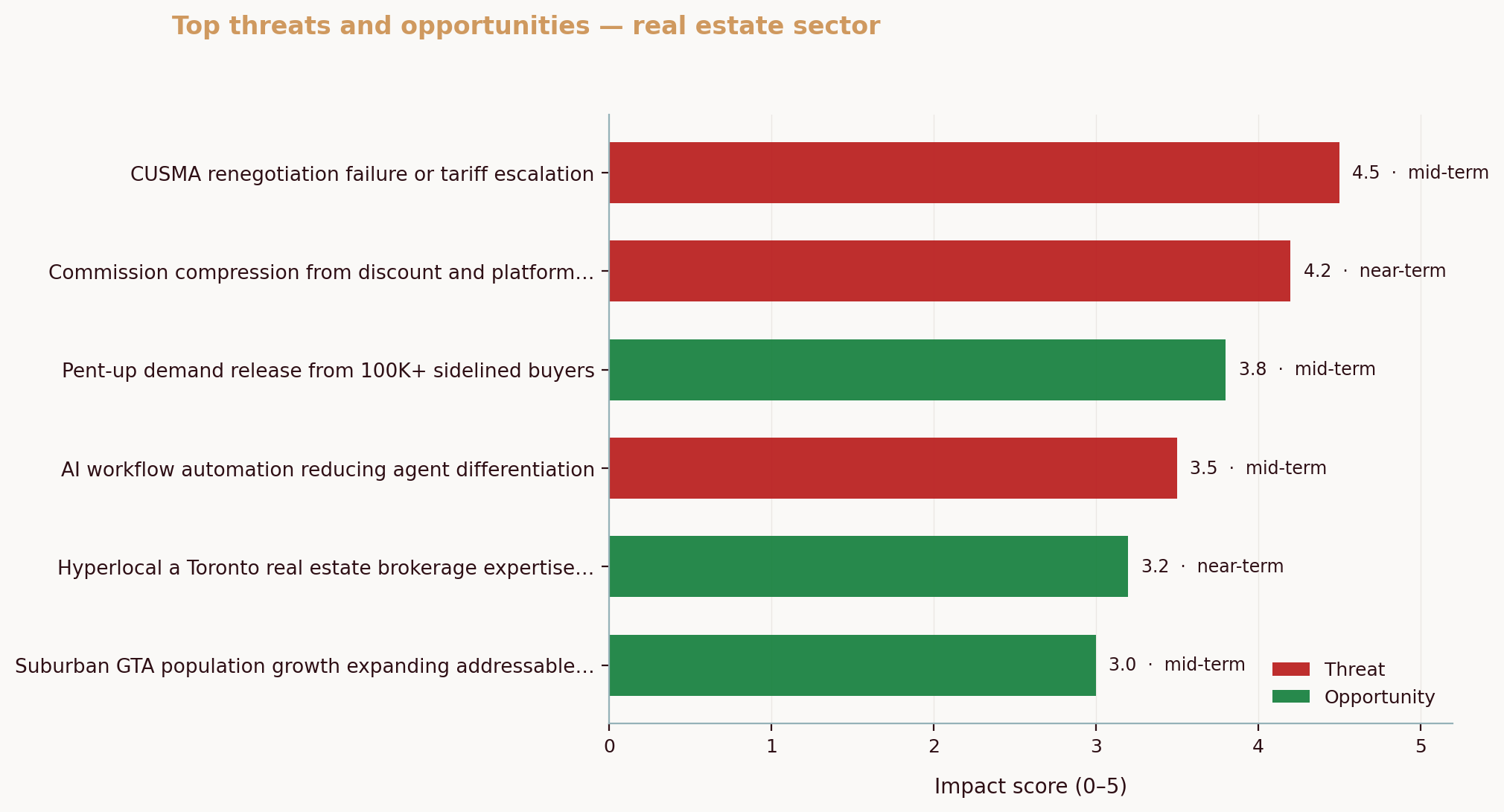
Start with operations. Split inventory into micro-segments by property type and 3–5-street tiles. Assign tile captains who live and breathe those blocks. Build a repeatable workflow: ingest data weekly, localize to the tile, publish a data pack, then distribute it to known sidelined leads. Route incoming interest by buyer profile, not first-come. Across 12 brokerages in our sample, a top recurring threat was “Low review volume and rating gaps are hurting local search visibility.” Fix that in parallel with a review-rehab sprint so your transparency work gets found. These tactics consistently convert in a split market. (realestatebygill.com)
Sales and marketing tactics that convert:
- Scripted transparency lines, for example: “We price using three same-street sales, adjusted for condition and exposure, here are the assumptions.”
- Targeted offers that reduce friction: pre-paid inspection, 48-hour conditional windows tied to known comp ranges, or seller-funded utility audits.
- Pre-emptive comparable packets for cautious buyers, including if-this-then-that price paths for minor renovations.
- Embed local market video content on tile pages and microsites so buyers connect comps to lived experience on that block.
Use this KPI dashboard to run a 6-week tile pilot and force accountability:
| Metric | Baseline | Target (6 weeks) | Tactic to influence metric | Owner |
|---|---|---|---|---|
| Qualified sidelined leads per tile | Last 4-week avg | +25% | Hyper-local data packs + QR codes on mailers | Marketing lead |
| View-to-booking rate (tile pages) | Last 4-week avg | +20% | 90-sec park-to-property video embedded above fold | Content lead |
| Offer attempts per 10 showings | Last 4-week avg | +15% | Range-based comps handed out at first viewing | Tile captain |
| Fall-through rate | Last 4-week avg | −20% | Pre-listing inspection + fee/utility transparency | Listing lead |
| Days on market (tile median) | Last 4-week median | −15% | Offer windows aligned to comp ranges and buyer paydays | Sales manager |
💡 Pro Tip
Start with one high-value hyper-local tile (a single 3–5 street cluster) as a pilot, test messaging, data packs and two video formats, then scale to adjacent tiles if conversion improves by 20%.
Want sharper internal alignment? Pair the pilot with a lightweight competitor SWOT so every agent
Mitchell Ozmun
SMB Researcher, Business Analyst - Saskatchewan Born and Raised