Saskatoon sports bars: Value, safety and vibe in 2026
Game night. Full house. Checks look thin. Staff sprint. A guest asks about kitchen hygiene, another about a cheaper lager. This is the squeeze. In 2026, Saskatoon diners press for better value, stronger food safety assurance, and a lively room at the same time. Local operators feel it most on weekends, when the expectations of Saskatoon sports bars and early‑evening family pizza restaurants converge. With margins tight and patience shorter, treating value, safety, and atmosphere as one operational problem is the only strategy that holds. It is the reality of the Saskatoon dining market, where customer value expectations, visible safety, and buzz collide.
The current demand triad in Saskatoon: value, food safety and atmosphere
What do local diners want from a bar on game night? Three linked cues. First, perceived value: ticket totals must feel fair against household budgets, and “extras” need to look generous. Second, visible food safety: people want signals they can see, not just promises, aligned with food safety regulations in Canada, especially around pizza stations and wing programs. Third, energy: they still want the roar when the Blades score and the audio that makes a UFC card crackle. Operators hear the contradiction every night, yet it is not a contradiction if you design for it. Chains like Canadian Brewhouse and Leopold's Tavern have set a baseline for screen density, crisp audio, and pacing, so independents need to meet those expectations in a way that fits their rooms.
Two data points frame the stakes. Analysts report a pullback in dining frequency as Canadians reassess discretionary spend, which heightens sensitivity to price presentation and perceived deal quality. Q1‑2026 food‑service report notes roughly three‑quarters of Canadians are eating out less often. At the same time, Statistics Canada’s 2025 review shows restaurant purchase prices remained elevated, with Saskatchewan among the provinces where price growth stayed faster than the national average.
For family pizza restaurants, the same triad shows up earlier in the evening: parents want a deal that feels honest, trustworthy prep they can point out to kids, and screens that keep everyone in the booth happy. Screen placement, moderated sound, and quick turns are sports bar atmosphere trends that also work for families. Designing operations around that single triad is the foundation for 2026.
Learn to spot your real competitors so the “value” you promise beats the alternatives customers are actually weighing, not the ones you assume.
Macro pressures squeezing margins: tariffs, supply shifts and labour costs
Margins are clipped from three sides: tariffs on supply‑managed imports, higher import prices and freight on produce and beverages, and stubborn labour costs. This is bar and restaurant margin management in practice, where procurement, pricing, and pacing must move together. On the tariff side, cheese and poultry sit behind tariff‑rate quotas (TRQs). When TRQs are tight or over‑quota, duty rates jump dramatically, which flows into pizza cheese and wings. Canada’s 2026 tariff schedule confirms these TRQ structures, and official schedules show over‑access duties on mozzarella in the mid‑200% range. See the CBSA 2026 Customs Tariff and a partner schedule detailing mozzarella at 245.5% over access. Global Affairs Canada’s 2026 TRQ notices also show how dairy, poultry, and egg allocations are actively managed, which affects landed costs.
Labour is not softening fast enough to offset inputs. The Bank of Canada’s Q1‑2026 Business Outlook Survey reports firms still expect input prices to be pushed by trade and tariff factors, even as wage growth expectations cool only gradually. Restaurants Canada’s 2025 annual review points to persistent operating‑cost pressure that keeps owners on a defensive footing. Compliance with food safety regulations in Canada also requires ongoing spend on training, logs, and smallwares, which operators must budget for rather than treat as ad hoc.
Discounting feels like the easy fix. It rarely is. Deep promotions train guests to wait for deals and drag down average order value (AOV) without fixing cost structure. Use the matrix below to weigh responses.
| Operator Response | Immediate Margin Impact | Perceived Value Effect | Atmosphere Impact | Recommended When |
|---|---|---|---|---|
| Blanket discounts (10–20%) | Negative | Short‑term lift, long‑term anchor | Neutral to dulling if overused | Clear inventory overhangs; very short runs |
| Bundled value (beer + app, family pizza sets) | Neutral to positive | Strong if framed as “smart pick” | Can boost social energy | You can pair high‑margin items |
| Menu engineering (anchors, decoys, copy) | Positive | Reframes price fairness | Neutral to positive | You have menu flexibility |
| Visible safety upgrades (see‑in prep, temp cards) | Neutral | High trust bump | Positive if designed warmly | Guests ask about safety |
| Portion/plating right‑sizing | Positive | “No waste” framing helps | Neutral | Portions are inconsistent today |
When value design, safety cues, and vibe move together, you avoid cannibalizing one with the other.
For competitive context, keep an eye on rivals’ public pricing and promotions with no‑cost methods, including family restaurant competition in early evening windows.
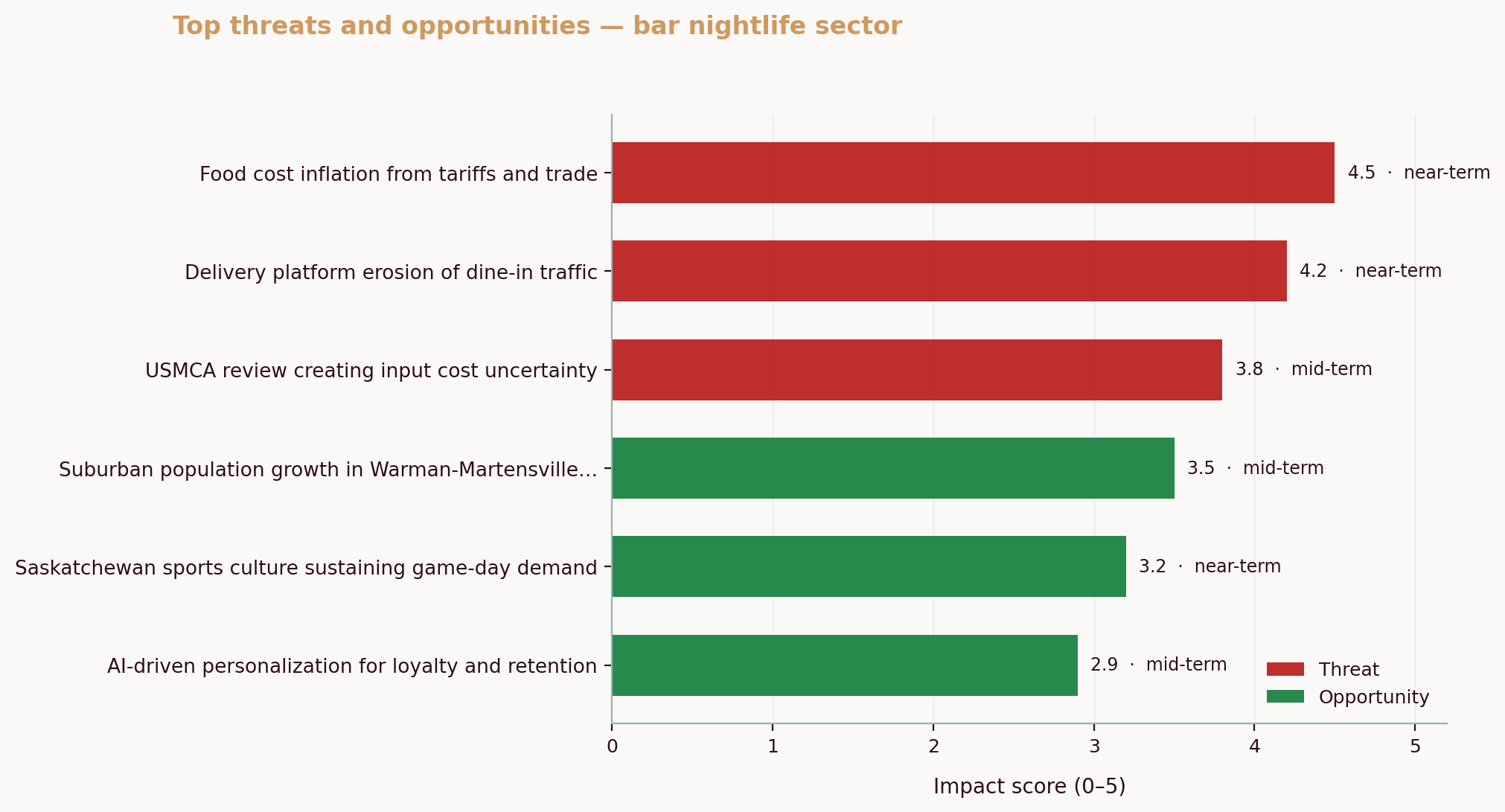
What the Aurevon March 2026 analysis shows about the triple pressure
Across 38 Canadian bar SMBs analyzed via the Aurevon Intelligence Service (March 2026), guests are more price‑aware on “everyday” items, attention to visible safety cues has risen, and patrons will trade some ambience elements for a deal that feels honest and safe. Ratings data across 35 businesses cluster tightly (median Google rating 4.1), meaning perceived value and safety cues often decide the tie.
Localized signals matter. Visit frequency dips on non‑event nights, but spend per visit holds when menus feature “smart pick” bundles and a few high‑trust signals at the pass. In the Saskatchewan sample, a midtown Saskatoon bar added a clean‑view pizza station and branded oven‑temperature placards by the host stand; paired with a lager‑and‑slice bundle, the venue sustained energy on quieter nights without cutting list prices. The broader dataset tags “Rising Operating And Input Costs” as a top recurring threat and flags “Experiential And Culinary Upgrades” plus “Review Recovery” as reliable upside paths when executed with discipline. In short, sports bar atmosphere trends that emphasize sightlines, lighting zones, and mid‑volume audio work best when they sit beside clear safety cues.
What does this change? Instead of reaching for across‑the‑board discounts, small visible safety upgrades and thoughtful menu psychology can lift perceived value by a similar amount, while protecting margin. See the difference?
To sharpen decisions with local realism, run a quick competitor SWOT tuned to a 10‑block radius.
Principles that reconcile perceived value, visible food safety and atmosphere
Four principles help you treat the triad as one system.
1) Design for perceived value. People judge value by context, not absolutes. Anchor high, highlight a “smart pick,” and make add‑ons feel like finds. It is like tuning three knobs on the same amp: turn up one, and the others respond. Keep customer value expectations front and center.
2) Prioritize visible safety cues. Guests trust what they can see. Temperature displays, labelled storage visible from the dining room, and a tidy, in‑view pizza station reduce uncertainty. Reassurance is value.
3) Use menu psychology to protect margin. Move margin‑friendly items into prime visual zones, write copy that sells quality, and deploy a decoy to make your profitable bundle look like the obvious choice. Done right, guests spend the same or more without feeling squeezed.
4) Weave safety into the vibe. Warm typography on signage, branded sanitizer at server stations, and a one‑line “how we keep your pizza safe” note on the menu keep the room human. The cue is hospitality, not a clinic.
One practical example: Instead of discounting wings by 20%, place a “Game Night Combo” with a house lager and oven‑kissed garlic knots at a round number, and seat nearby tables with line of sight to a spotless pizza station. Many guests will pick the combo because it looks smart and trustworthy.
Curious how rivals frame their “smart pick”? Revisit how to identify your real competitors.
Concrete, prioritized tactics for Saskatoon operators (quick wins and pilot projects)
Start with a four‑to‑eight‑week pilot. Choose two menu moves and two safety‑visibility upgrades. Track AOV, tickets per shift, spoilage, and a one‑question guest prompt about safety confidence.
Menu engineering moves for hockey and CFL nights: create a pizza‑for‑two set with a small Caesar and two sleeves of local lager, priced to a clean round; add a shareable decoy board priced above your combo to anchor fairness; rewrite two high‑margin appetizers with provenance and texture words that fit your brand. Portion right‑sizing works too: standardize wing counts and switch to a ramekin drizzle to control sauce cost without killing crave.
Safety‑visibility upgrades that preserve vibe: mount a tasteful oven‑temperature card at the host stand, add labelled cold‑hold storage visible from the pass, and keep a clean‑view prep zone. These cues double as stagecraft. A tidy station raises perceived value as much as a small discount, because it lowers risk in the guest’s mind.
Use light tech only where it speeds the rush. POS modifiers for bundle swaps, QR‑assisted ordering just for bar rails during national broadcasts, and a “prep cam” angle that lets guests see pies hit the oven can all improve throughput without flattening the room.
| Tactic | Estimated Effort | Upfront Cost | Time to Impact | Primary KPI(s) Improved |
|---|---|---|---|---|
| Game‑night combo with anchor/decoy | Low | Very low | 1–2 weeks | AOV, mix to margin |
| Visible oven‑temp and labelled storage | Low | Low | Immediate | Safety perception, reviews |
| Portion right‑size on wings/sauces | Medium | Very low | 2–3 weeks | Food cost %, waste |
| Copy refresh on 3 menu items | Low | Very low | Immediate | Attachment rate |
| QR rail ordering on peak nights | Medium | Low | 2–4 weeks | Throughput, ticket count |
💡 Pro Tip
Small visible cues matter: displaying oven temps, labelled storage, or a short “how we keep your pizza safe” line on the menu often raises perceived safety more than heavy training alone.
For tracking and calibration ideas, skim the free methods in how to track competitor pricing and marketing and fold them into a quick competitor SWOT. If you operate multiple sites, align pilots with the rival map from how to identify your real competitors.
Answering owners’ top questions about balancing value, safety and atmosphere
Will visible safety measures make my bar feel clinical and kill the vibe?
No, when done with design intent. Use warm signage, integrate safety cues into what guests already see (a branded temperature card at the pass, an open view into a tidy pizza station), and have staff frame steps as part of hospitality. The aim is reassurance, not a lab look; small, consistent cues raise confidence while the room stays lively. For families, gentle lighting, booth sightlines to screens, and moderated audio keep kids engaged without overwhelming parents.
How much can menu psychology substitute for discounts without losing business?
Thoughtful menu engineering, including bundles, anchoring, and a well‑placed decoy, can protect price perception and lift checks without cutting list prices. Start with a 4–6 week test, baseline your AOV, and compare game nights to non‑game control nights.
Which visible safety actions give the best ROI for small bars and family pizza restaurants?
Start with low‑cost, high‑visibility moves: labelled storage, a clean in
Mitchell Ozmun
SMB Researcher, Business Analyst - Saskatchewan Born and Raised