Could Regina’s Plan Endanger Saskatoon Live Music Venues in 2026?
Friday night. Your opener hits the first chorus. Three tables whisper about “fees.” A friend group bails for a headline tour announced in Regina. Your room still sounds great. It just looks thinner. That’s the new reality for Saskatoon live music operators staring at glossy renderings and big‑project headlines from down Highway 11, and watching regional entertainment trends shift across Saskatchewan.
Here’s the good news: the Saskatoon live music restaurant ecosystem hasn’t stalled. Programming is expanding, weeknights are steadier than they were two years ago, and regulars are still choosing proximity and hospitality over traffic and parking drama. Yet two forces are bending demand: Regina’s emerging mega‑venue ambitions, and mounting frustration with ticketed event value (especially drip‑priced extras). To stay ahead, owners need tighter pricing stories, sharper programming, and hospitality consistency that makes the stadium alternative look impersonal by comparison. That is how the Saskatoon nightlife economy keeps share when restaurant nightlife competition intensifies.
1. State of Saskatoon live-music restaurants today
Across the city, operators report more residencies, hybrid dining‑plus‑music formats, and stronger shoulder‑night patterns anchored by reliable local acts. The business model is familiar: modest covers or suggested donations, margins driven by food and beverage, and short booking windows that reward repeat local audiences. The formula still works when the value feels obvious at the door and at the table.
Look at Amigos Cantina: its public calendar shows frequent bookings that mix touring names with community favorites, the exact blend many restaurants emulate to keep discovery flowing while protecting weeknight traffic. The Bassment sets a useful benchmark on sound, genre variety, and residency discipline that small operators can adapt without extra headcount. That rhythm, predictable residencies paired with occasional “spike” nights, spreads risk and keeps FOH teams in sync. The challenge is that staffing gaps and mixed consumer perceptions about covers can erase those gains fast. National SME surveys flag hiring pain in hospitality, which undercuts consistency on busy nights and training depth on slow ones. That’s where value signals wobble. [Amigos Cantina events] (illustrative). CFIB reports persistent labour constraints for SMEs despite easing vacancy rates, half of small businesses still cite shortages as a growth barrier. [Mind the gap: workforce challenges] (cfib-fcei.ca)
So the base is healthy. But it’s being tested by a different type of competition that sells prestige, scale, and slick production. What happens when that pitch gets louder?
2. What Regina’s mega-venue developments are and why they matter
Regina already stages large events at the Brandt Centre (about 6,000 seats), with premium suites, centralized ticketing, and arena‑level production. On top of that, the city has advanced a multi‑year drive to renew or replace its event infrastructure, from council approvals of “catalyst” recommendations to recent private proposals that point to significant upgrades and potential capacity in the many‑thousand range. In short, Regina entertainment venues are moving upmarket. Translation for Saskatoon operators: more one‑night magnets within two hours’ drive, packaged with regional marketing horsepower. [Brandt Centre profile]. [City approvals coverage]. [Proposed arena/event centre scale]. [REAL District upgrade proposals, 2026].
Regionally, this matters because it can redirect discretionary entertainment spend toward fewer, pricier nights that feel “big.” It can also capture touring acts on single‑stop schedules. The likely impact for Saskatoon restaurants isn’t daily erosion, it’s softer weekend peaks and fewer first‑time walk‑ins when headline shows pop up down the road. That is how new venues affect local live music scenes in practice, they compress peak‑night demand near conflict dates.
Comparison helps clarify where small venues can win.
| Feature | Regina mega-venue | Saskatoon live-music restaurant | How Saskatoon can leverage/mitigate |
|---|---|---|---|
| Capacity | 6,000–10,000 seats (proposed/retrofitted) | 60–250 seats | Sell intimacy, artist proximity, and zero‑hassle arrival |
| Ticketing | Centralized, fees visible late in flow | Door cover or simple prepay | Make fees transparent upfront, bundle F&B |
| Production | Stadium-scale A/V, sightlines | Good sound, limited lights | Partner on tuned sound, set change discipline |
| Marketing | Regional campaigns | Local social + lists | Emphasize residency stories, predictable calendars |
| Guest journey | Security lines, parking, fixed concessions | Table service, community feel | Promise “full‑service during sets,” name the ritual |
With the build‑out context established, the question becomes: what are the exact forces reshaping decisions inside your four walls?
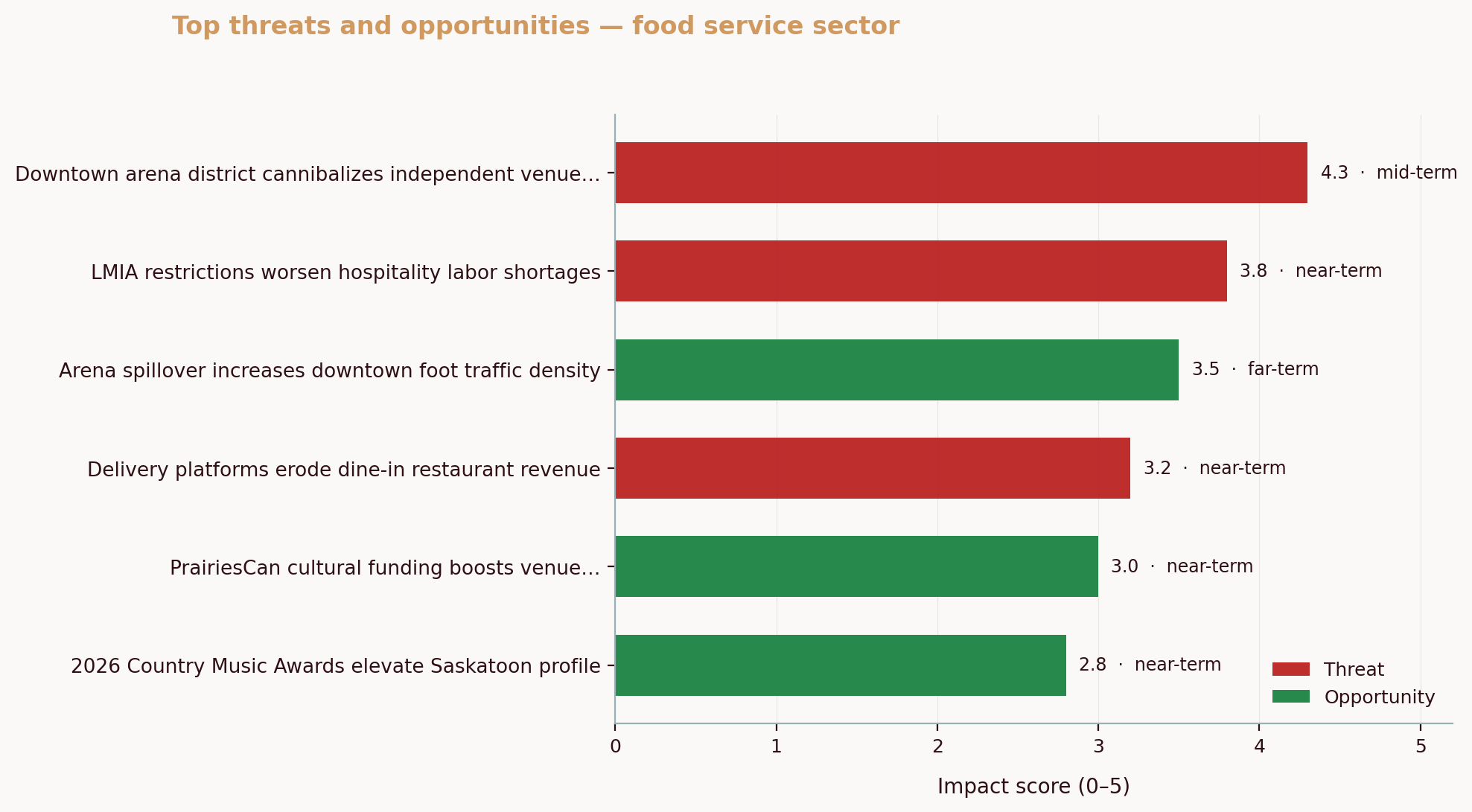
3. Aurevon Intelligence Service (April 2026): the dual forces reshaping the market
The April 2026 Canadian food‑service SMB analysis isolates two interacting forces. First, the big‑venue pull: large events reduce occasional regional demand for small rooms on peak nights by tempting groups to trade three local evenings for one “memorable” arena show. Second, a fixable internal gap: inconsistent clarity about ticketed value at small venues undermines repeat patronage, making customers more price‑sensitive than they need to be.
Across 83 Canadian restaurant SMBs analyzed via the Aurevon Intelligence Service, we found online reputation strength is not the limiter; the median Google rating was 4.7 (mean 4.59), with two‑thirds at 4.6 or higher. The drag is visibility and volume, not love: “near‑zero review counts are costing visibility versus established competitors with steady reviewer volume.” Low review volume and visibility appeared as a top‑threat cluster in 18 reports, while rising input costs and inflation pressure appeared in 14, compressing margins and raising the bar for what patrons consider “worth a fee.” Those conditions magnify any confusion about what a $10 cover buys beyond entry. See the difference? Strong ratings, thin review flow, and squeezed margins create fragile conversions. This is why clear bar market positioning, informed by regional entertainment trends, matters for Canadian food service SMB operators right now.
Think of it like sending two salespeople to pitch the same client. The arena pitch is polished and rare; your pitch is familiar but personalized. If your value story is muddy at the moment of purchase, the polished one wins, even if your experience is better.
For operators, this dual‑force framing is liberating: you can’t rewrite Regina’s capital plan, but you can fix value clarity, review flow, and repeat incentives inside 60 days.
4. Consumer frustration with ticketed event value (why perception matters more than price)
Consumers don’t complain about paying for great nights; they complain when price and experience feel misaligned. Common gripes include hidden or late‑stage fees in online checkouts, compressed service at showtime, unclear food or drink inclusions, and rigid seating that breaks the dinner‑and‑music vibe. Canada’s competition authority has pursued “drip pricing” cases in ticketing, reinforcing how sensitive buyers are to surprise add‑ons. Policy signals push toward upfront pricing, raising the bar for clarity across the industry. That matters to you because it reframes value at decision time. [Competition Bureau actions on drip pricing]. [Recent settlement in ticket resale market]. (canada.ca)
Here’s a data point from performing arts: in 2024, single‑ticket sales share rose to just over two‑thirds, up from 60.3% in 2018. More one‑off buyers means more checkout scrutiny and post‑event second‑guessing. If one night disappoints, repeat behavior collapses. Conversely, when a small‑room offer spells out value in plain language, many guests choose intimacy and hospitality over a road trip. In short, the pricing signal interacts with consumer sentiment to either accelerate churn or build loyalty. [Performing arts, 2024]. (www150.statcan.gc.ca)
So the risk is real. What can you do about it?
5. Actionable strategies for Saskatoon operators to protect and grow business
Start with pricing clarity. Post the total cover or ticket price early in the flow, list what it includes (priority seating, a welcome snack, or post‑set mingle), and cap fees. Pilot two tiers on busy nights: standard general admission and a small reserved‑table allotment. Bundle a fixed‑price “soundcheck supper” that locks in a pre‑show seating window and guarantees service during the first two songs.
Next, tune programming to create must‑attend habits. Extend popular residencies to 6–8 weeks, add curated micro‑scenes (songwriter circles, global grooves, jazz‑adjacent brunch), and tell those stories with visuals that spotlight intimacy and craft. When a Regina headline threatens your Saturday, move your spike to Thursday and frame it as “locals’ night.” Consider cross‑promotions with hotels or rideshares on known arena dates. For live music venues in Saskatchewan, this cadence stabilizes discovery while giving regulars a reason to plan.
Hospitality wins the tie. Run a pre‑show welcome ritual (staff handshake, amuse‑bouche), promise “eyes‑up” table checks during tracks two and five, and invest in one production partnership that improves your room’s sound for under $2,000. Before: a guest wonders if they can be served mid‑set. After: they know exactly when to expect a silent drop‑and‑go. See the difference?
To ground the moves, use structured thinking: revisit who your real competitors are this quarter, not last year’s list. Build how to identify your real competitors into your next team huddle, then sketch a competitor SWOT analysis for the three venues your guests also mention. As you run pilots, track competitor pricing and marketing weekly so your offers stay anchored to the market, not hunches. When a Regina arena date goes on sale, refresh the SWOT and tighten your bundles. For broader planning, revisit how to identify your real competitors after each 6‑week cycle, and refine your pricing watchlist with free methods to track competitor pricing. This is where Saskatoon bar competition is won, with clearer stories and repeatable offers rather than discounts.
| Experiment | Hypothesis | Cost/Operational impact | Success metric (to track) |
|---|---|---|---|
| Transparent “all‑in” cover posted 7 days out | Clarity lifts conversion at the door | Low; signage + post | Door conversion rate, walk‑away rate |
| GA + Reserved Table (10–15% of seats) | Small premium tier raises average check | Moderate; FOH mapping | Average check, reserved sell‑through |
| Soundcheck Supper (bundle) | Early seating smooths service, boosts F&B | Medium; fixed‑price menu | Pre‑show F&B per cover, on‑time seating |
| First‑timer + free appetizer | Reduces friction and drives trial | Low; capped redemptions | New‑to‑file % and 30‑day return rate |
| “Locals’ Night” shift vs. Regina spike | Retains core spend on conflict nights | Low; retime promo | Weeknight occupancy, repeat bookings |
💡 Pro Tip
Run one four‑week pilot: $5 off first‑ticket buyers plus a free appetizer for tables seated 45 minutes before showtime. Track cover conversion and 30‑day return rate.
Mitchell Ozmun
SMB Researcher, Business Analyst - Saskatchewan Born and Raised